
Category Archives: Horror

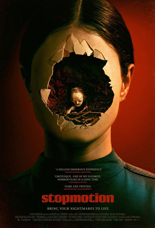
Stopmotion (2023)

From Robert Morgan, the creator of the wonderful animated horror short The Cat with Hands, comes the feature-length debut Stopmotion, a film exploring the unraveling mind à la Videodrome or Possession. The film centers on Ella Blake (Aisling Franciosi, The Nightingale), a stop-motion animator helping her arthritic and overbearing mother, Suzanne (Stella Gonet), finish what will likely be her final film.

Ella’s tumultuous but structured life gets thrown for a loop when Suzanne has a stroke and falls into a coma, leaving Ella to potentially finish the film on her own. The problem is, she struggles to come up with ideas — she’s a brilliant animator, but not much of a storyteller. So when a mysterious little girl begins showing up at Ella’s apartment and dictates a new story about a girl lost in the woods being chased by a grotesque figure called the Ash Man, Ella reluctantly listens, and begins making the young one’s narrative.
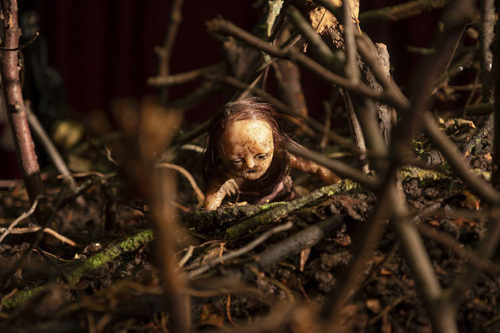
The new story is much darker, with figures made of mortician’s wax and spoiled meat, creating visuals that give ’90s-era Tool videos a run for their money. The little girl proves to be just as demanding as Suzanne, and this combined with the disturbing nature of the work begins to effect Ella’s sanity and her already fraught relationship with her boyfriend (Tom York).

Featuring stunning stop-motion animation from director Morgan, appropriately moody cinematography from Léo Hinstin, and a skin-crawling score by experimental sound artist Lola de la Mata, Stopmotion is a masterful slow-burn horror film with genuinely creepy imagery and a thoroughly shocking explosion of violence in its third act. Franciosi delivers yet another psychologically complex performance, proving herself to be one of the most dynamic actors in the horror landscape right now. Fans of Cronenberg, Zulawski and the eerie stop-motion films of Jan Svankmajer will not want to miss this one. —Christopher Shultz
Get it at Amazon.

Stupid Games (2024)

If there’s a saying I wish social media could ban, it’s, well, hundreds. But “Play stupid games, win stupid prizes” vies for the top spot alongside fellow bandwagon comments as “All the feels,” “I’m not crying, you’re crying” and, of course, “This.”

At least the movie Stupid Games has good reason for plopping the sentence on a title card, as what follows is a literal depiction of the adage.

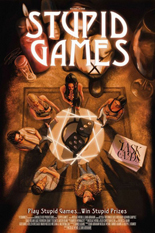
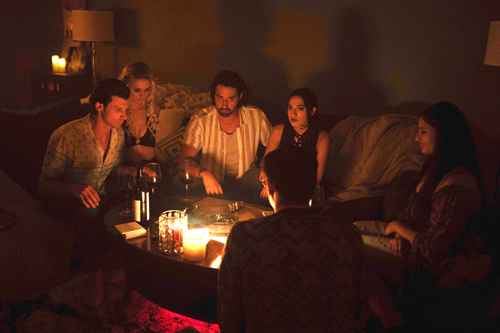
Three young women host a dinner and game night at their apartment. They invite three guys, oddly insisting on the 1:1 gender ratio. We know something is up — we’re just not sure what. By candlelight, the assembled six play a board game whose rules mix Truth or Dare with Two Truths and a Lie; Fuck, Marry, Kill; and a bag of Scrabble tiles.

And by “play,” I mean it, as the flick devotes nearly an hour to watching them do so in real time. As proven, that can make for some serious screen boredom, yet Stupid Games might be the exception. Although the acting is inconsistent and its visual palette overly dependent on blah hues of brown, we keep watching because of Tanner Adams’ script: For nearly two-thirds of the running time, we’re not quite certain where it’s going, but we genuinely want to see the destination.

How co-directors Nicolas Wendl and Dani Abraham (both helming their first feature) handle the eventual “bogeyman,” so to speak, is eerily effective for something so simple. Sometimes, having a $10,000 budget that makes CGI cost-prohibitive is a good thing. —Rod Lott

Get it at Momentu.

MaXXXine (2024)

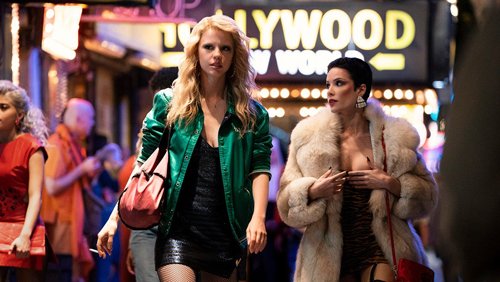
Add Ti West’s MaXXXine to the list of exploitation flicks Joe Bob Briggs would insist you check out. The much-anticipated, giallo-inspired climax to the X trilogy (2022’s X and Pearl) features voyeuristic knife-fu, car compacter-fu and, of course, stiletto-dick-stomping-fu. Despite the compelling and outrageous boxes it checks, MaXXXine provides a conclusion that — while in many ways incomparable — feels limp in the shadow of its predecessors.

Six years removed from X’s bloodbath, final girl Maxine Minx (Mia Goth, Infinity Pool) vies to move from porn to blockbusters. She’s made a name for herself in Hollywood’s underbelly, but her dreams have quickly outgrown the back alleys, strip clubs and peepshows where she finds herself. She nails an audition for a much-anticipated horror movie, The Puritan II. Unfortunately, a shady, annoying private investigator (Kevin Bacon, Tremors) and a serial killer targeting her closest friends muffles her celebration. Oh, and Pearl haunts her.

It can’t be understated: Each entry in the X trilogy has something to appreciate. X was an excellent homage to classic slashers supported by a phenomenal, dual performance from Goth. Pearl was a fascinating character study that combines the best parts of The Red Shoes and Henry: Portrait of a Serial Killer. MaXXXine, on the other hand, has an undeniably distinct style splattered across a living and breathing (and profusely bleeding) world.

But style alone can’t carry the film. It clearly defines what it’s examining, and the main idea it leans into — “fame’s a killer” and the sharp edge of stardom — yet only touches the surface. It’s like MaXXXine’s afraid to say anything challenging, so it instead opts for the most narratively convenient off-ramp it can scrape for. Similar to what made Nicolas Winding Refn’s The Neon Demon and Alex Garland’s Men lackluster, an uninspired climax rarely earns what those films’ effective first halves vie to accomplish.

That’s not to say MaXXXine is irreparably ruined by its final act. Goth still emerges as the backbone of all three Xs. She has a vast range that, though best showcased in Pearl, remains firing on all cylinders here. And West’s ability to keep dialogue snappy and natural is only exceeded by his talent for shooting captivating and alluring frames. Unfortunately, none of those exceptional traits can mask disappointing ends. It doesn’t matter how many times you punch Kevin Bacon in the face. Sequences pop an audience, but a thoughtful and well-rounded plot gives a flick permeance.

That said, you should still see MaXXXine; at the end of the day, even the weakest of the X trilogy is still far from schlock. True, what it does manage to say about an artist’s meteoric rise doesn’t carry the same weight as Pearl’s showstopping dance into a cruel reality. Still, like virtually all of West’s work, it clearly captures the tone it pursues. It’s just hard not to wish that aesthetic was part of a more realized package. Please don’t tease us like this next time, Ti. Please. —Daniel Bokemper

Get it at Amazon.

Copperhead (1984)

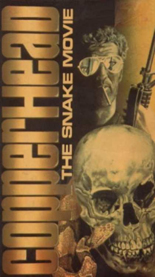
Lest ye doubt the power of the copperhead snake, the movie Copperhead opens with such a serpent killing a mouse, then swallowing it with impressive jaw reach unseen outside of Linda Lovelace’s CV. This food-chain footage could be an allegory for the man’s-inhumanity-to-man tale that follows, but let’s be real: Missouri-based Leland Payton wasn’t thinking that intently when writing or directing his shot-on-video epic.

Despite being “one of the nation’s top wildlife artists,” Ozarks resident Jerry Jerome (David Fritts, Stolen Women, Captured Hearts) has a big problem: the Randall clan — somehow, “family” isn’t quite the right word — that’s moved into the nearby abandoned church. Patriarch Howard (Jack Renner) is an overbearing asshole who loves exercising his Second Amendment right against innocent snakes almost as much as smoking Marlboros, abusing his boys or subjugating his freckled wife (Gretta Ratliff).

For painting purposes, Jerry needs to catch copperheads in jars that once held Peter Pan peanut butter or the tangy zip of Miracle Whip. But ol’ Howard just wants to shoot the shit out of the snakes — which he does, often in bloody, gut-oozing detail. Howard threatens to put holes in Jerry, too, if he steps foot on the Randall property again.

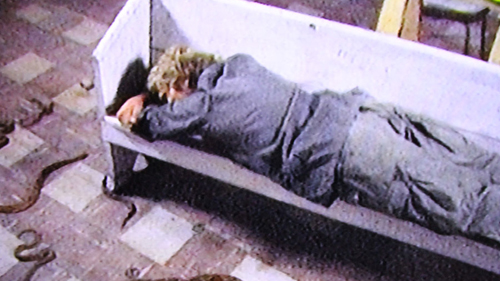
Speaking of that, Howard should’ve asked the gubermint to conduct a census of scaly reptiles before purchasing the church, because the literally holey place is a nest of copperheads. One night, the Randalls take up arms against 41 of them! More venomous pit vipers follow in the conclusion, of course, no matter how much of the aerosol can of Secret deodorant Howard’s daughter empties toward her slithering attackers.

I’ll give Copperhead this (because I’m sure not giving it hosannas for dramaturgy): Its use of real, honest-to-Gawd Agkistrodon contortrix lends a curiosity value and a palpable sense of danger, no matter how many safety precautions were taken. You think Samuel L. Jackson would put up with that shit?

Porn actress Annie Sprinkle (M*A*S*H’d, The Horneymooners, Surelick Holmes, et al.) cameos, albeit on the cover of a Stag magazine “read” by a Randall just before dripping-wet snake guts join the pages’ dried semen. —Rod Lott

Get it at Terror Vision.

The Vourdalak (2023)

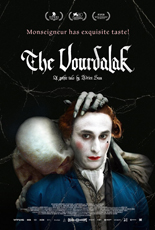
Adapted from an 1841 novella by Aleksey Konstantinovich Tolstoy, The Vourdalak marks the directorial debut of Adrien Beau. The Gothic vampire tale set in 18th-century Eastern Europe centers on a wayward Marquis (Kacey Mottet Klein) who finds himself at the mercy of a strange family living in a rural manor.

The old patriarch Gorcha has disappeared, leaving his kin to fight a band of Turks plaguing the area. He told his children, the effeminate Piotr and mysterious Sdenka (Vassili Schneider and Ariane Labed, respectively), that if he is gone longer than six days, but returns, he should not be let back into the house, as he will have transformed into a dreaded vourdalak. Gorcha’s eldest son, Jegor (Grégoire Colin), dismisses such concerns as mere superstitions, but Piotr, Sdenka and Jegor’s wife (Claire Duburcq) aren’t so certain. The Marquis isn’t sure what to think, and he is distracted by his sudden and insatiable attraction to Sdenka.

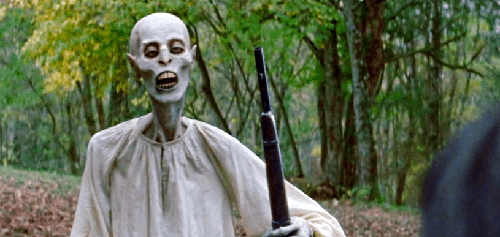
Gorcha returns just after the hour marking his sixth day gone, and he is very obviously no longer human. So much so, the character isn’t portrayed by a human at all, but rather a ghoulish puppet voiced by director Beau. Everyone can plainly see Gorcha is a vourdalak, except for Jegor, whose patriarchal stubbornness keeps him from seeing the truth the women and sensitive Piotr plainly see. He brings his father inside, and naturally, mayhem follows.

But this is mayhem of a more quiet sort, as the film is indebted to the atmospheric European horror films of the 1960s and 1970s. It also was shot on Super 16mm, giving its images sumptuous grains and ever-so-slightly faded colors, furthering its connection to cinema of old. The Vourdalak is quietly and grotesquely funny, especially in scenes involving Gorcha, whose blatant inhumanity is both perverse within the universe of the film and a practical effects marvel. It’s overall a stellar debut for Beau, one that feels more like the work of an old master than a relative newcomer, and a gloriously oddball entry into the vampire canon. —Christopher Shultz