Category Archives: Comedy

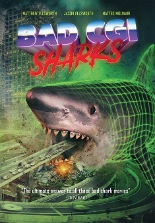
Bad CGI Sharks (2019)

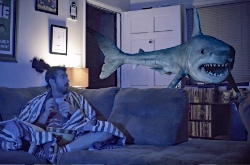
With just $6,257.34, Bad CGI Sharks does what the underwhelming fin-fronted film The Meg couldn’t do with $130 million: Be incredibly entertaining.

Matt (Matthew Ellsworth) loses his office job when he loses his cool, thanks to receiving after-the-fact news that Mom and Dad have shipped his no-good older brother to California to live with him. Embodying oil to Matt’s water, Jason (Jason Ellsworth) is a perpetually unemployed, possibly lobotomized man-child with a phallic man bun and a lofty dream on which, unlike his buttoned-up bro, he never gave up: to “make it” in Hollywood by finishing Sharks Outta Water, the 15-year-old screenplay they started writing — in longhand, of course — as kids.

Enter our Ricardo Montalban-sounding narrator, the mischievous Bernardo (a scene-stealing Matteo Molinari, The Silence of the Hams), whose magical director’s clapboard makes people’s movie ideas come to life. (Yeah, yeah — don’t ask. Just enjoy.) Suddenly, cheap-looking sharks are floating through Matt’s neighborhood and seeking human-sized snacks. So what if the creatures sometimes suffer rendering glitches while on the hunt?

Effectively writing, directing, producing and editing Bad CGI Sharks as a musketeer-thick trio, Molinari and the Ellsworth siblings turn many a shark flick’s deficiency into their primary selling point, and I’ve got to hand it to them: It’s kinda genius. The guys go so meta, they not only break the fourth wall, but ruin the soil around it so a fifth cannot be constructed. If you find the propulsive drum-and-bass score of the chase scenes self-aware, wait for the chat-show intermission at the one-hour mark.

Although not every actor in their unpaid cast is quite in lockstep, Ellsworth/Molinari/Ellsworth demonstrate a firm grasp on the rhythms of film comedy, both in camera and on the page, resulting in a knowing parody that earns each of its many laughs. Sharksploitation has never looked this good looking this bad. —Rod Lott

Get it at Amazon.

Rock ’n’ Roll High School (1979)

Cinema of the ’70s gave us a whole litany of cool characters to cheer for, from John Shaft to Han Solo; for me, however, one of the coolest characters has always been a smart-mouthed teen who not only blew up her high school in the name of rock and roll, but got the Ramones to play while doing it.

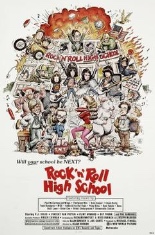
Yeah, it’s pretty hard to top Riff Randall in Rock ’n’ Roll High School

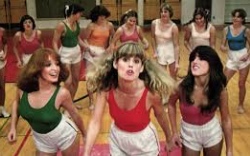
Riff Randall (P.J. Soles) is a punk-rocking teen — at least as punk rock as Roger Corman was probably willing to go in 1979 — who hates her school and loves the Ramones, regularly staging lunchtime rock riots as the jocks and the stoners and the nerds all groove together in a true rainbow coalition of high school unity, minus the freshmen, of course.

It’s a tenuous bond that only solidifies once totalitarian principal Ms. Togar (Mary Woronov) is put in charge of Vince Lombardi High, cracking down on any and all of the school’s mostly rebellious trouble-starters, including the music of Joey, Johnny, Dee Dee and Marky. This extends to the big Ramones concert where Riff publicly gives the “Hey-ho, let’s go!” to Togar’s fascistic rule of order.

Originally called Disco High — an idea that, truth be told, I would have loved to have seen as well — this Allan Arkush-directed production, while maybe not the best film of the time, it definitely is the coolest in a long time; the combo of Soles and the Ramones have a lot to do with that, but co-stars Woronov, Dey Young and, of course, Clint Howard, are the pepperoni on the pizza that makes it so damn tasty.

The soundtrack is tops as well, filled with plenty of blitzkrieging Ramones boppers — all the hits are here, kids — as well as tunes by artists as (somewhat) diverse as the Brownsville Station, Devo, Nick Lowe and Brian Eno, making appearances; Chuck Berry, the true king of rock and roll, is somewhere in their, too, as he really should be. Hail, hail, rock and roll!  —Louis Fowler

Get it at Amazon.

Jojo Rabbit (2019)

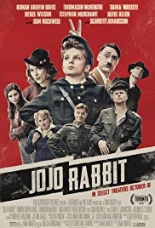
Dubbed an “anti-hate satire,” Jojo Rabbit starts off strong enough, with our hero (?) Jojo (Roman Griffin Davis) on his way to a Hitler Youth camp, the strains of The Beatles’ Germanic variation of “I Want to Hold Your Hand” on the soundtrack. After that somewhat enthusiastic intro, however, the film starts its downhill slide into pointed mediocrity, one from which it never fully recovers.

I guess what I’m saying is that, fully based on Taika Waititi’s comedic output, I fully expected to love Jojo Rabbit, but ended up shrugging my shoulders in a very Teutonic “meh.”

Young Jojo wants to be a good Nazi, so much so that Hitler himself is his goose-stepping imaginary friend. Attending the camp — with a mildly surprising array of guest stars including Sam Rockwell and Rebel Wilson, acting their broadest — Jojo is ostracized harshly because he won’t defend German ideals by snapping the neck of a rabbit.

Despite this, he does his best to conform to der Führer’s rule of law, one that gets a slight bit harder to do when he discovers that his mother (Scarlett Johansson) has been hiding a young Jewish girl in his deceased sister’s room. Jojo does his best to serve the cause while maintaining a tenuous friendship with the girl, mostly succeeding.

While Waititi’s film is full of many comfortable laughs masquerading as uncomfortable jokes, the film eventually breaks with the dark-comedy aspect all together, oftentimes threatening to topple over on its own self-imposed self-importance.

While Davis is serviceable as young Jojo, Waititi is at his comical best as the faux Hitler, speaking with anachronistic beatnik phrasings, getting gentle guffaws out of his imposing terribleness. Perhaps, though, it’s the casting of chubby little Archie Yates as Jojo’s pal Yorki as the surprising comedic presence that gets the film’s continually funniest scenes.

That being said, Jojo Rabbit is still worth a viewing, granted that you know what a disjointed book-burning of a movie you’re going into; it’s not angry enough to be a dark comedy and too silly to be a truly moving experience. —Louis Fowler

Get it at Amazon.

Polyester (1981)

Many people consider Pink Flamingos or Female Trouble to be John Waters’ bad-taste masterpieces, but I rudely disagree and instead offer the soap opera parody Polyester as the true mark of his dirty genius.

With this 1981 comedy, Waters reached a mainstream high-point with the casting of former teen idol Tab Hunter, but the actor (actress?) who truly stands out is, of course, Divine, as overly sympathetic housewife Francine Fishpaw. She’s a typically put-upon and long-suffering woman, constantly taken advantage of by her no-good family: porn theater-owning husband Elmer, foot-stomping son Dexter and table-dancing daughter Lu-Lu.

When the sleazy hubby is caught cheating with his skanky secretary, Francine spirals into a comical abyss of exaggerated alcoholism and lugubrious smells, with her only remaining friend being cleaning lady turned upper-class socialite Cuddles (Edith Massey), who routinely shows up to take her shopping at swanky Baltimore joints only the nouveau riche can truly love.

Things begin looking up, however, when Francine finds lusty love with handsome hunk Todd Tomorrow (Hunter) and all of the carnal pleasures that he brings the plus-size paramour; of course, being a Waters film, it won’t be long until the violently outrageous finale with a happy ending that only a Baltimorean (or Baltimorean at heart) could wish for and truly love.

Complete with an Odorama card that allows audience members to smell bad pizza, stinky sneakers and far, far worse — it’s better than 3-D! — the ludicrous one-liners come fast and furious, matched only by the odious plot that pays homage to both Douglas Sirk and William Castle. Forty years later, Polyester is still a riotous film that satirically peels back the rotten onion that is the nuclear American household.  —Louis Fowler

Get it at Amazon.

Greener Grass (2019)

When committing to a viewing of Greener Grass, it’s important to know what you’re in for: Not even four minutes in, the lead character gives her baby away to her admiring best friend. This on-a-whim ceding of parental rights is played for laughs.

If you don’t find any humor in that (much less the incontinent grade schooler to come), I offer these irrefutable, inconvenient truths:
1. Greener Grass is most decidedly not for you.
2. You are wrong.

Expanded for the better from its creators’ 2015 short, Greener Grass is not only the funniest film of the year thus far, but destined to grow in estimation as the right audiences find it (versus the other way around) and a fervent cult forms. Much like David Byrne’s initially ignored, now-celebrated True Stories, its loose vignettes form an absurdist whole that redefines deadpan.

Written and directed by its stars, Upright Citizens Brigade alum Jocelyn DeBoer and Dawn Luebbe, this satire of the suburbs posits an upper-middle-class middle America covered in a puke of pastels — a neighborhood where golf carts have replaced cars, children bear names like Citronella, and all the adults wear braces on their teeth. Those smiles may be forced, but the movie’s humor isn’t. Lines such as “Do people like my peas?” aren’t read as jokes, because the cast — including current Saturday Night Live utility player Beck Bennett — exudes confidence in knowing viewers attuned to Grass’ admittedly narrow wavelength of peculiarity will catch them.

The ostensible plot — a yoga-teacher neighbor is murdered by the local grocery store bagger — is, much like the characters DeBoer and Luebbe so skillfully skewer, just for show. That both ladies very much look the part makes their pic all the more deliciously subversive. —Rod Lott

Get it at Amazon.