
Category Archives: Action

My Name Is Modesty: A Modesty Blaise Adventure (2003)

mynamemodestyDespite toiling as a sexy spy, the comic-strip character Modesty Blaise never quite caught on in America. A 1966 movie based on Peter O’Donnell’s creation, Modesty Blaise, was made anyway, with Monica Vetti and Terence Stamp. It tanked.

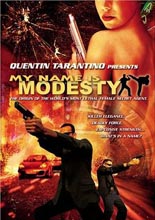
A few decades later, Miramax had the great idea of reviving Blaise for an intended series of action-packed films; arbiter of pop-culture taste Quentin Tarantino agreed, hopping aboard as a producer. Whereas Natasha Henstridge and Reese Witherspoon were mentioned for the role, no one was cast until Miramax’s rights were due to expire. Only then did the indie studio rush a Romanian-lensed prequel into production. Shot in 18 days by Tarantino pal Scott Spiegel (From Dusk Till Dawn 2: Texas Blood Money), it stars neither Henstridge nor Witherspoon, but the unknown (and, looking malnourished, unsexy) Alexandra Staden (Alexandra Staden, The Task). Is this any way to start a franchise?
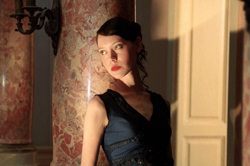
mynamemodesty1The answer is, as My Name Is Modesty makes painfully clear, no. The string-beaned Modesty pulls double duty as a casino card dealer and bodyguard. When its owner is brutally murdered and the joint’s fully vested employees taken hostage by the killer Miklos (Nikolaj Coster-Waldau, Mama), Modesty keeps her cool and makes a wager with him. They play roulette, and whoever wins the round earns a reward: she, a released hostage; he, personal intel about Modesty.

This being fiction, Miklos has absolutely incredible luck at the wheel, as he wins nearly every spin. Thus, Modesty fills him in on her upbringing — cue the flashbacks! — as a filthy orphan saved by a kindly old professor (Fred Pearson, 1994’s Priest) who taught her reading and kung fuing.

Modesty and Miklos talk and talk and talk and talk. And talk! Then, at the movie’s tail end, some half-assed gunfire and utterly weak martial arts erupt. Sad to say, but this tiny film — one that, at just 78 minutes, barely qualifies as one — takes place in one room and sorely lacks action, suspense, espionage or intrigue. And yet the powers that be at Miramax still had the gall to subtitle it A Modesty Blaise Adventure. (To be fair, that four-word subtitle is 75 percent representative of the flick’s contents.)

The one-room set isn’t the only tip-off that Miramax didn’t shell out more than a pittance for this sluggish mess. Another big one is its look, bearing the drab visage of a syndicated TV action hour. Worse, with the generic music, the chintzy title sequence that incorporates scenes we’ll soon see, the questionably attractive actresses and the swarthy-looking muscular males, the secret-agent origin story threatens to turn into softcore Cinemax fare at any moment.

But don’t go looking for flesh. Her name is, after all, Modesty. —Rod Lott
Get it at Amazon.

San Andreas (2015)

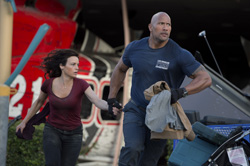
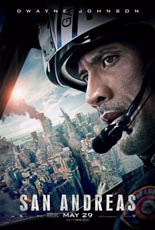
sanandreasWhen Dwayne Johnson (né The Rock) is introduced to San Andreas’ watchers, he’s done so with a literal beam of sunlight encircling his bald noggin like a halo, as if to say, “Here is our hero, our savior. He will save us all.” Was there ever any doubt?

Fresh off Furious 7, Johnson plays Ray, a Los Angeles Fire Department rescuer loaded with all-American character traits: military service and more than 600 saves under his utility belt. Where are this do-gooder’s wings? They’re the blades of the helicopter he pilots above the City of Angels, plucking texting teen girls from their precarious cliffside perches.

So heroic is Ray, it’s somewhat of a surprise that when a good chunk of California succumbs to a totally bitchin’ earthquake, the script by Carlton Cuse (TV’s Bates Motel) is unconcerned with seeing how many more dozens he can add to his 600 record; instead, his focus narrows to only two people among the affected millions: his estranged wife, Emma (Carla Gugino, Sucker Punch), and their well-developed daughter (Alexandria Daddario, Texas Chainsaw). If you weren’t married to Ray or a product of that union … sorry to say, but fuck all y’all.

sanandreas1And you know what? That’s really all San Andreas needs. Effects-driven spectacles such as this often are criticized for being soulless; in (perhaps overcorrecting and) confining the emotional scope to the family unit, however fractured, Brad Peyton (who directed Johnson in 2012’s better-than-you’d-think “kidventure” Journey 2: The Mysterious Island) at least attempts to show that feelings can bloom while stuff goes boom. Now, it still comes off as manufactured schmaltz, but again, a solid try is a solid try; the film’s $155 million take is Peyton’s participation trophy.

But let’s get real: Who sees an action movie — particularly one constructed around what insurance companies love to term “an act of God” — with family values in mind? Disaster flicks are brain-off excuses to see buildings crumble and cities fall. The effects of L.A. and San Francisco tumbling to dust are so incredible, you may wish Peyton offered frame-by-frame footage to allow your eyes to soak in the detail. (He certainly does when Gugino and Daddario run, for those men on the fence about purchasing the Blu-ray.) This damage — coupled with an earlier sequence of the Hoover Dam getting decimated — outdoes Roland Emmerich’s globally apocalyptic 2012 on the only point that matters: destructoporn.

The dam’s demise gives college professor Paul Giamatti (Straight Outta Compton) something to do besides showing off his mad Richter-lecturin’ skillz. San Andreas reveres his science as much it despises the greed of Ioan Gruffudd (2005’s Fantastic Four) as Emma’s über-wealthy beau; notice how much the movie delights in causing the cad misery.

As for Johnson, he emerges from the rubble like the Son of God, life-reviving powers and all. This is his show, after all, and he more than makes good on his he-man promise, carrying San Andreas on his big, buff, broad shoulders and past a point where you might hate yourself for hanging on so long. —Rod Lott

Get it at Amazon.

The Spirit (1987)

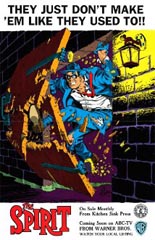
spirit87Seven years after breaking big in/as Flash Gordon, Sam Jones got the chance to play another Sunday-funnies superstar with/as The Spirit. All right, so it was made for TV, but at least this time, Jones didn’t have to suffer the indignity of having his voice dubbed by someone else. An added bonus (although we wouldn’t know it for another two decades and some change) is that the ensuing telepic is a greater, grander entertainment than Frank Miller’s $60 million stink-bomb adaptation for the silver screen.

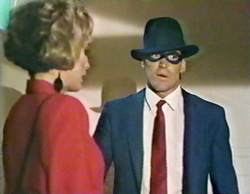
Being a feature-length pilot for ABC’s intended series, this version scripted by Die Hard scribe Steven E. de Souza depicts the origin story of Will Eisner’s comic-book creation: After presumably being shot dead by a baddie, the square-jawed, straight-and-narrow cop Denny Colt takes advantage of his antagonist’s assumption by donning a sliver of a blue mask to disguise his identity. Reborn as The Spirit, basically a superhero in a GQ-worthy suit, Colt sets about cleaning his beloved Central City of its crime problem, vigilante-style. That no one recognizes him — not even gal pal Ellen Dolan (a miscast Nana Visitor, aka Mama Voorhees of 2009’s Friday the 13th remake) — is ludicrous, but just let it ride; as comics readers know, that’s just the style and, er, spirit of the piece.

spirit871Faithful though it is to Eisner’s source material, this Spirit makes one major change that’s hard to argue against: giving young sidekick Ebony White an upgrade from his 1940s stereotype — a step above Stepin Fetchit — to a modern, palatable role. Now named Eubie, he’s played by Enemy Mine’s pint-sized Bumper Robinson. Hopefully, the shift would have happened regardless, but that it did is not at all surprising, especially considering blaxploitation pioneer Michael Schultz (Cooley High) was at the helm. That said, Schultz’s Spirit is left with a few unfortunate hallmarks of its own era: namely, big hair on the ladies, a synth-sax score and multiple Rick James references.

On the plus side, where dozens more tick marks reside, The Spirit boasts a vibrant color palette that predates Warren Beatty’s Dick Tracy, a general pulp vibe as enjoyable as an ice-cold glass of Tropicana, and a permeating sense of humor that’s mostly meant to be, even if our effective detective twice says, “Crime, especially murder, is never a laughing matter.” —Rod Lott

Get it at Amazon.

Death Race (2008)

deathraceIb Melchior’s short story “The Racer” — the source material for 1975’s Roger Corman-produced cult classic Death Race 2000 — doesn’t even receive credit in the 2008 remake Death Race until the very end. No big deal — it bears little resemblance to the story, anyway.

That 10-pager — I first encountered it in the Forrest J. Ackerman-edited anthology Reel Future — is little more than a quick morality tale, about Hank and Willie, two guys with a car equipped with bull’s horns on the front, competing in a cross-country race in which scores are obtained by mowing down pedestrians. They’re skilled at making kills until one of them starts imagining the face of his daughter on all of their targets, and decries his participation.

deathrace1For Corman, screenwriter Charles B. Griffith (The Little Shop of Horrors) and director Paul Bartel (Eating Raoul) just took that core idea of the race and amped it up with a bevy of colorful characters with crazy names — Hank or Willie simply wouldn’t do — like Frankenstein, Machine Gun Joe, Calamity Jane, Matilda the Hun and Nero the Hero. They also kept the bull’s horns.

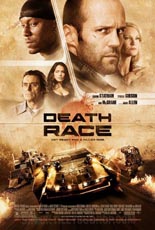
For Hollywood’s big-budget remake and these PC times, however, mowing down innocent people for sport won’t do, so writer/director Paul W.S. Anderson (Resident Evil) makes his competition internal, in an enclosed track on a prison island. The drivers are hardened criminals; five victories and freedom is granted, according to icy warden Joan Allen (Face/Off).

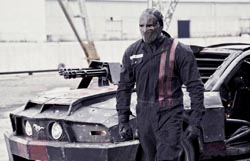
In the ’75 film, former Kung Fu master David Carradine was the star, a heavily scarred racer named Frankenstein who hid his face behind a mask for much of the film. In this ’08 model, Frankenstein is the race’s superstar, but it doesn’t matter much who’s behind the mask. When the first Frank dies in an earlier Death Race, the warden asks new felon Jensen Ames (original Transporter Jason Statham) to take the name and get behind the wheel. Of course, Statham looking like Statham, he only has to wear the mask in a couple of scenes because no one can see through the windows of his souped-up Ford Mustang.

The one element from Melchior’s tale that the new film makes use of is the idea of the daughter. Here, she’s a newborn, but she drives Ames’ conscience. It’s a little out of place and feels tacked on at the end, but doesn’t detract from a stupidly enjoyable hour and a half. Bartel’s film was an all-out satire; Anderson’s is an all-out actioner. Melchior’s “The Racer” lay not quite committed to either. —Rod Lott

Get it at Amazon.

Police Story: Lockdown (2013)

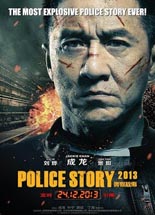
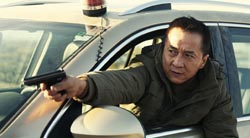
policestorylockdownEntry No. 7 in Hong Kong cinema’s unrelated Police Story franchise (if we count Michelle Yeoh’s Supercop 2 spin-off), Police Story: Lockdown again stars Jackie Chan, this time as Capt. Zhong, a middle-aged career cop and now a widower. He meets his emo-medical daughter, Miao (Jing Tian, Special ID), at a trendy, two-story nightclub complete with private rooms, go-go girls and frickin’ live piranha.

Resentful of her workaholic father’s years of absenteeism, Miao nonetheless makes an effort to reconnect, starting with introducing him to her new beau, Wu (Liu Ye, The Chef, the Actor and the Scoundrel), formerly a pugilist in an illegal boxing ring, currently owner of this very hot spot. Zhong immediately dislikes Wu and … well, father knows best, because Wu takes his whole bar hostage, plopping all patrons who weren’t able to flee during the melée into the dancing cages. (No word if such dual use was in mind when Wu designed the club, but the cages certainly came in handy, no?)

policestorylockdown1As villains go, Wu is pretty cardboard — or maybe candy glass is more apt here — and as heroes go, Chan is Jackie Chan, the ever-reliable, brand-name action star. From Little Big Soldier director Ding Sheng, Lockdown is middling fare at best — nowhere near Chan’s peak (which includes a handful of the Police Story stories), but equally distant from his more-recent nadir. It is what it is, which means that while the film is limited by its (mostly) single location, it’s worth tuning in just to watch the fight sequences (and usually the bloopers, although that’s not the case here). The 60-something Chan isn’t quite as fast on his feet these days, but like Fred Astaire or Gene Kelly, he’s never going to lose all those moves. Aging suits him well, even when the scripts fall short. —Rod Lott

Get it at Amazon.