
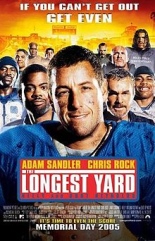
 The original The Longest Yard was a landmark of ’70s-era, anti-establishment sentiment. It was violent, savagely funny, mean and an unapologetic spit in the face of authority. As directed by the gifted Robert Aldrich, The Longest Yard of 1974 was about as cutting-edge as mainstream comedy got at the time.
Fade in to 2005 and an ill-conceived remake, with Adam Sandler in the Burt Reynolds role of Paul Crewe, a fallen NFL quarterback rotting in a Texas prison when he is tapped to organize a football team of convicts to play the guards. What is deemed cutting-edge a generation later? Hollywood doesn’t have the cojones to focus too much on the sociopathic tendencies of convicts.
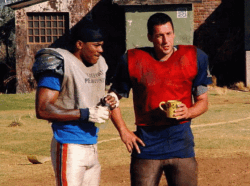 Nope, nowadays cutting-edge means anti-gay. And The Longest Yard of 2005 is chock full o’ backwards, redneck, stereotype-embracing, queer-is-ha-ha-funny gay-bashing:
• We’ve got a prissy fella who develops an instant crush on Sandler because our hero is boorish and has crashed his girlfriend’s Bentley after going on a drunken joyride. (Gay people love brutes, don’cha know).
• We have a gaggle of flamer convicts who make up cheers like, “Gimme a D! Gimme an I! Gimme a C! Gimme …” (Get it? They want, well, you know …)
• We have two inmates caught making out over a surveillance camera.
• We have Rob Schneider in a cameo (reason enough to avoid the picture) as an overzealous convict all aflutter over the possibility of a group hug in the showers.
It appears that gay-bashing is the one remaining widely accepted form of bigotry left in America. —Phil Bacharach
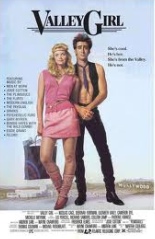
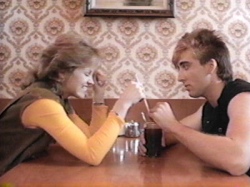 Deborah Foreman stars as Julie, a good-looking, popular, high-school hottie in San Fernando Valley who’s tired of her good-looking, popular, high-school hottie boyfriend, Tommy (Michael Bowen). In true Capulet fashion, she is drawn to Randy (Cage), an L.A. County punker whose haircut and clothes suggest a certain mousse-addled worldliness … if The Fixx embodied worldiness.
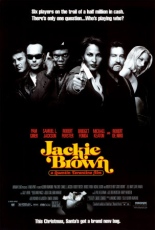
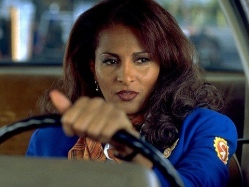 That doesn’t mean it isn’t also a hell of a lot of fun, brimming with dark humor, film-geek references, show-off set pieces and Tarantino’s patently quirky dialogue. Most notable, however, is that the writer/director snags outstanding performances from two beloved icons of 1970s B movies: Pam Grier and Robert Forster.
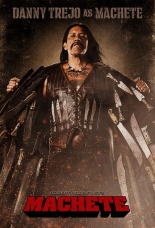
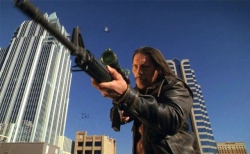 The titular character, though (what, you didn’t know Machete’s a name?) is played by familiar character actor Danny Trejo, a big, thick slab of a human whose real-life travails (ex-con, ex-boxer), are etched on a face seemingly swiped from Monument Valley.