All posts by Rod Lott

To Catch a Yeti (1995)

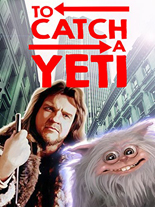
Corpulent rocker Meat Loaf (Wayne’s World) stars as Mr. Big Jake Grizzly in the Canada-lensed, kid-friendly comedy, To Catch a Yeti. Big Jake and his donut-dreaming sidekick, Blubber (Richard Howland, TV’s Lost Girl), attempt to catch a yeti. ’Tis a noble pursuit.

Eschewing the true definition of a yeti, the film gives us not an abominable snowman or a super-sized cryptid, but an abomination of a puppet: a furry, rat-tailed, buck-toothed gnome who giggles like a hyena that somehow survived being hit by a BFGoodrich tire.
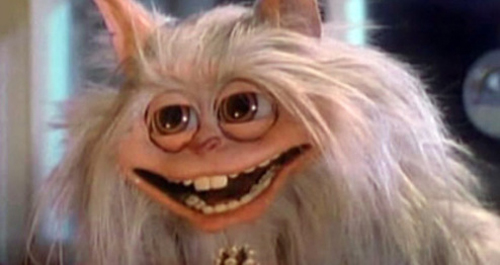
Escaping Big Jake’s sweat-mitted clutches, this so-called yeti seeks refuge in the backpack of a hiker who unknowingly brings the little scamp home. The hiker sticks the thing in the fridge, feeds it frankfurters and calls him Hank. The scene in which Hank discovers toothpaste may be the most pornographic thing you will see outside of pornography.

Without fail, the man’s precocious daughter, Amy (Chantallese Kent), quickly loves Hank like she would any other mutated, decidedly unvaccinated creature brought home by her parents, so it’s only a matter of time before Big Jake and Blubber chase her and Hank all over town. Unfortunately, at film’s end, the yeti is released into the wild, not drawn and quartered. Given a scene depicting little Amy and Hank sharing a bed, I will not write off the possibility of the legacy sequel, To Birth a Yeti. —Rod Lott

Get it at Amazon.

Skinamarink (2022)

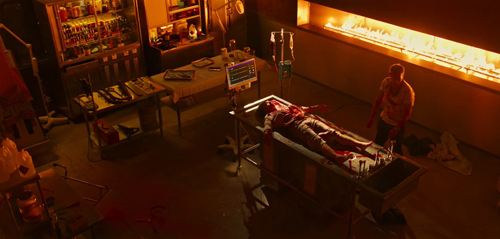
Judging by the viral noise on TikTok — a terrible way to live, IMHO — you’d expect the $15,000-funded Skinamarink to be the next Paranormal Activity. It’s not.

That’s not necessarily a negative. It all depends on the criterion being judged. To consider just the potential for word-of-mouth wildfire among the age groups reacting to its trailer on social media: Do you believe the average millennial or Gen Zer has the patience to sit through 100 minutes of an experimental film? Because that’s what Skinamarink is, one rung above pure abstraction. The majority of moviegoers of any generation don’t possess the palatability for something so mass audience-unfriendly; David Lynch’s Inland Empire finally can cede the title.

Again, not necessarily a negative. While clearly horror, the debut for Canadian filmmaker Kyle Edward Ball is the type of work that nearly defies criticism. Nothing about it operates by notions of convention, yet it represents a singular creative vision free of outside interference or concerns about commercial potential.

In 1995, two young siblings can’t locate their dad in the house. Stranger, the doors and windows — and even the commode — start to disappear; chairs sit on the ceiling. Thumps are heard, as is a disembodied, casually threatening voice. Sound scary? It should.

Through low angles, deliberate misframing and fuzzy imagery that simultaneously suggest surveillance footage and a pirate broadcast, Ball starts at a level of disorientation and builds trepidation from there. As the kids go about their mundane existence, no longer able to tell day from night, only the glow of the television — with its constant parade of public-domain cartoons — offers any comfort (not that “Cobweb Hotel” does). Jolts of terror disrupt that semblance of normalcy.

Ball’s lo-fi aesthetic extends to the sound, humming with the warm pop of vinyl. On its own, that aural element could offer womb-like comfort, but contributing to a whole, it helps make Skinamarink the closest approximation of a dream a feature has achieved. This is no catalog of jump scares; it’s art. —Rod Lott

Santo vs. Doctor Death (1973)

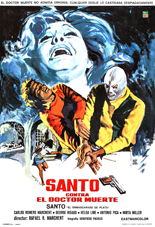
Mexico’s favorite son, the masked wrestler Santo (Santo), heads to Spain to compete in the world championship. Thanks to Interpol meddling, he’s forced to side-hustle as a secret agent to thwart the fine-art forgeries of Dr. Robert Mann (George Rigaud, Horror Express). Because Santo vs. Doctor Bob would make a terrible title, the Mexploitation film is called Santo vs. Doctor Death.
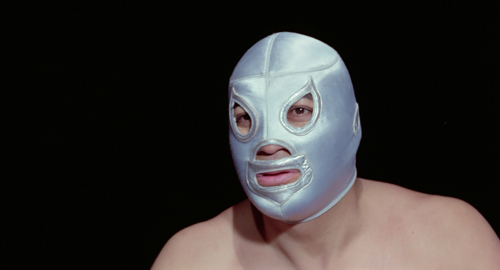
Assisting Santo is plainclothes Interpol Agent 9004, but you can call him Paul (Carlos Romero Marchent, Cut-Throats Nine). Soon, they learn Dr. Mann has more going on than copying precious masterworks; he’s also killing off precious models after he’s done growing tumors in their hot bods. (I promise that makes sense in context.)

This may be heresy to others’ eyes and ears, but I found Santo vs. Doctor Death to be in peak condition when it’s not wasting time in the wrestling ring, whereas seeing Santo slam a chair into an enemy’s face elicits a primal thrill. That’s because director and co-writer Rafael Romero Marchent (Sartana Kills Them All) keeps the 007-esque adventure zippy. In a standout scene, Santo and a henchman spar amid public urinals — more than four decades before Tom Cruise and Henry Cavill did so in Mission: Impossible — Fallout.

From unsolicited surgeries and acid baths to threats with a jar of scorpions, the proceedings play like expert pulp. Best representing that dime-mag aesthetic is a sequence in the booby-trapped bowels of Dr. Mann’s castle. It’s honestly a shame Doctor Death remains Rafael’s only Santo movie. Certainly, other opportunities existed, with this being one of eight Santo pics in ’73 alone. —Rod Lott

Get it at Amazon.

Dangerous Game: The Legacy Murders (2022)

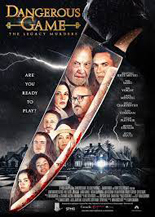
Creepy old asshole Jon Voight plays creepy old asshole Ellison Betts, patriarch and Big Pharma magnate. For his 80th birthday, he invites his human possessions children and their families to his murder castle palatial estate. Jonathan Rhys Meyers (From Paris with Love) is the heir apparent, while Will Sasso (2012’s The Three Stooges) wants none of that BS. If the casting of those two as brothers seems far-fetched, just you wait.

A mysterious gift arrives for the shindig. Like all presents in screens big and small, the box is not sealed in any way, lest three seconds be wasted on watching someone rip paper. One lift o’ its lid reveals a handsomely designed game that shares the film’s title (and logo treatment): Dangerous Game: The Legacy Murders. It comes complete with a Jigsaw-esque voice barking cryptic orders over the mansion’s PA system, I guess.

What transpires is a one-by-one thinning of the Betts clan, as they’re put through a series of challenges involving secret rooms and booby traps. Sean McNamara (director of more Baby Genuises sequels than one should affix his name to) gives us a cockamamie mix of Saw filtered through the dysfunctional family dynamics of HBO’s Succession, minus the latter’s all-around brilliance. Or the former’s commitment to its formula, for that matter.

Barely mustering enough of a damn that sitting in a wheelchair requires, Voight goes whole-hog à la Anaconda, taking a tone no one else in the cast dares, because it’s not called for. Everyone else modulates to the proper level, except when asked to feign extreme pain. On that note, Legacy Murders’ standout scenes include Sasso losing a heel and a cat losing all nine lives to a whirling sink disposal.

As slick as that kitchen appliance after the fact, but lacking the kung-fu grip to squeeze any juice past the first 30 minutes, this is not a sequel to Abel Ferrara’s Dangerous Game, the 1993 pairing of Harvey Keitel and Madonna. In case you were wondering. —Rod Lott

Get it at Amazon.

Prey of the Jaguar (1996)

Covert operative-turned-family man Derek Leigh (Maxwell Caulfield) leads the good life. Having shunned busting drug cartels, he now spends his time on menial construction gigs, his dorky family and harvesting quite the porn-star mustache. But when Bandera (Trevor Goddard, 1995’s Mortal Kombat), a criminal he helped put behind bars, makes a prison break and slaughters his fam in payback, ol’ Derek again turns to kickin’ villain booty.

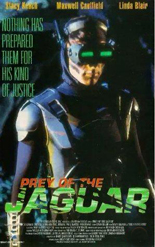
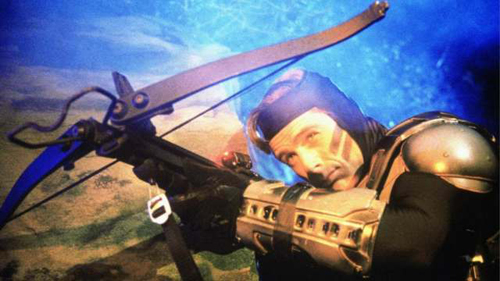
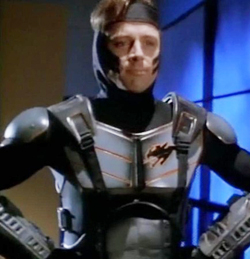
The style in which he does so, however, sets Prey of the Jaguar apart fron your standard, direct-to-video revenge thriller. Caulfield consults an Asian kung-fu master (John Fujioka, American Ninja) for training, purchases a crossbow and dart guns, and dons a homemade costume to become a superhero named — pause for dramatic effect — The Jaguar.

Hobbling along in plastic, smeared face paint and ViewMaster goggles, he looks like RoboCop costumed by TG&Y. Sharing a trait with Caulfield’s Grease 2 character, The Jaguar’s also a cool rider, scouting about town on a sleek black motorcycle, even though this film doesn’t have the budget to fill the Kawasaki Ninja with gas so we can see it move.

Caulfield gives an expertly poor performance as the unwitting, yet comfortably quick-quipping crimefighter. When Leigh informs his Remo Williams-esque mentor that (in so many words) his to-buy list will be much, much shorter this Christmas, he hugs a punching bag and collapses into unconvincing sobs. Then there’s the matter of the hard-to-swallow dialogue, too, like when Jag confronts his nemesis’ henchman:

Jaguar: “Tell Bandera he better learn to pray, because now he is!”
Henchie: “What?”
Jaguar: “Prey!”

Prey of the Jaguar trots out all the clichés; among them, the enemy who makes a bullseye in darts just as he vows to kill the hero, and the inevitable good-guy-saved-when-bad-guy-gets-shot-in-the-back-by-surprise-supporting-character climax. It also trots out the inexplicable, like a ponytailed Stacy Keach cameo or an ultra-secret government spy agency running reports on a dot-matrix printer.

In the hands of hack director David DeCoteau (Sorority Babes in the Slimeball Bowl-O-Rama), Prey cannot be taken seriously, not even when it offs the protagonist’s wife and kid. The setup and credit sequence scream “syndicated TV movie,” while Caulfield jumping around (subbed in part by obvious stunt doubles with longer hair) like a Ritalin kid on Halloween is the nail in the credibility coffin.

Following other Z-level DTV heroes like Black Scorpion and The Demolitionist, this Jaguar is another dumb-fun example of why superhero movies are tough to tackle without tens of millions of dollars. —Rod Lott

Get it at Amazon.