
All posts by Rod Lott

Rewilding (2023)

If you’re making a folk horror movie, especially on a miniscule budget, the one thing you must do is take advantage of the United Kingdom landscapes. In the anthology Rewilding, his first effort as writer or director, Ric Rawlins does this in spades — all in a smidge under an hour, Millicent. From shores to forests to fields, Mother Nature deserves a co-starring credit in each of “three folk tales.”

Each story centers on its setting. After two people enter a seaside cave, inexplicably vanish, then turn up safely and say they saw the devil, an aging archeologist professor investigates. A woman working on a book of interesting trees is told about a man so obsessed with one, he perished there. And finally, for the Halloween edition of the newspaper, a journalist visits a remote village to witness its festival.

All the rage since Robert Eggers’ The Witch broke big in 2015, folk horror is arguably more popular now since its early-1970s heyday. Among its points of appeal are the deep-seated mysteries in its roots; although any go unresolved in part or whole, audiences are willing to sacrifice answers if they get a good jolt in return. The short-form film is the ideal delivery system for this sort of storytelling, and Rawlins succeeds by batting a fitting 0.666.

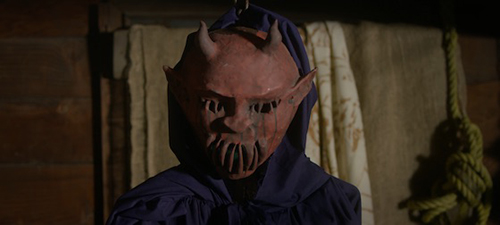
Naturally, its Midsommar-on-$2-a-day financial limitations mean a few performances resemble Ren Faire theatrics. So Rawlins powers through by leaning into his influences — Picnic at Hanging Rock to Eyes of Fire to The Wicker Man — and coming out the other side with no fewer than three shocking and disturbing images that are hard to shake. —Rod Lott

Get it at Amazon.

Cat Eyed Boy (2006)

Based on the late-1960s manga by Kazuo Umezu, Cat Eyed Boy is about a cat-eyed boy. (Let’s just call him “CEB” to make things easy and not spend all our hyphens in one review.) Resembling what I’d imagine the McDonald’s Hamburglar to spawn — but with short pants, tube socks and cleft lip — he lives in the rafters of an empty home in a village outside Tokyo.

As the shot-on-video movie opens, a family moves in and CEB slowly reveals his presence to the brother and sister. The precocious brother is cured of his asthma when CEB power-hocks a loogie straight from his sinuses into the back of the kid’s throat. The teenage sister’s hair-hidden, half-face birthmark peels off when CEB licks it with vigor and without consent. Lest you think this is all about his magic saliva, you’re wrong; CEB also urinates on the boy’s bullies.

Director Noboro Iguchi, he of such Japanese nonsense as Mutant Girls Squad and Zombie Ass: Toilet of the Dead, works in a story — kinda sorta — with the village terrorized by a trench-coated, bandage-wrapped Darkman-looking motherfucker and a bumpy meatball monster that’s a dead ringer for a type 2 on the Bristol stool scale.

Luckily, CEB’s spit bores holes … so I guess the movie is all about his magic saliva. Expectorate or no, Cat Eyed Boy is a missed opportunity. Umezu’s original stories — including “The Meatball Monster,” which this adapts — are a blast of gateway horror; what they aren’t, weirdo premise and all, is goofy comedy dependent on gross-out humor. That makes Iguchi the wrong type to faithfully bring CEB to the screen. Other than replicating the main character’s design, this translation doesn’t work. If it were on film, it might better sell the facade. However, the utter flatness and cheapness of video only heightens the fakery, making the entire thing look like a joke.

As of this typing, Cat Eyed Boy has no legitimate American release, but you can watch it on YouTube below. While no English subtitles exist, they’re not what you’d call necessary. —Rod Lott

The Chosen One: Legend of the Raven (1998)

All collagen and silicone, Carmen Electra got her first lead role thanks to The Chosen One: Legend of the Raven. A superhero film before such a thing was in vogue, it merges The Crow, Deliverance and anything ever shot in that sketchy wooded area by every neighborhood. She plays McKenna, a vengeful hussy selected to carry on the longstanding tradition of a Native American tribe. Or something like that.

It begins with her sister, Emma (Shauna Sand, former Playboy Playmate and former human), pursued by the local womanizing redneck (Michael Stadvec, The Dentist) in a town full of womanizing rednecks. He kills her to get his grubby hands on her necklace, which grants the wearer mystical tribal powers, but before expiring, she hides it under a couple of leaves. Why she didn’t use the jewelry’s functionality to escape harm, we’re not supposed to ask.

Upon hearing the news of Emma’s death, McKenna moves back home. Her old flame, Henry (Tim Bagley, The Mask), is now sheriff. He’s shacking up in a mobile home with Nora (Debra Xavier, American Vampire), who may as well be named Whora. Henry ditches her for McKenna faster than a budget divorce, naturally driving Nora to take up meth.

Meanwhile, McKenna sees visions of Natives in her bedroom, beckoning her to become “the chosen one.” (Are Carmen and the devil walkin’ side by side?) Putting in repeat visits is the spirit of Emma, whose vocal delivery leads viewers to believe director Lawrence Lanoff (Playboy: Babes of Baywatch) instructed Sand, “Hey, do your Kathy Ireland.”

So that Legend of the Raven can last longer than 30 minutes, McKenna gives in to the ghosts and wears the necklace, thus imbuing her with aforementioned mystical tribal powers. Suddenly, she’s excitedly licking her dinner plate and dry-humping the air around her. Soon, she and Henry have music-video montage lovin’. When they go at it again, it’s with a half-gallon of milk, which made me want to swear off the moo juice.

An hour into this opus, McKenna finally dons a costume as Indigenous superhero The Raven — which is to say she wears a skin-tight silver spandex onesie, complemented with spiked and steel accessories. Inversely, Nora resurfaces as an out-and-out comic-book villainess in black leather and a yard-sale Lone Ranger mask. They have a poorly choreographed fight to the overacted finish.

Continuity is absent from The Chosen One, as is a logical script. I didn’t even get to mention the subplot about the Route 33 serial killer (Lanoff himself). And check out the cutaway of birds in flight … as one poops. This is the rare movie that dares to play the line “How ’bout a knuckle sandwich?” entirely straight.

At the end, McKenna and Henry agree to eat a cow. The whole experience is best summed up by exclaiming, “Crazy. Froot Loopin’ crazy!” — a line cribbed from the Decampitated trailer preceding this Raven. Nevermore. —Rod Lott

Get it at Amazon.

Hunt Her, Kill Her (2022)

Single mom Karen has a new gig as a factory’s night-shift custodian. Day 1 is a doozy — and not because she has to scrub toilets. Rather, the warehouse is infiltrated by a few Halloween-masked men who want to punch her clock for good. You probably guessed as much from the film’s title, Hunt Her, Kill Her. I presume the tweak of the military term “hunter-killer” is intentional, as these guys clearly are on a mission; the reason, simple to suss out.

Played by Natalie Terrazzino in her first feature credit, Karen is not the most relatable protagonist. Then again, co-directors Greg Swinson and Ryan Thiessen (Five Across the Eyes) didn’t construct the movie for depth. A simple stalking exercise, the well-shot Hunt Her, Kill Her would work better if the warehouse were more labyrinthian or better spatially established to liven the routine. I’m certain it’d be tiring to chase or be chased by someone for an hour, but now I know it can be tiring to watch, too. —Rod Lott

Get it at Amazon.

What’s Up Front! (1964)

What’s a nudie cutie without the nudie? Why, it’s What’s Up Front!, directed by Bob Wehling, scripter of 1962’s infamous Eegah. In fact, this film is something of an Eegah reunion, being co-written by Arch Hall Sr. and co-starring caveman-kidnap victim Marilyn Manning.

Homer L. Pettigrew (the weasel-resembling Tommy Holden, Magic Spectacles) used to sell pots and pans. Now, through a setup even a sitcom would reject, the founder of Johnson Bras (Hall Sr. himself) anoints Homer as its first door-to-door brassiere salesman. Homer proves a real mover and shaker, but the sales manager (Carmen Bonacci) schemes with secretary Candy Cotton (Manning) to take credit for all the sales.

Not much of a story hangs on the flick. I’d ask you to forgive that pun, but What’s Up Front! is full of them — all of them. For example, Mr. Johnson laments declining sales by telling his troops, “Bras are sagging!” Homer moves from one mishap to the next, including accidentally stepping on the dress of Mr. Johnson’s lovely daughter (Carolyn Walker), ripping it partly off. His visit to hillbilly territory yields one true laugh when a prospective buyer says, “Last time we bought anything from a travelin’ salesman, I was 13! Just married!”

For a movie about female undergarments, that focus never veers to the fetishistic. Thus, What’s Up Front! feels remarkably modest, as if it’s fearful to take action beyond a wink — sexy, yet sexless. Amid the nudie-cute boom at the box office, its total absence of bared skin makes it a curiosity. So colorful and carefree, it might be mistaken for a Walt Disney picture if production values were present (for example, underwater ocean scenes are so clearly a swimming pool, you can see the floor). Is the sight gag of a goat with lingerie tied to its horns really all that far from a field goal-kicking mule? —Rod Lott