
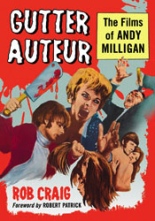
 Had I not just read Jimmy McDonough’s acclaimed 2001 bad-moviemaker bio, The Ghastly One: The Sex-Gore Netherworld of Filmmaker Andy Milligan, I would have found Rob Craig’s new book on the same subject much more enlightening.
Don’t get me wrong: Gutter Auteur is recommended to fans of grindhouse flicks; I just feel like much of the über-eccentric filmmaker’s story read as repetitive. (Craig cites McDonough’s book throughout as a source.)
However, I’m guessing many film fanatics haven’t read The Ghastly One. After all, it’s now a dozen years old, out-of-print and, therefore, insanely expensive; Andy Milligan is far from a household name à la Ed Wood; and the only reason I read it is because, having devoured McDonough’s bio on Russ Meyer, Big Bosoms and Square Jaws, a year earlier, I simply wanted more words from him, no matter the subject.
The big question is whether room exists for two books on such a niche personality. Of course! It helps greatly that Craig is not interested in retelling Milligan’s life story beyond a 20-page summation. Instead, he aims his critical eye at examining the man’s movies closely.
Admittedly, it takes a little time to get there — about 120 pages — because preceding the meat are chapters that set up the pervading culture of the late-’60s era in which Milligan began to toil, particularly as the times related to homosexuality (Milligan was gay, to an unnatural degree of hate for heteros) and the sexploitation film. While doing so is necessary, one could argue against the inclusion of two of these chapters: one explaining the Times Square grindhouse, which is the equivalent of choir-preaching here, and the other a biographical sketch of Milligan’s regular producer/distributor, William Mishkin. Whose bio is it anyway?
When we do arrive at the Milligan filmography, rife with underfunded weird-horror efforts that include 1970’s Guru, the Mad Monk and 1972’s The Rats Are Coming! The Werewolves Are Here!, Craig’s book comes alive, ably conveying the seediness and sleaziness of their content.
I should note that I’ve never seen a Milligan movie, and yet, as with McDonough’s Ghastly book, Gutter Auteur hooked me. From all accounts, however, I sense Craig may be ascribing a tad more depth to Milligan’s work than is there. (We soon shall see, as finishing Gutter Auteur prompted me to place an immediate order of Something Weird’s double-feature DVD of 1968’s The Ghastly Ones and Seeds of Sin.)
Of course, it should be considered praise that I found the study so compelling, given my utter lack of exposure to the films delved into so thoroughly. Poster art and stills sprinkled throughout complement Craig’s descriptions and deconstructions of Milligan’s wicked little morality matinees of malfeasance and madness. —Rod Lott
Buy it at Amazon.


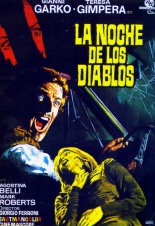 Right from the start, The Night of the Devils is a room-clearer, announcing its intentions to the audience with a nightmarish montage of full-frontal nudity and graphic violence, complete with an exploding head and a ripped-out beating heart. “Don’t like it?” the film seems to say. “It’s best you leave now.”
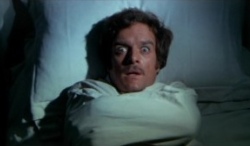 Gianni Garko (Devil Fish) literally stumbles into the story as Nicola, an amnesiac brought to a mental institution. Taking up most of the running time, a flashback reveals how he got there: Swerving to miss a woman in the woods, he experiences car trouble, and ventures to a nearby, rundown village for help. There, they keep the windows barred as protection against what plagues the night.
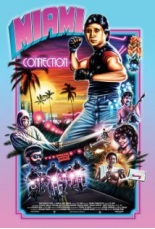
 The story behind
 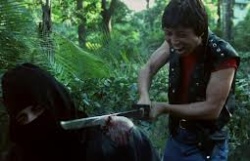 The rock group booted from the club in favor of Dragon Sound doesn’t take the diss lightly, so its members order the peaceful quintet of black belts to be killed. Somehow, this comes to involve a clan of black-robed ninjas brandishing very sharp swords, a cocaine ring, a guy with a beard that appears to have been swiped from a G.I. Joe doll, a motorcycle gang, various gym rats with beer bellies and, perhaps most notably, a missing father. Don’t miss the dramatic mail-opening scene!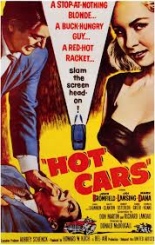
 Nick Dunn (John Bromfield,
 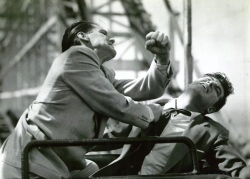 Steered with no-nonsense efficiency by Western TV director Don McDougall,