
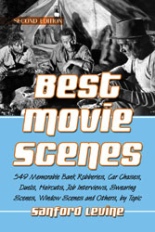
 Man, oh, man, how I truly wanted to love — or even just like — Best Movie Scenes, because I find film-related lists a blast to read. One of my favorite parts of my recent Christmas-to-New-Year’s vacation was poring over all 288 small-print pages of 10 Bad Dates with De Niro: A Book of Alternative Movie Lists, an impulse-clearance purchase that turned out to yield rewards of pleasure exponentially greater than my meager $2 investment.
Needless to say, I was thirsty for more. Yet Sanford Levine’s paperback round-up is a bad date in itself, starting with a wholly unnecessary framing concept that simply does not make sense.
Barring a reprint of Levine’s two-page introduction, my words can’t explain adequately the bizarro idea the author puts forth: a strange scenario in which he and his friends are members of über-niche organizations like the Best Neck Brace Scenes Club, complete with regular meetings and voting and all.
Yeah, I don’t get it, either.
But that doesn’t stop him from carrying it out through the entirety of the book, organized alphabetically by subject, including such topics as “Sagging Shoulders” and “Name Mispronunciation.” (Admit it: You’re dying to know what he’ll name as cinema’s all-time finest “Fluttering Drapes” scenes, right? Right? Well, it’s here.)
Under each topic are several unnumbered examples, written in a mumble-mouthed manner that stands squarely between baffling and rambling. As an example, read this excerpt about 1979’s rom-com Starting Over, a Burt Reynolds/Jill Clayburgh pairing mentioned in the “False Teeth” chapter:
“While false teeth fans prefer to see an actual denture, they are not averse to scenes in which false teeth are merely mentioned, as long as they are mentioned in a favorable light. … For the record, marriage proposal fans: did put in a claim for this scene, but it was quickly dropped when false teeth fans, possessive about their territory, threatened to have every actor and actress in every winning marriage proposal scene checked for dentures.”
For a second example, this in-full verdict on the 1973 prison drama Papillon, within the entry on “Food Mushing”:
“Some food mushing scenes are not for the fainthearted. This is especially true when they are set in a solitary confinement cell on Devil’s Island. Food mushing fans, however, are not easily revolted. So when Steve McQueen is put on half rations for not squealing on Dustin Hoffman, he shows he can mush food in a revolting way with the best of them. The fact that the ‘food’ he mushes is beetles and grasshoppers in no way violates Rule 3 in the newly revised Food Mushing Manual. In essence, Rule 3 states to the be eligible for a food mushing award, an actor may mush anything as long as it is eventually eaten.”
Now imagine that for about 200 pages, because that’s what Best Movie Scenes is. And I stress the word “imagine,” because I discourage you from reading it. At least those two examples actually reference scenes, because Levine sometimes cheats by not mentioning any. One example, from “Accounting,” is Moonstruck: “In an informal vote the membership elected Cher the prettiest accountant ever to balance the books in a movie.”
I think that the author may be aiming for comedy, but if so, it was lost on this reviewer without a rimshot to cue me. Levine keeps returning to the same titles (Chevy Chase’s Funny Farm earns no fewer than three spots), which demonstrates a dearth of imagination, and occasionally throws in recipes. Repeat: recipes.
Worst of all, and perhaps I’m just nitpicking, but it pains me to no end when books on film don’t bother to get simple facts correct. Peter Riegert is a fine comedic actor deserving of more press than he gets, so it’s an insult to mangle his name as “Peter Reichart,” which isn’t even close.
Revenge of the Nerds II is referred to only by its subtitle of Nerds in Paradise; Francis Ford Coppola’s The Godfather: Part III is rendered as Godfather III; and in Levine’s mixed-up mind, David Fincher’s The Social Network is praised for having taken home Oscars for Best Picture and Best Director — prizes it famously lost.
And on and on it goes, wrongly, lazily, poorly and painfully.
Again, the friend in me grabs you by the shoulders and, with a gentle shove, nudges you instead toward 10 Bad Dates with De Niro, which is everything Best Movie Scenes is not: erudite, witty, logical, readable. —Rod Lott
Buy it at Amazon.

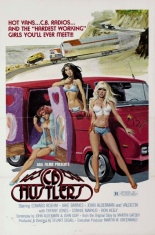
 Odds are, the amateurish, plotless sex comedy known as C.B. Hustlers likely was dated the very day it was released. The title refers to a “rolling cathouse” of a pimp and his three shapely truck-stop whores, ready to service weary rig drivers at the drop of $25.
 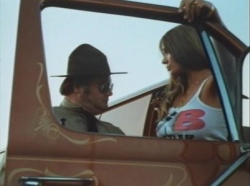 There’s not a laugh to be had in this mix of Hal Needham and Hee Haw, but its 85 minutes breeze by like those damned 18-wheelers on the freeway. A couple of reels were even out of order on the print I saw, but I didn’t mind at all, especially when I saw that Uschi Digard’s big sex scene was filmed from the perspective of the lucky guy beneath her.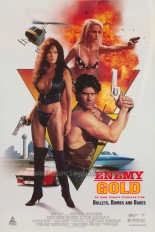
 With
With 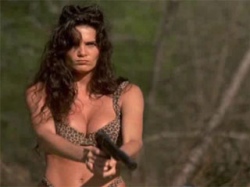 Flowing readily from co-writer Christian’s pen are exchanges such as one in which male lead Chris Cannon (Bruce Penhall) discusses the agents’ newest weapon of defense: crossbow arrows with tips that “explode three seconds following penetration.” Becky replies, “Like old boyfriends.” Rimshot! The best line, however, comes after a naked lady in a shower asks Santiago, “What’s up?” and he says, “I am.” (Get it? He means he totally has a boner.)
 Part kick-’em-up revenge tale and part sappy love story (guess which part I didn’t care for?),
 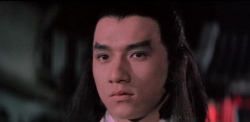 Prior to the attack, Cao Lei feigns disinterest in his pregnant girlfriend so she’ll skip town and, thus, be safe. But she runs into the arms of a not-so-nice guy who, it is revealed with no surprise, is a rival clan leader. So Cao Lei must save her, but first he is nearly killed (with intrigue) and then brought back to his vital self by his enemy, a scar-faced woman who then scars him, making his face look like he has an expired Steak-umm glued to one side.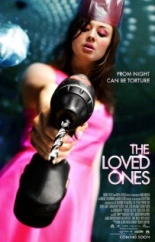
 And you thought
  Lola doesn’t accept rejection well — like, at all. With the help of her father (John Brumpton,