All posts by Rod Lott

Hammer Films’ Psychological Thrillers, 1950-1972

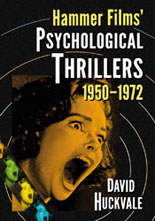
hammerthrillersWith Hammer Films’ Psychological Thrillers, 1950-1972, you know David Huckvale has done his job when I fill up my Amazon Wish List with titles I don’t yet own and move those that I do and haven’t seen — several found on The Icons of Suspense Collection — to the top of my DVD viewing pile.

When people think of Hammer, they think “horror”; some misinformed fans don’t even realize the legendary UK studio made anything but fright films. Thrillers, it did even better — at least that’s my purely subjective view, but Huckvale would seem to agree, calling them “more than catchpenny essays in suspense.”

His book examines all 17 of them — the psych-focused ones, anyway, and then only those falling between the golden years of 1950 and 1972. (Sorry, Hilary Swank and The Resident!) But first, he lays the groundwork by discussing the classics that informed Hammer’s approach to the genre: Henri-Georges Clouzot’s Diabolique and four from Alfred Hitchcock. That said, when it comes to one of the former’s famous twists, Huckvale contends that “Hammer got there first,” with 1950’s The Man in Black.

Barely a chapter goes by — one, literally — without mentioning cribs from Hitchcock, whether birds and baths, mirrors or mothers. Huckvale reserves perhaps his highest praise for what arguably looks the most overtly Hitchcockian of them all: 1963’s Maniac.

From start to finish, the author delivers smart, insightful readings, comparing the films to one another, analyzing them in relation from Shakespeare to Sigmund Freud, yet remains standing on the opposite side of dullsville. There is more merit and credibility on any given page than in the whole of Randy Rasmussen’s Psycho, the Birds and Halloween: The Intimacy of Terror in Three Classic Films, a fellow new release from McFarland & Company.

Huckvale may veer often, but he always has a point, and he is as comfortable teasing the prospect of Cary Grant playing the Phantom of the Opera as he is at referencing Kierkegaard. —Rod Lott

Buy it at Amazon.

The Wild World of Batwoman! (1966)

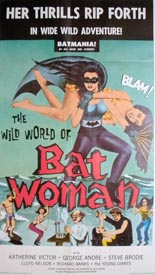
wildworldbatwomanRated G for gawd-awful, The Wild World of Batwoman! may represent the most shameless cash-grab in the cinematic history of coattail-riding. I’m tempted to think even Roger Corman, King of the B-Movie Clone, would shake his head at writer/director/producer Jerry Warren’s transparent attempt at turning America’s Bat-mania into holy simoleons.

At the time of the mild Wild, ABC was cowl-deep in a ratings and cultural bonanza with the Pop Art-influenced Batman series starring Adam West and Burt Ward. Warren’s greedy response was to throw together this intentionally silly hour of no power, funded presumably with whatever change he found on the way to the office. The only way the huckster could appear more flagrant is if he had named his heroine Batgirl.

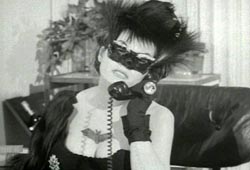
wildworldbatwoman1Batwoman (Katherine Victor, Warren’s Teenage Zombies) may sport the curves of TV’s Yvonne Craig, but bat-insignia aside, similarities screech to a halt. Her face hidden by a cheap party mask and her hair covered in a mess of feathers, Batwoman looks less like a superhero and every bit a drag queen — only her vacuum-packed bosom proves she is a she. In dreary monotone, she communicates via wrist radio (calling Dick Tracy!) with her coven of bikinied Batgirls. The obedient young women are vampires, “but only in the synthetic sense,” which means they drink yogurt instead of blood, whatever the fuck that means.

The tissue-thin plot involves numerous parties — namely, panty hose-faced Rat Fink (Richard Banks, Warren’s Frankenstein Island) — aching to get a hold of an “atomic hearing aid” capable of listening to any telephone conversation. Speaking of scientific discoveries, “happy pills” slipped to the girls makes them so lax, they go-go dance for what viewers will swear is days on end. Also starring in this incredibly boring oddity is no one of note, plus the equally talented chocolate milk and soup. —Rod Lott

Buy it at Amazon.

The Snorkel (1958)

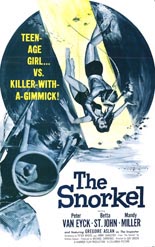
snorkelHammer Films’ The Snorkel opens with a long, silent sequence in which black widower Paul Decker (Peter van Eyck, The Thousand Eyes of Dr. Mabuse) methodically sets up an elaborate death trap for his wife, apparently drugged into unconsciousness on the couch. After sealing the room shut, he rigs it to flood with natural gas while he lie safely in the crawlspace, accessible via secret door underneath the carpet. He’s in no danger of asphyxiation, thanks to the scuba gear he wears, from which this psychological thriller takes its utterly silly-sounding name. (Even sillier? The credit that reads, “John Holmes’ dog ‘Flush’ as ‘Toto.'”)

The deliberate precision Decker takes suggests these steps have become a routine. He has done this before; he knows exactly what he’s doing. And so does director Guy Green (The Magus), for The Snorkel is a superb Hitchcock imitation.

snorkel1The dead woman’s gangly teenage daughter, Candy (Mandy Miller, The Man in the White Suit), immediately accuses Paul as the killer, beyond a Shadow of a Doubt. She still suspects him of killing her father, too, in a boating “accident” several years prior. Thus, at the core, we have a locked-room mystery in which, privy to the solution from frame one, we’re just waiting for the other characters to catch up.

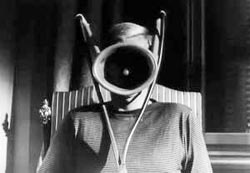
How Green manages to wring suspense from that, I’ll never know, especially since we know those characters will, given the times. In ever-noble black and white, The Snorkel presents one of the more perverse methods of murder the screen has seen to date, and that uniqueness — the posters classify it as a “gimmick,” which sounds too William Castle-esque — goes a long way in appeal. It also grants instant menace to van Eyck, who looks so evil and creepy sitting quietly in that apparatus, no acting is necessary. —Rod Lott

Buy it at Amazon.

Brain Dead (1990)

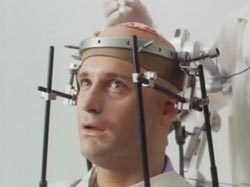
braindeadAdam Simon’s Brain Dead is engineered to mess with your head. It undoubtedly will succeed if you have trouble telling Bill Pullman apart from Bill Paxton, since both men star in the loftier-than-usual Roger Corman production.

Pullman (Spaceballs) is neurosurgeon Dr. Rex Martin, cajoled by hospital administrator Jim Reston (a visibly grease-slicked Paxton, Weird Science) into determining if mental patient Jack Halsey (Bud Cort, The Life Aquatic with Steve Zissou) is faking his clinical paranoia. A mathematics genius believed to have killed his family, Halsey has important numbers in his head that some very important people want retrieved.

braindead1Entering his findings into what appears to be a MacPaint knockoff, Dr. Martin finds Halsey to be the real deal. Our good doctor then helplessly bounces between realities in which he is not the physician, but the patient; in which he is a doctor, but under Halsey’s name; in which various people — including his wife (Patricia Charbonneau, Manhunter) — are found murdered, their eyes stabbed free of their sockets.

So often does Brain Dead leap from level to level, with Dr. Martin jolting “awake” in a sweaty panic, I couldn’t help but think of The Kids in the Hall‘s classic sketch a year earlier in which “I had the pear dream again.” Simon’s movie is like those three minutes, if extended to a feature length. It would function better as an episode of The Twilight Zone — which makes total sense since Charles Beaumont, a regular scribe for that landmark TV series, shares screenplay credit with Simon — especially since they do not have the budget necessary to pull off their collective ambition.

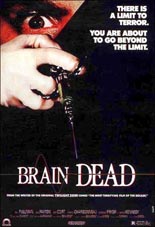
Is it “the most terrifying film of the decade,” as the posters claimed? No. It’s not terrifying at all, yet at least one cannot fault the movie for overflowing with ideas. Whereas Simon went on to bigger things, notably Corman’s Carnosaur, Beaumont remained deceased, having passed away in the late 1960s. Another nugget of trivia: Paxton’s Martini Ranch band provides the club-ready, Dragnet-era Art of Noise-esque end theme. —Rod Lott

Buy it at Amazon.

The Unholy Rollers (1972)

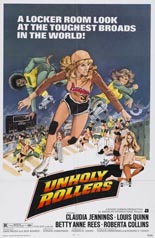
unholyrollersWTFSick of being sexually harassed by the boss, cat-food factory worker Karen Walker (Claudia Jennings, Gator Bait) impulsively quits and parlays her hot temper and hot bod into a career as a professional roller-derby skater. Despite never having played the sport before, she proves a natural. Despite proving a natural, she provokes jealousy as she zooms right past her fellow orange-jerseyed Avengers, literally and figuratively.
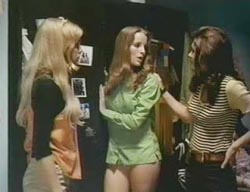
The Unholy Rollers is an odd-duck mix of the sports drama and producer Roger Corman’s hick-underdog comedies. Scripted by Corman regular Howard R. Cohen (Saturday the 14th), it asks us to believe that Karen could not only become a citywide star, but make “lots of money,” which she drops on new furniture, family and friends, and a car with a zebra-print hardtop. Yet we kind of believe it because director Vernon Zimmerman (Fade to Black) trusts viewers will topple head over heels for Jennings. She possesses such an all-American beauty and confidence, it’s difficult not to, even while taking note of the third-rate arena.

unholyrollers1As depicted in this flick, roller derby is pro wrestling on wheels, complete with costumed heroes and villains, all of whom clutch cans of Coors as if water had yet to be invented. The skating sequences bring a real snap to the two-bit proceedings, and it is here that first-time editor Martin Scorsese demonstrates a touch of the genius to come.

Don’t mistake The Unholy Rollers for genius. Narratively, it’s a mess, braking for joke-tellling sessions that remind one of the opening spreads of Mad magazine’s movie parodies. The story threads abruptly culminate in a strange, downbeat ending of self-destruction that, like any of Karen’s brutish teammates, comes from nowhere to knock you out. It’s an easy watch, however, and it becomes clear that the film has more on its mind than exploitative elements; it checks through those as quick as it can in order to settle into a parable about the price of fame. —Rod Lott

Buy it at Amazon.