
All posts by Rod Lott

Hi-8: Horror Independent Eight (2013)

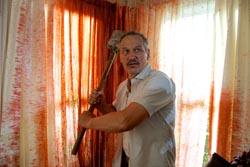
hi8Taking an analog-inspired cue from the V/H/S anthology franchise, Hi-8: Horror Independent Eight goes even further down the scale of format quality, with each of its eight segments (wraparound included) shot on fullscreen video. Rather than coming from today’s mumblecore world, Hi-8’s contributors herald from an even more lo-fi movement: regional horror flicks shot on video (SOV). If you’ve so much as heard of their work — Cannibal Hookers, Sorority Babes in the Dance-A-Thon of Death, Mulva: Zombie Ass Kicker! among them — you’re predisposed to have interest in viewing this “all-star” experiment.

A typed-on-computer title card warns (read: promises) “overt gore and unbearable suspense”; Hi-8 delivers on exactly one of these, and overall results are scattershot as a pulsating sprinkler with no adjustable range. On the plus side, Tim Ritter (Truth or Dare? A Critical Madness) charts the “complicated” relationship between a wife and her husband, who happens to be a rapist / serial killer. On the minus side, Chris Seaver (Return to Blood Fart Lake) turns in a three-character piece that plays stalker rape for comedy. Ha?

hi81Inconsistency is Hi-8’s only constant: Tony Masiello’s tale of “a lost SOV” titled Bloodgasm has a decent setup and a poor payoff, whereas Todd Sheets (Zombie Bloodbath) follows a radio DJ in an EC Comics-style story with a decent payoff and a poor setup. Among the project’s octet of shorts, the best doesn’t even try for shocks — just laughs. Genuinely LOL-hilarious, it’s from The Vicious Sweet’s Ron Bonk, who simultaneously sends up George A. Romero and 1980s-style action by plopping a Snake Plissken-esque he-man amid an attack of the undead on his Nana’s nursing home.

The entire exercise ends with a list of the eight rules each filmmaker had to follow — only practical effects allowed, wind noise encouraged, etc. — and this should have appeared at the start just to prep the unsuspecting / uninitiated as to what they could expect from the whole of Hi-8. Those not used to SOV “epics” will have a really tough time with it. —Rod Lott

Buy it at Amazon.

The Equalizer (2014)

equalizerAntoine Fuqua’s The Equalizer bears only nominal resemblance to the 1980s television series of the same name, in which British thesp Edward Woodward spent four seasons on CBS prime time as force of vengeance-for-hire Robert McCall. The big-budget actioner casts decidedly non-British Denzel Washington in the same role, yet more accurately could be titled Denzel Does Damage. Not for nothing does Fuqua frame his Training Day star strutting his stuff toward the camera as an explosion mushrooms from behind in slow motion.

Secretly a former intelligence agent, the widowed McCall now lives a lonely life of routine as a minimum-wage worker at a home-improvement chain. When not hauling lumber, he can be found sipping tea and reading Great American Novels at a greasy-spoon diner. It is there he gets drawn back into the world of bam-bang-boom when he comes to the defense of his friendly neighborhood teen prostitute (Chloë Grace Moretz, 2013’s Carrie), thereby stepping in the pile of doo-doo that is the Russian mafia.

equalizer1Have no fear, for Fuqua allows McCall to do that Robert Downey Jr.’s Sherlock Holmes thing where he stylistically surveys the room and figures out all the shit that’s about to go down before it goes down. McCall does one better than Holmes by estimating how many seconds each ass-kicking will take. The Equalizer is also The Timekeeper.

It all coalesces in an after-hours showdown inside the Home Depot stand-in, where McCall employs various tools from the shelves to booby-trap the big-box store with gory results. While clearly the film’s showstopper sequence, it doesn’t compare to the highly similar, hardware-enabled plan of revenge exacted by Kim Basinger in 2008’s While She Was Out. Of course, that sleeper didn’t have white-hot star power at its center; the cucumber-cool Washington plays badass so well, he’s the reason you’ll forgive the corny subplots and other ludicrous touches. —Rod Lott

Buy it at Amazon.

The Comic Galaxy of Mystery Science Theater 3000: Twelve Classic Episodes and the Movies They Lampoon

comicgalaxyFour years after publishing an academic essay collection on TV’s Mystery Science Theater 3000 in 2011’s In the Peanut Gallery, McFarland & Company dips back into Deep 13 territory with Chris Morgan’s The Comic Galaxy of Mystery Science Theater 3000: Twelve Classic Episodes and the Movies They Lampoon, a refreshingly accessible tour of the cult series’ 11-season run that works as both a history overview and greatest-hits tour.

As the subtitle says, Morgan ticks through a dozen key episodes, one per season except the final, which earns two chapters. (The author also throws 1994’s Mystery Science Theater 3000: The Movie in for good measure, as well as a 12-page discussion of shorts.) In doing so, he’s able to relay the show’s entire lifespan, from a scrappy, local TV time-filler to a pair of national major-cable networks, and detail how things evolved as the years passed, on both sides of the screen.

The approach also allows Morgan to dive deep into what he feels are representative eps, to examine not only the movies skewered and screwed, but the riffs doing the skewering and screwing. Because the book is written for total accessibility, his commentary can be a joy to read; take, for example, this observation of second-season gem Catalina Caper: “Two different women lose their tops in this movie, which is either one too many or 20 too few. Either do that bit once or be completely morally and intellectually bankrupt. There is no room for middle ground.”

Refreshingly, while he clearly is a hardcore MST3K fan, he’s not a blinded fanboy; in fact, he tasks the creators to task for mean-spirited jokes on actors’ weight and/or appearance. On the other hand, readers may be left questioning Morgan’s own judgment over what classifies as a classic episode. Most notably, while he acknowledges season-four closer Manos: The Hands of Fate as being synonymous with the show, he writes, “That is not to say this episode is the favorite of most people. It’s a strong episode, sure, but … the riffing isn’t top of the line” — and this opinion stands in stark contrast to decades’ worth of fan-favorite lists.

There are other eyebrow-raisers, from him doubting the MST3K creators would ever take on Syfy dreck like Sharknado (which they did last July), to calling Star Wars’ special effects as “somewhat poor.” But to each his own, right? Less forgivable are an overuse-to-point-of-abuse of “as stated previously” and factual errors (Roger Corman didn’t make a Captain America movie), but at least the latter arrives in very short supply.

Bottom line: Comic Galaxy comes strongly recommended to all membership levels of MSTies. While it’s not the definitive history of the revolutionary series, it’s a good one. —Rod Lott

Buy it at Amazon.

The Houses October Built (2014)

housesoctoberTo the surprise of no well-versed viewer of horror, The Houses October Built refers to the “haunted” variety — in particular, those ramshackle attractions that spring up nationwide in the weeks leading to Halloween, then shutter their makeshift doors until next fall. Houses, however, is no documentary, although it started life that way in its original 2011 incarnation of the same name. Now, that scrappy project has been restructured as a mockumentary, getting slathered with a heavy coat of the found-footage craze in the process.

The story seems tailor-made for that approach, slim as it is: Five friends spend five days in an RV, going from town to town to take in the best haunts the season has to offer. Because they’ve brought a camera, it’s like we’re in the actual spook-shack halls with them: It’s tough to see and not as much fun once you’re inside. They also hit up more inventive entertainment experiences, from shooting paintballs at zombies to patronizing strip clubs where the dancers don masks (not a bad idea, based on the bethonged I’ve seen IRL).

housesoctober1And that’s about it, until this ersatz Scooby-Doo gang gets the itch to track down the not-advertised, not-on-the-map “underground haunt” that’s rumored to make its visitors shart their britches in terror. The question of whether they’ll make it out alive is answered in Houses’ opening minute, so don’t enter this one in search of suspense; the exercise is more about being jolted by SUDDEN! LOUD! NOISES! than any skillful building of tension. While unremarkable and anticlimactic, its mix of fact and fiction makes for a decent time-waster.

The Houses October Built is directed by Bobby Roe, one of the aforementioned five haunt-hunters, all of whom we can assume are playing themselves since they go by their real first names and, lest ye already forgot, much of the 91 minutes comes cobbled from its humble documentary beginnings. (If you can find it, the Best Buy-only Blu-ray contains the full doc as a bonus feature.) Bubbly Brandy Schaefer is our token female and, comparatively speaking, the voice of reason among fellow travelers Mikey Roe, Jeff Larson and Zack Andrews, because there’s always a Zack. (What, no Chad?) —Rod Lott

Buy it at Amazon.

Tusk (2014)

tuskAfter delivering a few sharp efforts right out of the gate, writer/director Kevin Smith became as lax, predictable and increasingly off-putting as those hockey jerseys he wears like a uniform. For more than a decade, the bar for his movies has been set awfully low, yet along comes the bonkers Tusk to clear it with air to spare. Accounting for much of its success is that, as with 2011’s Red State, Tusk bears next to none of that Kevin Smith feel — one of pot worship, infantile humor and fanboy-pandering in-jokes.

Ironically, Tusk’s most Smith-y element can be found in the arrogant, immature, insensitive lead character. He’s Wallace (Justin Long, Drag Me to Hell), a podcaster with a porn ’stache who makes bank by tracking down and interviewing weirdos. His latest target to exploit takes him o’er the border to Canada, until an unforeseen turn of events leaves Wallace high and dry and desperate for content.

Tusk1One plot-convenient urination in a bar bathroom later, he’s pissed himself into a lucky break by learning via handbill of local retired seaman Howard Howe (Michael Parks, Django Unchained), a crusty coot who has many weird tales to share about his ocean voyages of yesteryear. Wallace takes the bait … and a cup of drugged tea, waking up to learn Howard’s true intentions: to turn him into a walrus. Let the body horror begin!

Tusk is essentially Smith’s entry in the Human Centipede sweepstakes, yet explicitly a comedy. And with Parks chewing the scenery and a surprise A-lister all but unrecognizable as an Inspector Clouseau type, it is funny … just not to all tastes; dark humor rarely is, which is why it’s so often misunderstood. While the film shows seams of padding in its expansion from a literal joke in Smith’s own podcast to a lark of a feature, it’s the scenes between those seams that count, and Tusk has several you not only haven’t seen before, but won’t be able to unsee ever. Not that I would try, given the flick’s unexpectedly high repeatability factor. —Rod Lott

Buy it at Amazon.