
All posts by Rod Lott

Fear Clinic (2014)

fearclinicIf it’s Tuesday, it must be a new straight-to-video horror film starring Robert Englund. In this case, it’s Fear Clinic, born from the short-lived web series of the same name, in which the former Freddy Krueger traded Nightmares for phobias.

Englund reprises his role as Dr. Andover, renegade brain researcher and inventor of a coffin-like machine that animates one’s fears into vivid hallucinations, in hopes of curing his patients of that which frightens them to the point of crippling. This being a horror movie, the contraption doesn’t work as planned. This being from the same creative team as the 2009 series — namely, director/co-writer Robert Hall, the man behind the effective throwback ChromeSkull slashers — it arrives as a missed opportunity and a major disappointment. What worked in episodic bursts does not gel as one shared story, which concerns the struggling survivors of a tragic diner shooting that left several dead, including one child.

fearclinic1In shedding the serial nature of its source material, Fear Clinic the feature loses its base appeal. While it’s not required viewers have the show under their belt before watching the movie, this project does serve as a direct continuation. Yet it doesn’t even follow its own internal logic, so fans may be as lost as newcomers as to just what the hell is going on. I was, and I happily devoured those episodes as they premiered five years prior.

Budgetary issues are apparent, and may be somewhat to blame for the script not being up to snuff. I am assuming that a poor showing in crowdsource funding are why once-attached Kane Hodder and Danielle Harris are no-shows in reviving their series characters; in their place is Slipknot vocalist Corey Taylor — not exactly a fair trade. Casting issues aside, one can’t help but notice how fake the CGI spiders look: so pitiful, the intended scare effect is anything but. Speaking of the arac war, a special effect Hall is able to pull off seems swiped from the Venom portions of Spider-Man 3. Oh, what a tangled web … —Rod Lott

Buy it at Amazon.

The Bride Wore Black (1968)

brideworeblackThirty-five years before Uma Thurman’s Kill Bill bride murdered her way through a five-person list to avenge the assassination of her would-be hubby, Jeanne Moreau did the same in The Bride Wore Black. The film was director François Truffaut’s homage to the suspense thrillers of Alfred Hitchcock, whom the French New Wave pioneer interviewed in the now-essential cinema-study text Hitchcock/Truffaut, published one year before.

For this stylish tribute, Truffaut brought frequent Hitch composer Bernard Herrmann (Psycho) along for the tour and tapped a crime novel by Cornell Woolrich, who wrote the short story on which Hitch’s Rear Window was based.

While the details surrounding the shooting are held from viewers too long that confusion initially reigns, brand-new wife Julie Kohler (Moreau, La Femme Nikita) watches in horror as the love of her life is shot dead on the church steps, presumably seconds after the ceremony bound them ’til death do they part.

brideworeblack1Part!

One thwarted suicide attempt later, the grieving, perpetually frowning Julie decides to move on with life, as in getting even with the quintet of card-playing bachelors responsible for her spouse’s untimely demise. As she does so, each through a wildly different method — pushing, poisoning, whatev — she crosses off the poor bastard’s name in her little black book. (An avenger’s trade secret? Accurate, real-time record-keeping.)

Even masters of cinema have their missteps, and that’s how Bride may strike viewers who look at it strictly as an exercise in the Hitchcock vein. Without Herrmann’s score in place, the movie doesn’t feel the slightest Hitchcockian; heck, Moreau isn’t even blonde! To be fair, approach Truffaut as Truffaut. The French approach genre markedly different than the English, and Bride is his take on the thriller as Fahrenheit 451 was his take on sci-fi: an ambitious, if not entirely successful marriage of art and commerce. With an unexpected sequence of animation, the film is always interesting to look at, even when the story points lag. Don’t pay too much attention beyond what resides at the surface, because Truffaut didn’t; in fact, he left open a huge plot hole — upon which the entire work hinges. —Rod Lott

Buy it at Amazon.

Mad Movies with the L.A. Connection

madmoviesIn 1985, I was 14 and at the peak of my obsessive love for Mad magazine. Late that summer, when I read a one-sentence mention in TV Guide that a syndicated show titled Mad Movies was among that fall’s new fare, I flipped. Finally, something to look forward to in my so-called life!

Imagine my disappointment when Mad Movies soon premiered, and under the full title of Mad Movies with the L.A. Connection. Not only did the program have zilch to do with my favorite “cheap” mag, but I didn’t find it all that funny, either, no matter how hard its rather desperate laugh track tried to convince me otherwise. (Don’t even get me started on FTV, the woeful MTV parody that shared the hour on my local station.)

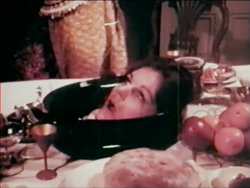
The premise of Mad Movies was simple: The California-based improv troupe The L.A. Connection lip-synched a comical new storyline to heavily condensed versions of various films in the public domain, including comedies (The Little Princess), mysteries (Sherlock Holmes and the Secret Weapon), thrillers (D.O.A.) and horror (Night of the Living Dead).

I share all that so I can say that even with my relationship with the show being brief and unsuccessful, I still looked forward to reading the world’s first — and likely only, ever — book on the short-lived series: the straightforward-titled Mad Movies with the L.A. Connection by Cashiers du Cinemart madman Mike White. After all, the show has its cult, and I admire its playfully anarchic, subversive spirit even without loving the final product. It’s possible that without it and similar experiments (see below), Mystery Science Theater 3000 would not exist.

From BearManor Media, the slim paperback details the show’s history, and it’s one that includes such players as Alan Thicke, Will Ferrell and — va-va-voom! — the Landers sisters. While not exactly sordid, the behind-the-scenes stories are candid enough to reveal a fair share of dueling egos at play, so perhaps it’s for the best the series lasted only one season. White includes an episode guide shortly after the halfway mark, and the book is illustrated with photos and old ads throughout.

It’s to White’s credit that the book would be interesting enough telling The L.A. Connection’s brush with nationwide mainstream television. Yet he doesn’t stop there; as readers of Cinemart’s most recent issue know (being treated to a preview excerpt), White discusses the comedic art form of “mock dubbing” as a whole, which has resulted in such niche features as What’s Up, Hideous Sun Demon (with Jay Leno among the voice cast), Blobermouth and Hercules Returns, all of which I now must see.

Love or loathe Mad Movies the TV show, any fan of that culture-spoofing style will enjoy Mad Movies the book. If there’s a bone to be picked from this chicken, it’s that White often quotes what should just be paraphrased, if not all but stricken, and yet his prose flows. (Allow me to pause and plug his outstanding collection of film criticism, 2013’s Cinema Detours.) At 132 pages, it can be read in less than two hours, which is roughly equal to the total time I spent watching the show in ’85 before deciding to stop tuning in; there were many Mads to be read and re-read, after all. —Rod Lott

Buy it at Amazon.

Fifty Shades of Grey (2015)

50shadesSays bachelor billionaire Christian Grey early in the hotly anticipated Fifty Shades of Grey, “I enjoy various physical pursuits.” Given the cultural dominance of the source material, even those who haven’t read E.L. James’ best-selling “mommy porn” novel (which began life as a piece of Twilight fan fiction) recognize the innuendo dripping from the line: In the bedroom, the dude loves to employ ropes, whips, crops, chains, cuffs and other items displayed on end caps at your neighborhood True Value hardware store. 
 
It’s one of many moments spring-loaded with a nudge and a wink, not all of which are spoken. In its aim to titillate, Fifty Shades trafficks in the unsubtle, beginning with a shot of our virgin heroine, Anastasia Steele (because she’s strong, get it?), craning her neck at Grey’s phallic tower penetrating the Seattle skyline. Soon after meeting the man for an interview, she absentmindedly fiddles with a pencil about her puffy lips. In case audiences are so hormonally charged in anticipation that they miss the sexual symbolism at play, the writing instrument literally is labeled “GREY” (it’s his penis, get it?).

50shades1As the film drones on, subtlety becomes as beaten as Steele’s behind. Witness Grey (Jamie Dornan, TV’s The Fall) completing a contract negotiation on anal and vaginal fisting and the like by telling the object of his affection possession, “I’d like to fuck you into the middle of next week.” Steele (Dakota Johnson, 21 Jump Street) doesn’t clear her calendar; instead, she attempts to crack Grey’s cement wall of emotions. In his world of whims and privilege, everything is a transaction, to the point where his power quirks reside on such a level of Howard Hughes-odd — won’t sleep in a bed with another person, hasn’t been photographed with a woman — that the script would not be out of line if its third act revealed robotic parts lurking behind Grey’s beady eyes. 

But Fifty Shades has no third act; it barely has a second. Whereas story structure demands setup, then conflict and, finally, resolution, the incongruously 125-minute movie is nearly all establishment, with maybe 15 minutes of conflict before an abrupt cheat of an “ending.” Although director Sam Taylor-Johnson (Nowhere Boy) has given James’ S&M novel more well-lit gloss than justified, the script credited to Saving Mr. Banks scribe Kelly Marcel is reductive, dumb and dull. For one and only one example, how to convey Steele’s lower lot in life as mousy and unworldly? She uses — gasp! — a flip phone. Repeat: a flip phone! What a vulgarian! 

As Steele, the oft-unclothed, oft-writhing Johnson proves deft at the front half’s comedic scenes, then less effective carrying the dramatic weight toward the end. She fares better than the clearly miscast Dornan, whose rote, single-expression delivery unintentionally turns him into an object of ridicule. When you can’t even sell an O-face in a supposedly erotic film, that spells disaster. 

And there are two more entries in the Fifty Shades saga to come? Were this starter package campy instead of empty, my ass and a theater seat might be more inclined to commit to a binding agreement. —Rod Lott

Buy it at Amazon.

The Town That Dreaded Sundown (2014)

towndreadedWhat at first appears to be a baffling creative choice in the 2014 version of The Town That Dreaded Sundown rapidly reveals itself to be among its greatest assets: In the world of this remake, the original 1976 film exists. Obscure compared to most of what Hollywood revives and reboots these days, that source material is referenced throughout as the authorities and various townspeople discuss it; many even watch it.

While this film is fictional, the crime spree it depicts has real-life basis: In 1946, a serial killer dubbed The Phantom of Texarkana (among other catchy names) had the border regions of the Lone Star State and the Natural State gripped in a state of shock. His five murders went unsolved and became cemented in cinematic immortality for the ’76 Sundown, a cheap but effective (and profitable) project for hick-pic director Charles B. Pierce (The Legend of Boggy Creek) that wades in docudrama and horror thriller without fully committing to either. The remake has no such identity crisis, pushing all its chips to the corner of the felt marked “slasher.”

towndreaded1In its meta take, the Texarkana residents commemorating the murders’ 65th anniversary are panicked when a copycat killer — potato-sack headgear and all — begins offing good-looking youngsters who dare give in to their hard-R impulses. Our parentless Final Girl (Addison Timlin, Odd Thomas) survives and investigates.

By acknowledging not just the true-crime element, but Pierce’s real-life film, director Alfonso Gomez-Rejon (the Sundance-anointed Me and Earl and the Dying Girl) and screenwriter Roberto Aguirre-Sacasa (2013’s Carrie remake) are allowed to have their devil’s-food cake and eat it, too; technically, they’re not recreating Sundown’s kills with contemporary gore galore (near-iconic death-by-trombone scene included) — they’re commenting on them, right?

There is no correct answer. Love or loathe the execution (pun not intended), there is no denying it’s different. Gomez-Rejon calls the shots with considerable style; they pop with gorgeous color. He also ably captures the heavy humidity of the region’s sticky summer nights. If only all horror remakes could convey half as much. —Rod Lott

Buy it at Amazon.