
All posts by Rod Lott

13 Tracks to Frighten Agatha Black (2022)

Who is Agatha Black and why is a chef’s dozen of tracks trying to frighten her? As appealingly (albeit a bit stiltedly) played by Bridie Marie Corbett, Agatha is practically a recluse — or “ree-cloose,” as a family member drawls — who barely gets out of the house she shares with her sickly aunt. 

Make that shared, past tense, as Aggy is healing from the horror of a recent break-in that ended with her aunt murdered. To cope, she absorbs herself with a beloved childhood curio: a stack of ghost story LPs her late father gifted her.

As she revisits the stories, which get progressively more grisly and adult, elements from the slabs of vinyl bleed into real life, like a neighboring couple fatally hammered beyond recognition. As they say in Dallas, where this was shot, just what in the Sam Hill is going on here?
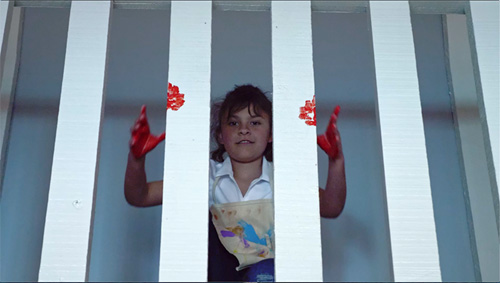
13 Tracks to Frighten Agatha Black is a perfect title. I admire not only its rhyming structure, but also how it sounds like the names adorning so many of the spooky albums that entertained kids in the 1960s and ’70s. I should know; I was one of them (for the ’70s half, at least). Before we were allowed to see horror movies or read horror comics, we could listen to horror story records. They were a gateway. As such, I hold reverence for them, even if I never want to hear them with middle-aged ears, preferring to leave that spell unbroken. 

Whatever writer/director Bradley Steele Harding’s relationship is with 33 1/3 rpm novelties, his idea for 13 Tracks is ambitious, but also kinda brilliant! Other first-time filmmakers should be as lucky. Each time the needle drops on another tale, the fuzz on the soundtrack is so, so satisfying.

However, I almost didn’t watch it past the opening credits (narrated by cult legend Udo Kier, incidentally) because the dialogue-free prologue depicting Agatha as a child is off-puttingly overacted with motions befitting a mime’s routine. To be bluntly honest, I abandoned the movie twice across two years’ time before finally ceding my full attention, encouraged by a rave review in David John Koenig’s Lowest Common Denominator review guide. I’m glad I did. 

While not “sure to give you the whim-whams” — a Monster a Go-Go reference, I assume — Harding’s movie bears enough ingenious touches for a rainy afternoon’s entertainment. I’d love to see his idea fleshed out with real financial weight behind it. Additionally, I look forward to his sophomore feature, Occult Canvas, which appears to mine another object of 1970s nostalgia: Rod Serling’s Night Gallery. —Rod Lott

Get it at Amazon.

The Secret Art of Human Flight (2023)

Depressed to a point of paralysis over his wife’s premature passing, the grief-stricken Ben (The Royal Tenenbaums’ Grant Rosenmeyer) follows an internet rabbit hole to a mysterious man offering an escape — not suicide, but the power to fly. Not of sound mind, Ben spends $5,400 on the shady self-help course.

Soon, the would-be guru appears at Ben’s door with a litany of tasks as highly unorthodox as his name: Mealworm. The ravings of a lunatic? The work of a prophet? Or perhaps all in Ben’s imagination? The answer awaits in The Secret Art of Human Flight, an ambitious fantasy from director H.P. Mendoza (I Am a Ghost) and first-time screenwriter/America Ninja Warrior contestant Jesse Orenshein.

When venturing into magical realism, some amounts of quirk and whimsy are expected — if not required — to pull things off. But leaning too heavily upsets the balance, sending viewers tumbling into the twee. That’s what happens here, following a promising start.

As Mealworm, Paul Raci (rightly Oscar-nommed for the powerful Sound of Metal) is excellent. In the moments Secret Art delights, it’s no coincidence Raci is onscreen. And when he’s not, the film often frustrates; Rosenmeyer’s character is simply not likable. A deep funk is a fine establishing point, but as the story progresses, and Ben is revealed to be even more of an asshole, cheering him on is too large an ask.

If nothing else, The Secret Art of Human Flight is worth watching for its end credits song, a slice of such pop jubilance that I would’ve sworn under testimony as the work of The Polyphonic Spree. Instead, it’s Mendoza, Raci and Rosenmeyer. If only the film the tune supports were as uplifting and transportive. —Rod Lott

Get it at Amazon.

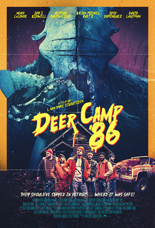
Deer Camp ’86 (2022)

In horror movies, hunters often receive the short shrift. They’re almost always randos relegated to one scene for the sole purpose of being dispatched by Jason Voorhees and his ilk. They’re not introduced so much as placed in the way — a minor obstacle to “overcome” on the way to those nubile, horny teens.

A throwback to the slasher decade, the horror comedy Deer Camp ’86 upends that architecture, making the hunters the protagonists — not necessarily a change for the better. Here, five friends head to the woods to slay bucks and does, but risk getting slain themselves by a Native American spirit noted for its skull visage and Predator-esque clicks.

From first-time director L. Van Dyke Siboutszen, Deer Camp ’86 reminded me of the screen outings of the Broken Lizard troupe, in all the positives and negatives that comparison brings. On the plus side, that includes a willingness to “go there” without care of offending; conversely, they “go there” without knowing what to do with it.

Its humor is largely predicated upon two obnoxious varieties: gotta-take-a-shit and fucked-your-sister. Hanging over the telling of these jokes is an air of obliviousness at how unfunny the jokes are. Whenever neophyte scripters Bo Hansen and Riley Taurus place a sequence at bat with potential for inspired craziness, they fail to pay it off.

Nothing embodies the movie’s consistent swing-and-a-miss run than the extreme close-up of a tick burrowed into a hunter’s testicle. What happens? The parasitic arachnid is simply plucked from the nut; the entirety of the gag is that a ball sack fills the frame. All in all, hardly worth stuffing to mount on your den’s wall. —Rod Lott

Get it at Amazon.

Jim Haggerty’s Grave Danger (2009)

Poor Becky. After walking for the length of the entire opening credits to her apartment, hopes for R&R get decimated by a phone call from an unnamed man who wants to tell her some “scary stories” and says she’s in … grave danger!

And also she’s in Jim Haggerty’s Grave Danger, a no-budget, shot-on-video anthology from the New York-based moviemaker whose name adorns the title. Not exactly the cachet of Tyler Perry, but perhaps a PSA of sorts, lest someone thinks they’re renting Quentin Tarantino’s CSI two-parter.

In the first story, paranoid Victor (Jae Mosc) believes he’s being followed by a tuxedoed chap, whom no one else sees. Becky’s reaction to this tale o’ terror? “Yes, it scared me. It was scary. Okay, is that what you want? Yes, it scared me.”

Then, there’s Carol (Kate Webster), who buys a gaudy tribal statuette that entrances her into donning lingerie and seducing deliverymen, only to kill them.

Thirdly and finally, Abe (Bud Stafford, The Putt Putt Syndrome) is a washed-up ventriloquist struggling to afford meds for his ailing wife (Kaye Bramblett, Squeeze Play). When a birthday party gig stiffs him on payment, Phineas extracts the debt in blood. Phineas is his dummy, BTW.

Oh, in between those vignettes, the caller (Jonathan Holtzman, Sweet, Sweet Lonely Girl) convinces Becky (Debbie Kopacz) to undress to nothing. She complies.

Needless to say, none of Grave Danger qualifies as scary, outside of characters’ goombah pronunciations like “PAH-k,” “TAH-k” and “re-TAHD” for, respectively, “park,” “talk” and, well, let’s not get canceled. It needs a fourth story in which Haggerty explains how he convinces all these women — friends? family? apartment complex neighbors? — to take off all their clothes for, what, maybe $20 and free cardboard pizza?

Strangely, the one who doesn’t is top-billed Cathy St. George, erstwhile Playboy Playmate for August 1982, as Dr. Geraldine Masters, which I take as a reference to Don’t Look in the Basement. —Rod Lott

Get it at Amazon.

The Mouse Trap (2024)

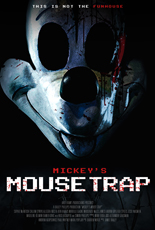
Monday, Jan. 1, 2024 — a date which will live in infamy — the original version of Mickey Mouse scampered into the public domain. And enterprising filmmaker Simon Phillips was ready, dropping a trailer for the slasher flick Mickey’s Mouse Trap.

Now simply titled The Mouse Trap, it borrows the Star Wars crawl to deliver a disclaimer erring on the side of the caution, lest someone confuse this for actual Walt Disney Company product. With this Mickey teleporting and stabbing, how could they?

At the FunHaven arcade, the manager (Phillips) forces Alex (Sophie McIntosh, The Sacrifice Game) to work late on her 21st birthday for a party that’s rented out the place. Turns out, it’s for Alex — a pretty shitty thing for her “friends” to do, if you ask me. They kick off a night of sex, drugs and Skee-Ball — all spoiled by the Mickey-masked manager, who kills them one by one … and sometimes by two, somehow hiding within a space that isn’t exactly a labyrinth.

Why become such a fun-killer? If Phillips knows, his script doesn’t show it. As far as I could muster, it’s because the manager spills a drink on a frayed cord of a film projector loaded with Mickey’s debut cartoon, Steamboat Willie, thereby transforming him into a homicidal maniac. I suppose that could happen, question mark.

Unlike the similar Winnie-the-Pooh: Blood and Honey, the movie is watchable, with Deinfluencer director Jamie Bailey giving it more of the rhythms that resemble a “real” film. Also unlike Blood and Honey, in a select few spots, it approaches fun. (One of them: Asked whether she’s ever seen a horror movie, a young woman answers, “No, Marcus, I have a sex life!”)

But very much like Blood and Honey, The Mouse Trap is first and foremost a rushed-out cash grab, existing only to exploit Disney’s copyright loss before anyone else could, quality be damned. Another commonality the two flicks share: just ending without an ending. While I get the curiosity factor, this chunk of cheese isn’t worth taking the bait. —Rod Lott

Get it at Amazon.