Before covering the subculture of cover bands in 2002’s little-seen Tributary, director Russ Forster pursued another “notable” subject in oddball music. So Wrong They’re Right examines the small, but fervent — okay, freakishly obsessed — cult surrounding the music industry’s most Jurassic of formats: the 8-track tape.
Filmed cross-country, the lo-fi movie interviews nearly two dozen 8-track enthusiasts — a few of them falling into what society would deem “normal,” but a majority of them otherwise — about their unusual hobby. Among the notable subjects are members of the ’90s grunge-rock outfit Gumball, who once bought a garage full of 30,000 tapes because they could, and a woman whose fondness for the format is surpassed only by an unhealthy fixation for toothy CHiPs star Erik Estrada.
Too long by a tad, yet always amusing, So Wrong proves not having a budget is insignificant if your camera is aimed at real people with compelling stories to tell. The highest praise I can give it is it made me want to buy one those cool, highly coveted “space helmet” 8-track players — not to play anything; just for purposes of aesthetic display. —Rod Lott
Before hitting it big (and inadvertently buying the farm) with The Crow, Bruce Lee’s son, Brandon, starred in the cheapo actioner Laser Mission, in which he plays American spy Michael Gold. He’s dispatched to encourage defection in Russian professor and laser weaponry expert Braun, played by Escape from New York-er Ernest Borgnine. (Unfortunately, at this point in Oscar winner Borgnine’s storied career, the Hollywood vet was believable only as a consumer of vast quantities of pastrami.)
As Prof. Braun disappears, the glittering Gold gets in deep with the Russian army and finds himself on the run, searching for the educator with the assistance of the prof’s daughter, Alissa, the blonde-haired, helium-voiced and breasts-forever-verging-on-escaping Debi Monahan (Wolfgang Petersen’s Shattered). Together, Michael and Alissa have a chase in a Volkswagen Microbus, shoot countless baddies with dead-on aim and bicker so much that the two are destined to become one (“That’s mister asshole to you!”).
Quite clearly, Lee possessed an easygoing charm that worked for him, although here, he acts largely through his tank top. Monahan has … well, I mentioned them already. For this action film saddled with a science-fiction title, director Beau Davis (Stickfighter) apparently could afford only one song, which they run into the ground: Knopfler’s “Mercenary Man.” (And sorry, but that’s David Knopfler, not Mark, so it’s not Dire Straits so much as just plain dire.) Faults and all, for five-and-10 adventure flicks that populate hundreds of public-domain DVD collections, you can’t do much better than Laser Mission. —Rod Lott
Admittedly without researching, I can think of no prostitute other than Xaviera Hollander to have achieved such a level of American fame that Hollywood responded in kind by turning her memoir and her life into a veritable film franchise. Naturally, her household-name status was a genuine by-product of the Me Decade (as opposed to our current Me Me ME Decade); I’m half-surprised she wasn’t called upon by prime-time TV to corporate-synergize by testing the cabin mattresses aboard The Love Boat or causing Tattoo to spill some ink during a visit to Fantasy Island.
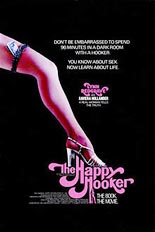
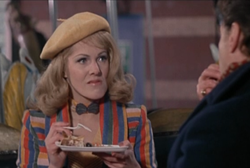
Based on Hollander’s 1971 memoir of the same name, The Happy Hooker is a sex comedy that is neither all that sexy nor all that funny. Furthermore, title be damned, it’s not all that happy, either. In fact, Nicholas Sgarro’s virgin outing as a feature director is so bad, it’s depressing. (No wonder he was banished to television forever after, cresting with 54 episodes of Knots Landing.)
Gods and Monsters’ Lynn Redgrave strikes one as vigorously miscast in the role of the real-life, larger-than-life Hollander, but at least she grants sympathy to her character. Arriving in America from Holland, Xaviera is gaga for the rich guy she moved continents for (Nicholas Pryor, Risky Business), until his deep-seated mommy issues suffocate their planned nuptials with a throw pillow.
She revolts the same way many women do: balling as many men as possible. What she enjoys, she soon gets paid for, which leads to full-time freelancing and, eventually, full-blown whoredom heading a bordello. See, Xavier does anything and anyone, while her peers may flinch. Make out with a black chick? Not a problem! X’s color-blind tongue is already out, wet and a-waggin’!
For something so sordid-sounding, The Happy Hooker is not only boring, but almost fully absent of nudity. Redgrave’s big number has her stripping to her underwear — and then back again — while dancing atop the conference room of a Wall Street executive (Tom Poston, TV’s Newhart). The only flesh bared is brief, yet belongs to Anita Morris, Ruthless People’s risqué redhead, here turned into a giant banana split with extra whipped cream. As with every scene in Sgarro’s film, it’s not as much fun as it sounds.
This awful flick was followed by 1977’s awful The Happy Hooker Goes to Washington and 1980’s truly awful The Happy Hooker Goes to Hollywood, which would be forgotten from pop culture’s collective conscience if not for Adam West (TV’s Batman) appearing in drag and getting blown. With each adventure, a different leading lady donned the garter belt. —Ed Donovan
Sex begins with a kiss, which must be why the 1896 featurette The John C. Rice-May Irwin Kiss — all 47 seconds of it — provoked such a uproar among a puritanical public. Distributed by Thomas Edison’s company, The Kiss (as it is better known) depicted just that and nothing more — a fleeting peck, really, between two completely clothed and consenting adults — yet was viewed as obscene, an affront to Christianity and this country’s very moral fiber.
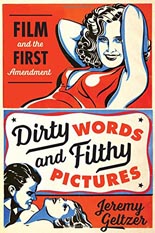
As Jeremy Geltzer tracks with frightening precision throughout Dirty Words and Filthy Pictures, the then-new art form known as cinema often was targeted as Public Enemy No. 1. This was a time when boxing dramas were perceived as a threat, when courts ruled that film censors did not infringe upon First Amendment rights because the movies were “mere entertainment, not speech worthy of protection.”
Available in both hardcover and trade paperback, the University of Texas Press release finds Geltzer, an entertainment and IP attorney, suggesting that to trace the history of free speech is tantamount to tracing the history of film. He is correct. His story is one of … well, if not good vs. evil, one of good-intentioned vs. evil. As such stories should, the villains bear unique and memorable names like Lloyd T. Binford, Damon Huskey, Judge Michael Musmanno and Maj. Metellus Lucullus Cicero Funkhouser; they just happen to have been real people. The only thing scarier is that they were real people with power, which they wielded to legislate their own narrow worldview and belief system to everyone else.
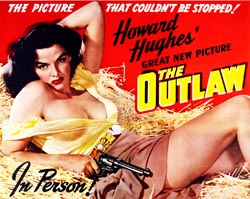
From film’s infancy to the legal skirmishes still challenging the pornography industry today, Dirty Words and Filthy Pictures by and large chronologically covers each legislative and/or community battle over the so-called “epidermis epidemic,” documenting each slam of the gavel, every swipe of the censor’s scissors. While the hygiene pictures and porno-chic movement obviously play large parts in this true-life account, so do utterly innocuous works as Howard Hughes’ 1943 Western, The Outlaw, for accentuating Jane Russell’s (covered) bust, and 1955’s Son of Sinbad, another Hughes production, for its inclusion of “lust provoking” dance scenes by stripper Lili St. Cyr, here non-stripped.
Not every controversy was over S-E-X, either. Take Curley, Hal Roach’s 1947 attempt at creating another Little Rascals, which dared depict white kids and black kids as social equals in the classroom. Some things have yet to change.
The sheer number of examples is alarming — just one element that makes Geltzer’s book a great, smart read. As eye-opening as it is pulse-raising, Dirty Words and Filthy Pictures entertains as it informs. It also will surprise you, starting with its foreword by Alex Kozinski: Yes, you really will read, enjoy and appreciate a book whose intro comes from the chief judge of the United States Court of Appeals for the Ninth Circuit. It is ordered! —Rod Lott
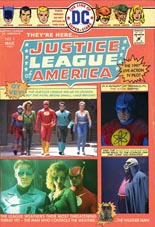
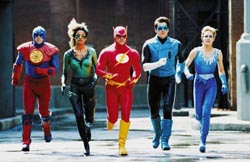
In the mighty tradition of Roger Corman’s The Fantastic Four — and by that, I mean never to emerge legally from the shelf on which it sits — is Justice League of America. Made for the CBS network, yet never-aired, the live-action movie assembles some of DC Comics’ most beloved superheroes … who are neither Batman nor Superman. See, with the rights to those two tied up with the Warner Bros. blockbuster machine, this Justice League is built upon a lineup of second-stringers: most notably Green Lantern, The Flash and The Atom.
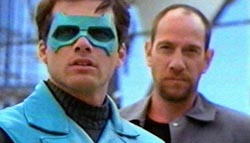
When he’s not conjuring goofy umbrellas, power tools or helicopter blades with his magic ring, Green Lantern (Matthew Settle, I Still Know What You Did Last Summer) tries to salvage his crumbling relationship with a young hottie. The Atom (John Kassir, the Cryptkeeper of the Tales from the Crypt franchise) is a pudgy science geek, whereas The Flash (Kenny Johnston, Scenes of the Crime) is a jobless loser, not to mention a clueless numbskull cast from the mold labeled “Joey from Friends.” Rather than talk shop at, say, a Hall of Justice, these guys loaf around in bathrobes in their shared apartment, where they attempt to fix the TV so they can watch — corporate synergy alert! — Touched by an Angel.
Joining them in their sporadic deeds of derring-do is Fire (Michelle Hurd, I Spit on Your Grave III: Vengeance Is Mine), who — although she has the power to shoot flames — is just here to give the JLA a little diversity, as she is African-American. (Speaking of color, I am uncertain why a superhero named Fire is costumed in green.) When not busy as a struggling actress pursuing the role of the banana in a fruit commercial, Fire joins the guys as the JLA’s true hideout: an underwater structure overseen by an overweight Martian Manhunter (David Odgen Stiers, TV’s M*A*S*H).
Their fine and peaceful city of New Metro is under threat of its first-ever hurricane, whipped up by the snarling-evil figure known only as The Weather Man, who wants $20 million to not level town with a tidal wave. As we later learn (excepting the fact it’s totally obvious from the get-go), this villain is actually the highly respected researcher Dr. Eno (Miguel Ferrer, 1987’s RoboCop). Conveniently, while stumbling upon his lab one night, Eno’s perky assistant (Kimberly Oja, TV’s Son of the Beach) finds herself zapped by a freakish cloud of crude computer animation, which grants her the ability to freeze things. Because of this incredible party trick, the JLA recruits her and dubs her Ice, and of course she will turn the tidal wave into a sheet of ice. Yep, the plot is wound up that easily.
As you have every right to expect, Justice League of America makes for a veritable two-course meal of corn and cheese. After ABC’s more-than-decent The Flash series from 1990, it’s pathetic to witness that character taking a job as a mailman, so that many yuks may be elicited by the sight of him delivering letters at breakneck speed. We also watch him down food at a rate that puts competitive eater Takeru Kobayashi to shame, capped by that surefire laff-grabber, the hearty belch. Meanwhile, The Atom’s heroics are pretty much reduced (no pun intended) to shrinking so he can free a cat trapped under a porch. Oh, and he also gets small to enter a room undetected by an alarm laser, under which he limbos, as Chubby Checker’s “Limbo Rock” plays on the soundtrack. (Insert your own hearty belch here.)
That said, from a standpoint of pure guilty pleasures, I loved it! Directed by Félix Enríquez Alcalá (Fire Down Below) and, reportedly, Lewis Teague (Cujo), the teleflick is at least made with technical competence, but maybe not so much that your attention is diverted from the joke-heavy script or school-play costumes or any other budgetary shortcoming. As prime-time superheroes of that era go, the Justice League tops 1996’s Generation X and the David Hasselhoff-led Nick Fury: Agent of S.H.I.E.L.D. So, yeah, good news, Zack Snyder: The bar isn’t set that high. —Rod Lott

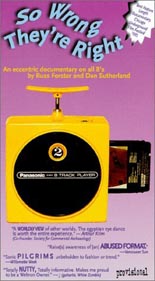
 Before covering the subculture of cover bands in 2002’s little-seen Tributary, director Russ Forster pursued another “notable” subject in oddball music. So Wrong They’re Right examines the small, but fervent — okay, freakishly obsessed — cult surrounding the music industry’s most Jurassic of formats: the 8-track tape.
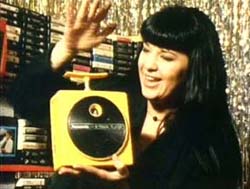 Too long by a tad, yet always amusing, So Wrong proves not having a budget is insignificant if your camera is aimed at real people with compelling stories to tell. The highest praise I can give it is it made me want to buy one those cool, highly coveted “space helmet” 8-track players — not to play anything; just for purposes of aesthetic display. —Rod Lott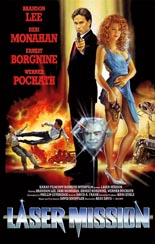
 Before hitting it big (and inadvertently buying the farm) with


 In the mighty tradition of Roger Corman’s
  Joining them in their sporadic deeds of derring-do is Fire (Michelle Hurd,
  As you have every right to expect, Justice League of America makes for a veritable two-course meal of corn and cheese. After ABC’s more-than-decent