
Just as Hellhole is not your average women-in-prison picture, the Ashland Sanitarium for Women is not your average nuthouse. It’s where Susan (Judy Landers, Stewardess School) is sent after her mother is murdered before her eyes and she suffers a head injury while escaping the killer’s nicotine-stained clutches. Susan awakens in the asylum with a classic case of amnesia, which is convenient for Landers, who always seems absent-minded in her roles. Bless her buxom heart, but she’s all puffy hair and vacant stare.
The reasons for her mom’s death? Purely unimportant, other than to keep Susan in peril even within the institution’s walls, because the killer (Ray Sharkey, Scenes from the Class Struggle in Beverly Hills) disguises himself as an orderly in hopes of finding her alone so he can finish the job; if he happens to bangs a nurse and/or resident along the way, so be it. Ironically, all the Ashland patients are endangered, because within the bowels of the place, the evil Dr. Fletcher (Mary Woronov, Eating Raoul) and Dr. Dane (Marjoe Gortner, Starcrash) conduct their experimental research toward creating the world’s first chemical lobotomy. Any patient who misbehaves unwittingly serves as a guinea pig.
To paraphrase Spinal Tap’s “Hell Hole,” the window’s dirty, the mattress stinks, the floor is filthy, the walls are thin, the nudity is plentiful. Per the WIP template, toplessness is a must of its caged coquettes, yet Savannah Smiles (!) director Pierre De Moro throws bottomlessness in there, too, to give his flick a bonus layer of ’80s sleaze. More than eager to please in the bared-breast department is Edy Williams (Russ Meyer’s Beyond the Valley of the Dolls), delivering her lines in a breathy, cue-cardy voice that makes everything sound suggestive, down to an offer of sharing soap: “Use mine. It’s hypoallergenic.” Despite her efforts to steal the show, that honor is taken by Sharkey as Silk, the chain-smoking heavy in black leather who looks like he arrived from a failed audition for Can’t Stop the Music. To continue that analogy, Nancy Walker’s loss is De Moro’s gain. —Rod Lott
Curiously, two new books are about the idiosyncratic and ill-mannered German cult actor Klaus Kinski. The one to get is Klaus Kinski, Beast of Cinema: Critical Essays and Fellow Filmmaker Interviews, edited by Matthew Edwards and including the perspectives and talents of several others. (It takes a village, people!) Edwards — whose excellent 2007 collection, Film Out of Bounds, also was published by McFarland & Company — separates the book into thematic thirds: essays, interviews and reviews. In doing so, he and his contributors approach their subject from a variety of angles and points of accessibility. Covering everything from his iconic collaborations with Werner Herzog to his late-in-life residency in B-moviehell, the essay portion finds Beast of Cinema at its most buttoned-up, whereas the book loosens up considerably for Edwards’ Q&As with those who worked with Kinski and lived to tell about it — most notably, Schizoid director David Paulsen and actress Flo Lawrence, both rife with tales of the actor’s bad behavior, physical and sexual. By the time Beast hits the section of approximately 50 reviews, it has its shirt unbuttoned and feet on the table. Pour yourself two fingers of your hard liquor of choice and peruse the reviews, heavy on spaghetti Westerns, sexploitation, spy adventures and scary fare — unsurprisingly the reason I’ll return to this text in years to come.
Having written the history of American International Pictures in 1984’s Fast and Furious, it makes sense the ridiculously knowledgeable Mark Thomas McGee would be the one to write Katzman, Nicholson, Corman: Shaping Hollywood’s Future. Available from BearManor Media, the book spotlights the careers of “three pioneers in bargain basement entertainment,” primarily in the 1950s: producer Sam Katzman, AIP co-founder James Nicholson and multihyphenate content machine Roger Corman. Rather than tie them together in one narrative — which would make sense, given their crossed paths — he handles each man separately. In his usual easygoing style, McGee is less interested in sharing their stories than he is leaping from one anecdote to another, not always stopping to ensure transitions for smooth sail-through. The result is highly conversational, as if you’re seated at the corner of a bar with the author, but he’s a good drink or two ahead of you, so forgive him if and when he rambles. While I would have preferred a tighter-told work — or at least one with consistency in presentation among its thirds — fans of the AIP era should find enough behind-the-scenes nuggets to chew on, not to mention capsule reviews of select films and a smattering of photographs. KNC is not bad, but it’s not essential, either.
Few things have influenced the horror film more than the Grand Guignol, aka that theater in France in which characters were rather graphically tortured and killed onstage; it’s not uncommon to see “Grand Guignol” used as a descriptive adjective in film criticism today. Short of catching some brave local theater troupe in your area staging a tribute show, Mel Gordon’s Theatre of Fear and Horror: The Grisly Spectacle of the Grand Guignol of Paris, 1897-1962 is as close as we can get to experiencing this late, great art form. (And having sat through one of those tribute shows, I much prefer this book.) Gordon quickly but satisfyingly dispenses with the origins and history of the place so he can dig into the real meat of the piece: single-paragraph descriptions of 100 Grand Guignol classics, supplemented with a more-than-generous helping of photos, playbills and revealed tricks. Originally published in 1988, this expanded edition from Feral House arrives with an additional script (“Orgy in the Lighthouse”) and, in the trade paperback’s center, 14 color pages, all but the last of which reproduces the original illustrated posters, both lavish and ghoulish. Thriving on visual stimulation throughout, the volume is a gorgeous package of garish content. Following Sin-a-Rama: Sleaze Sex Paperbacks and It’s a Man’s World: Men’s Adventure Magazines, Feral House continues to knock these new-and-improved reissues out of the park.
The genre of the giallo is so voluminous by now, it is all too easy to fire off a bad book in search of a quick buck. Mind you, Michael Sevastakis’ Giallo Cinema and Its Folktale Roots: A Critical Study of 10 Films, 1962-1987 is not that book. (This is.) With each chapter devoted to a particular film, the McFarland book makes the case for the giallo’s artistic merit — an idea most mainstream critics scoff at once the blood runs running. Rather than focus on the usual suspects (in titles and directors), Sevastakis spreads the wealth, with no filmmaker repped more than once; while the names you expect are indeed here (Dario Argento, Mario Bava, Lucio Fulci, etc.), the work chosen for each is not necessarily the anticipated default selection — for instance, Umberto Lenzi is featured by neither Eyeball nor Spasmo, but Seven Blood-Stained Orchids — and damn, does the author break it all down with aplomb. His discussion is detailed, insightful and intelligent — perhaps a deeper dive than you’d like for leisurely reading, but hey, it backs up his point that there’s much more to these films than meets the (gouged) eye. —Rod Lott
So deep is my love for 1982’s Creepshow that, although I already had paid $20 for a brand-new VHS of it back in the day, I happily parted with a similar amount once the George A. Romero film debuted on DVD. Only one problem existed with that disc, as well as the eventual Blu-ray: It was bare-bones, featuring a trailer and nothing else. (Chapter selections and interactive menus do not count, Warner Bros.)
In the category of Better Late Than Never comes Michael Felsher’s Just Desserts: The Making of Creepshow, a feature-length documentary previously available only in the UK. Remarkably, it’s worth the decadelong wait. Even if Stephen King declined to participate, Romero is all aboard, as are FX wizard Tom Savini, actress Adrienne Barbeau, actor Tom Atkins, comic artist Bernie Wrightson — hell, even that noted ray of sunshine Ed Harris! (And yes, thank the Lord, he does discuss his improvised disco-dancing skills.)
No stranger to the world of documentaries for genre pictures, Red Shirt Pictures head Felsher doesn’t waste time with reiterating EC Comics history lessons, because, really, if you do not already possess at least a primer-level understanding of the once-controversial Tales from the Crypt and its companiontitles, would Just Desserts even be up your alley? Topics of relevant discussion instead include Romero’s approach to coaxing King in his first acting role, how they faked Ted Danson’s drowning and the in-camera methods used to give Creepshow its unique, comic-book look. Best of all, however, are the anecdotes — and they number many — surrounding the challenges of cockroach wrangling … and the unavoidable mishaps.
The highest praise one can give such a thorough behind-the-scenes undertaking is that he or she could have sat through another half-hour or more. With Just Desserts, the Creepshow superfan in me says, “Duh, you lunkhead.” —Rod Lott
In the village of Edo, a corrupt businessman conspires with the local magistrate to tear down its shrine and tenement house, in order to make way for a brothel.
The word “brothel” aside, you don’t give a flip about any of that, do you? I get it. Because the title of the Japanese film is Yokai Monsters: 100 Monsters, by Buddha, you want monsters! And monsters you certainly get in this decidedly bonkers, bizarro fantasy from the Daimajin creative team of director Kimiyoshi Yasuda and writer Tetsurô Yoshida.
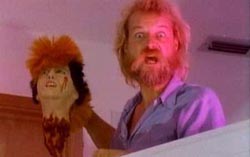
The flick’s structure allows for a mix of monster stories within the story and eventually full immersion of said monsters into our main plot of political machinations. (Uh-oh, did your interest begin to wane again with that phrase? Brothel! Brothel!) No matter the level of narrative Inception, way is made for many supernatural freaks to hit the screen, including a hairy cyclops, a snake-necked woman, a squatty midget caveman, a giant hag face in the sky, a featureless face on some guy and, perhaps most WTFy of all, a one-eyed umbrella creature that hops around on its lone leg and unfurls a tongue of a length that would provoke jealousy in Gene Simmons.
True to the title, dozens more monsters exist. Wonderfully surreal even by today’s seen-it-all standards, the folktale as cautionary tale was followed by two more Yokai Monsters pictures: Spook Warfare later in ’68 and Along with Ghosts the next year. Both play as 100 Monsters does: as if the classic 1964 omnibus Kwaidan had been remade by Sid and Marty Krofft. —Rod Lott
If horror masters from Edgar Allan Poe to Stephen King have taught us anything, it is this: Cats are no damn good. A compelling piece of supporting evidence is The Uncanny, a feline-themed triptych from Milton Subotsky, a producer who specialized in the horror anthology (with 1972’s Tales from the Crypt being perhaps the most enduring example).
In present-day Montreal, fidgety author Wilbur Grey (Peter Cushing, The House That Dripped Blood) shares the details of his latest book to his publisher (Ray Milland, Terror in the Wax Museum), who expresses misgivings about its commercial prospects — after all, who would believe that adorable kitty cats are actually vessels of unbridled evil? In an attempt to change his host’s tune, the pussyphobic Grey shares three such cases, all helmed by Naked Massacre’s Denis Héroux, in his final film as director.
First up, in pre-WWI London, a miserable crone (Joan Greenwood, 1961’s Mysterious Island) excludes her ungrateful cad of a nephew (Simon Williams, The Fiendish Plot of Dr. Fu Manchu) from her new will, instead leaving the entirety of her estate to her cats. Electrified with a nasty wit, this segment entrances viewers, thus positioning The Uncanny from the start as a veritable buffet of horror and suspense.
Unfortunately, it’s all downhill from there. In 1970s Quebec, the middle story about a tween girl (Chloe Franks, Whoever Slew Auntie Roo?) being mean to her little sister (Katrina Holden, Death Wish 4: The Crackdown) is a patience-trier further hampered by the goofiest of effects. Slightly better is the trio’s closer, set in Hollywood’s Golden Age, with cats causing chaos on the set of a motion picture starring Valentine De’ath (Donald Pleasence, The Monster Club) and his lover (a slinky Samantha Eggar, Curtains). It ends with a joke that also appears to be its raison d’etre, as if screenwriter Michel Parry (Xtro) started there and worked backward. —Rod Lott