All posts by Rod Lott

Fire (1977)

Producer Irwin Allen kept his once-Towering cinematic credibility in flames with Fire, a virtual remake of his previous year’s telepic Flood — just with another basic concept from your high school chemistry class (or a then-rather popular 1970s R&B-funk band).

The real-life town of Silverton, Oregon, comes under siege from a massive blaze sparked by the cigarette butt carelessly discarded by a greasy convict (Neville Brand, Psychic Killer) doing chain-gang cleanup work in the forest. In the line of fire — literally! — are such soaped-up characters as a widowed lodge owner (Vera Miles, The Spirit Is Willing), the well-below-her-league old man who has tried to get into her pants for decades (Ernest Borgnine, The Poseidon Adventure), and a teacher (Donna Mills, who clenched a bigger role two years later in Hanging by a Thread, another Allen tele-epic) on a field trip with her young charges.

And speaking of Hanging by a Thread, Patty Duke again assumes the role of an unhappy wife, here married — for the moment, at least — to a fellow doctor (Alex Cord, Chosen Survivors). Perhaps their love will be, um, reignited? Dur.

An Allen touchstone, the well-stocked cast is fun to watch, including Erik Estrada (Airport 1975) as a prisoner who uses the smoke as convenient cover for an escape. Director Earl Bellamy (Walking Tall Part II) puts Estrada front-and-center as much as he can, assumedly realizing the soon-to-be-CHiPs star’s chiseled good looks are Fire’s most special of effects. It’s certainly not the lazy stock footage of terrified townspeople — some in horn-rimmed glasses, to show just how mismatched the material is. —Rod Lott

Get it at Amazon.

Blair Witch (2016)

Welcome back to Burkittsville, Maryland! And this time, we really mean it!

Sixteen years after the misbegotten Book of Shadows: Blair Witch 2 retroactively decimated moviegoing America’s collective enthusiasm for 1999’s revolutionary and wildly influential The Blair Witch Project, Lionsgate finally sought to right the franchise ship with a long-overdue threequel bearing the plain-Jane, abbreviated title of Blair Witch.

Perhaps the wait was too long overdue, as the film proved unable to live up to the studio’s hopes. Whatever the reason, its being seen as a failure is a shame, because despite that unimaginative title, Blair Witch is a damn fine horror film that continues to surprise and subvert.

Believing that his older sister, Heather (the original film’s iconic snot-dripping female lead), still may be alive, young paramedic James (James Allen McCune, Snitch) dares to venture deep into Black Hills Forest where she disappeared. Among those accompanying him are his kinda-sorta-maybe girlfriend (Callie Hernandez, Machete Kills), who is shooting the excursion for her college documentary class. In a broad sense, you know where this is going, but the how is more of a question mark.

Continuing to work in tandem after successful at-bats with You’re Next and The Guest, director Adam Wingard and writer Simon Barrett face having to meet the expectations of viewers who want to see a continuation of the story and further exploration into the mythology, but also something they haven’t seen before. To achieve that balance is precarious, yet somehow, Wingard and Barrett manage, starting with a way to utilize the found-footage conceit in a different manner.

That said, their style is not for everyone. Although perfectly accessible, it is too experimental and trope-tripping to be branded with certainty as mainstream-friendly; therefore, if their previous collaborations were not made from the recipes you desired, then Blair Witch is apt to not be the trilogy capper for which you’ve waited so long. It wasn’t what I had been anticipating; it was far better. —Rod Lott

Get it at Amazon.

Mars in the Movies: A History

With movies, as with potential mates, everyone has a type toward which he or she instinctively gravitates. For me, it’s heists or spiders. For Thomas Kent Miller, it’s that angry red planet — a lifelong fascination that culminates in the publication of the book Mars in the Movies: A History.

Released by McFarland & Company, the trade paperback surveys nearly 100 Mars flicks, roughly from the 1910 Thomas Edison silent short A Trip to Mars to 2015’s blockbuster The Martian. With the latter making a mint and taking seven Oscar nominations, you’d think Miller would find Ridley Scott’s populist smash to be a source of unending joy. Instead, he had “zero emotional response to the film. When I should have felt elated, I felt nothing.” And that call-’em-as-I-see-’em approach is all part of the book’s hours of fun.

Miller discusses each movie (and the occasional television miniseries), dividing them up among several themed sections: everything pre-Destination Moon, voyages to Mars, invasions from Mars, life on Mars, War of the Worlds adaptations and sequels, comedies, spoofs and, finally, the handful of post-Martian projects. The aforementioned Destination Moon, a 1950 George Pal production, earns its own chapter because the author places it on a pedestal of influence, arguing that only Star Wars and 2001: A Space Odyssey have affected and altered the science-fiction genre as much.

Whether you share that opinion, Miller makes quite the case for it. Throughout the book, readers will notice how he holds these movies accountable for their science. This makes sense since he used to work for NASA, which sometimes, he fully acknowledges, puts him at odds with the mainstream view — most notably in the cases of The Martian and 2005’s War of the Worlds, the Steven Spielberg/Tom Cruise pairing he finds to be such “an onslaught of negative energy” that he is “astonished” it found such critical and commercial favor. Again, reading him getting so worked up only contributes to the enjoyment.

And Mars in the Movies, despite the sourness I’ve highlighted, is enjoyable — even greatly so. I don’t wish to give the impression that reading the book is akin to watching the old man across the street screaming at kids to get off his lawn. From the Flash Gordon serials to Disney’s epic John Carter flop, from the beloved to the obscure, Miller holds great love for the genre and many of the films featured. If there was not already a book on this subject, there needed to be one. Miller has written it — and the definitive one at that … even if his take on 1962’s Battle Beyond the Sun may be the only I’ve ever read that failed to mention how Francis Ford Coppola’s inserted monsters look like a penis and a vagina. —Rod Lott

Get it at Amazon.

Reading Material: Short Ends 1/6/17

Now adults, the children of the 1980s clearly are nostalgic, judging from this past fall’s glut of books on that era’s teen movie. Hadley Freeman’s Life Moves Pretty Fast came first, followed closely by Kevin Smokler’s travel-leaning Brat Pack America. Now, journalist Jason Diamond joins the fray with Searching for John Hughes: Or Everything I Thought I Needed to Know About Life I Learned from Watching ’80s Movies, but stands out as unique because it’s a memoir. Hoo-boy, is it ever. As a Chicagoan, Diamond felt a particular kinship to Hughes’ movies — Sixteen Candles; Ferris Bueller’s Day Off; Planes, Trains & Automobiles; Home Alone, et al. — which tended to take place there, albeit in the fictional suburbia of Shermer, so the miserable barista longing to be a professional writer embarked on a biography of the iconic filmmaker. Instead, as we witness, the project morphed into this memoir of the author’s own terrible childhood and arguably even worse teenage years, during which Hughes’ CV offered a recurring temporary escape. The end result is raw, real, gut-wrenching and, like Hughes’ work, worthy of resonating with an entire generation. Oh, if only they read more than 140 characters!

With Applause’s paperback release of Film Noir Compendium: Key Selections from the Film Noir Reader Series, newcomers to the dynamic duo of cinematic historians Alain Silver and James Ursini can get a taste of the goods without having to wonder which prior volume to purchase or whether to buy them all. (You may find yourself doing the latter if you enjoy this lovingly oversized presentation, overflowing with hundreds of stills.) Compendium culls some 30 articles from 20 years worth of contents — all with an academic bent, but not to a point of inaccessibility. Standouts include Ursini’s visual breakdown of the Mike Hammer classic Kiss Me Deadly; Todd Ericsson’s 1990 examination of noir’s then-resurrection as a genre (e.g., Dennis Hopper’s The Hot Spot, Michael Mann’s Thief and William Friedkin’s To Live and Die in L.A.); and Paul Schrader’s well-informed “notes on film noir,” which is the equivalent of a master class — no surprise to readers of the Taxi Driver scribe’s Film Comment pieces, past or present. The book’s layout could stand a sharper design, but the words are what really matter here — especially when you have Stephen Farber putting “the bitch goddess” under a microscope.

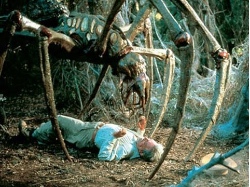
Which horror films feature the most of Mr. Mephistopheles? Which horror soundtracks are the scariest? Who draws horror comics best? The answers to these and many other superlative-determining questions await in The Thrill of Repulsion: Excursions into Horror Culture. For the Schiffer-pubbed hardcover, Horror News Network contributor William Burns presents nearly two dozen essays on terror-related topics primarily concerning movies, but also not ignoring TV, music and books (comics included). Nearly all of the chapters are presented in the ever-popular list format, each cleverly and consistently going to 13, rather than the standard, ho-hum 10. I was unfamiliar with Burns’ name or work, so I don’t know how much critical credibility he brings to the project, but he obviously is well-versed in cinema that goes bump in the night. I especially enjoyed his countdown of horror films “That Deserve Better,” because his selections prove him right, from The Boy Who Cried Werewolf to the top-slotted The Spider Labyrinth. —Rod Lott

Get them at Amazon.

The Silence of the Tomb (1972)

No tombs exist in Jess Franco’s The Silence of the Tomb, but that omission is all fine and dandy, considering the cult-fave filmmaker does include something he often neglects: a plot. Bonus: It’s a lucid one at that!

A supposedly fabulous (and definitely fatuous) actress, Annette (Glenda Allen, Franco’s Dolls for Sale) invites all her superficial friends for a wine-and-dine weekend on the island she has purchased with her wealth and now calls home. Well, it’s home when she’s not on set or jet-setting the globe. Her bastard child with film director Jean-Paul (Francisco Acosta, Franco’s Kiss Me Killer) lives there, but is raised by Annette’s extremely jealous sister, Valerie (Montserrat Prous, Franco’s The Sinister Eyes of Dr. Orloff), who serves as our unreliable narrator.

Collective weekend plans of fun in the sun (and sack) go awry when the child disappears from his bedroom, with a ransom note demanding 2 million pesos left in his place. Given the heavy privacy of and limited access to the island, the culprit must be among the 10 or so people sleeping under Annette’s roof — perhaps even Annette herself. But who? And why?

And then the murders begin.

In setting up Silence, writer/director/producer Franco uses Agatha Christie’s iconic And Then There Were None as his jumping-off point, but then veers wildly to give the whodunit his own stamp. The Franco faithful know that typically entails a streak of sexual perversity — just not in this instance. Nor is that cause for alarm, because while The Silence of the Tomb is colorfully accessible to mainstream audiences, this mystery is by no means conventional. From the leisurely score to breathtaking scenery (courtesy of Spain and the striking Prous), enough era-emblematic elements are present for the project to be unmistakably Franco’s, even if he kept it in his pants, so to speak, and even though the story originated in a novel by Enrique Jarnes. Franco changed the book where it counted, primarily to turn the reveal and subsequent explanation into something so ludicrous, we happily can attribute it only to Mr. Vampyros Lesbos himself. Well played, Jesús. —Rod Lott

Get it at Dorado Films.