All posts by Rod Lott

The McPherson Tape (1989)

One of the earliest found-footage movies, if not the earliest, Dean Alioto’s no-budget The McPherson Tape purports to document one family’s encounter with extraterrestrials on an evening in the fall of 1983. Despite the title, this clan’s surname isn’t McPherson, but Van Heese. The night that changes their life happens to coincide with their celebration of a girl’s fifth birthday, thereby accounting for the constant use of the video camera.

The Tape’s strongest suit is that the cast members interact like a real family would at a paper-plate supper — gentle ribbing, overlapping conversations and all. Other than the two brothers — our ostensible leads — we witness more normal human behavior than we do acting. But — and this is rhetorical — how exciting is watching normal human behavior?

After that interminable dinner, unusual lights through the windows prompt the brothers to wander through the woods to see what’s what. From a distance, they spot a couple of alien life forms stepping off a landed spacecraft, or, in the words of one of the Van Heese boys, “a Martian or shit or somethin’!” Rightly fearing for their lives, they hightail it back to the house … until they decide to go back outside again. Among a power failure and the siblings hauling a dead alien inside (without affording us a glimpse), the family plays Go Fish and the matriarch voices her desire to watch Johnny Carson.

And so it goes (and goes and goes and …) until the literal last shot, when something interesting finally happens, giving us our first good look at the space invaders. It’s a letdown, however, because it’s nothing you can’t see answering the door every Oct. 31. An anal probe would elicit more emotion. In 1998, for Dick Clark Productions and the late, not-so-great UPN network, Alioto remade The McPherson Tape as Alien Abduction: Incident in Lake County with less believability, but more tension and action, not to mention actual characters named McPherson. —Rod Lott

Get it at Amazon.

The Killer Is One of Thirteen (1973)

Two years after her spouse’s suspicious death, Lisa Mandel (Patty Shepard, My Dear Killer) invites a dozen friends and family members to spend the weekend at her spacious country estate. As only happens in the movies, no one’s calendar holds a conflict, so everybody shows up. Why has she gathered them? To find out which one of them murdered her husband! What’s on the menu? Exposition!

In classic Agatha Christie fashion, every guest has a motive; Lisa simply needs time on her dime to suss out the culprit among the parlor of suspects. Also in classic Agatha Christie fashion, that task becomes markedly easier as they begin dying — but not until after the one-hour mark, oddly enough. You could call this Spanish-language film And Then There Were Ninguna. Croquet is played; “elegant gigolos” are discussed; affairs are consummated; allegations are hurled. Eventually, one of them sticks.

Featuring Paul Naschy in a small role as part of Mrs. Mandel’s help, The Killer Is One of Thirteen comes from Javier Aguirre in the same productive year he and Naschy collaborated on Count Dracula’s Great Love and Hunchback of the Morgue. Although by no means a bust, this project is the least of the three, with Aguirre unable to crack the code of how to handle such an expansive cast; we get to know only a few characters — and barely at that, with the possible exception of Shepard’s widow — while others don’t even register from scene to scene. The film is no great mystery, but we’ll call it good enough. —Rod Lott

Dance Macabre (1992)

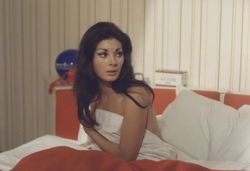
Behind the camera of Dance Macabre stands a trifecta of 20th-century cinematic cheese in director Greydon Clark and producers Menahem Golan and Harry Alan Towers, so it’s a shame this Russia-lensed terror tale is more Limburger than Parmesan.

In what originally was intended as a sequel to his 1989 turn as The Phantom of the Opera, Robert Englund stars as Anthony Wager, famed choreographer of the fabled Madame Gordenko’s ballet academy. For the school’s inaugural class of students from outside the Iron Curtain, rebellious American teen Jessica (Michelle Zeitlin) is enrolled, to whom Anthony takes a great liking because she resembles his late, beloved Svetlana. As for Madame Gordenko, well, she’s bound to a wheelchair and (apparently) sunglasses, and speaks using a throat harmonica.

To the surprise of no one, Anthony’s rising interest in Jessica is inversely proportional to the school’s student population — why, it’s almost as if someone is trying to eliminate the competition so she can cop the top spot by default! Also to the surprise of no one, those kills come rather rote and unimaginative — something one can’t say about the dialogue, which is so bewildering it sounds like Clark had his script translated into Russian, then translated back into English and shot that version; to wit, “Do you want to get wet with me? Do you like bubbles?”

Do you like Dario Argento’s Suspiria? Because in setting and premise, but nothing else, Dance Macabre is indebted to that horror classic — and I mean a lot, as in the-mob-will-come-to-break-your-legs a lot. In something of a cosmic interest payment, Clark presages an element of Luca Guadagnino’s Suspiria remake by — spoiler alert, although it should be evident from the trailer — having Englund bend gender to also play Gordenko. While the makeup is unconvincing, it adds a touch of the perverse to a dull film lacking originality and energy. —Rod Lott

Get it at Amazon.

Fantasy Island (2020)

A TV mainstay of the 1970s, Fantasy Island ran for seven seasons successfully by adhering to a four-step formula, sprinkled liberally with Ricardo Montalban as suave resort host Mr. Roarke:
1. Guests fly to the titular isle.
2. Guests experience their fantasy.
3. Guests learn a lesson.
4. Guests depart the island.

Jeff Wadlow’s film version of Fantasy Island does the same, yet can’t succesfully make it through less than two hours. The concept’s second step is so malleable and ripe with possibilities that it would be difficult to botch, yet the Blumhouse production does just that. It isn’t the incompetent train wreck its savage reviews may suggest; it’s just boring, which is arguably worse.

In for Montalban is End of Watch’s Michael Peña as Roarke. Among his weekend guests are a sandblasted Lucy Hale (reteaming with Wadlow from Blumhouse’s Truth or Dare), out for revenge; Priest’s Maggie Q, out for love; Swallow’s Austin Stowell, out for closure; and brothers Ryan Hansen (Central Intelligence) and Jimmy O. Yang (Patriots Day), out to get laid. Other than keep these subplots on separate tracks as the TV show, anthology-style, Wadlow attempts to unify them into one big plot weighed down with rules and mythology no one wants or needs explained.

The problem in doing so is that each begins with distinct elements, from torture porn to raunchy comedy to family drama, then all shoved under the veneer of the supernatural. And since no subplot works on its own, they underwhelm even more in tandem. As a mor(t)ality tale, Fantasy Island throws viewers a lot of things that sound inviting — duplicitous duplicates, sea snakes, Charlotte McKinney’s bouncing breasts — but add nothing to its spooky stew of emptiness. I wish I had seen it in theaters, if only to witness audience members’ reaction to the last shot’s “reveal”; I suspect they groaned, and they had every right. —Rod Lott

Get it at Amazon.

Stay Tuned for Terror (1965)

From Emilio Vieyra, director of The Curious Dr. Humpp, comes the arguably more bizarre Argentinian tale Stay Tuned for Terror, aka Strange Invasion, in which an entire town’s television sets suddenly go on the fritz. It all happens in Clearview — subtle, Señor Vieyra — where every channel of every TV starts broadcasting only a ’round-the-clock hypnotic pattern of waves, baffling authorities.

This is immediately met with the urgency of government response, shouting over the phone, screeching brakes, nosy reporters and fully suited men problem-solving in a board room as if this were Apollo 13 and not just housewives crying in vain, “Gimme my stories!”

Because children have no taste and will watch anything, Clearview’s kids remain transfixed by the signal, which renders them glassy-eyed and cataleptic — basically, the most emotionless kids this side of Midwich. Remove them from their perch in front of the tube and they fall ill and throw tantrums, much like today’s tots when the Wi-Fi signal goes down. As doctors and other experts theorize the signal’s origin and purpose, prepare to hear “diathermic” so often, you could make a drinking game out of it.

Unlike its cathode-ray threat, Stay Tuned for Terror is harmless speculative fiction, more fun in concept than in execution. Written by Philip Kearney and Les Rendelstein, the duo behind Paul Bartel’s wonderfully warped Private Parts, the pic grows as repetitive as the Liberty Mutual jingle, but at 71 minutes, is mercifully brief. The message is perfectly simple; the meaning is clear: TV is a drug, so please, for the love of God and country, patronize the cinema. —Rod Lott

Get it at dvdrparty.