What do you get when you cross schizophrenic singer Wesley Willis with an attack Schnauzer with an overflowing toilet with a white-trash pool party with a Jim Varney mask with dinner-roll shenanigans with a portly Boy Scout with a deep hole with a female ventriloquist with egg tricks with a remote-control biplane with a Pride parade with a baby-shower smoke break with a confident squirrel with a Pee-wee Herman doll with gratuitous carrot-eating with golfers in drag with a disembodied deer’s head with a testicle festival with low-calorie horseradish with 50-year-old tits with Howard Frum with a baby who totally sucks at swimming?
You get America’s Runniest Home Videos, a 20-minute mixtape of rapid-fire camcorder found footage from VHS tapes several dozen families will soon regret accidentally donating to Goodwill — all from the fine folks at the finer Strange Tapes zine. —Rod Lott
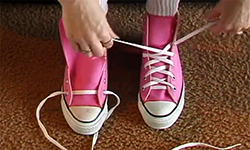
If nothing else — and that’s indeed the case — shot-on-video titan J.R. Bookwalter’s production of Chickboxer resolves a question that has baffled mankind for decades: “How long is too long to lace a pair of shoes?” The answer, per the activity sloooooowly happening underneath the insufferable opening credits, is 4.5 minutes. Now you know.
In a needless fourth-wall demolition that’s like the Cryptkeeper in a Dress Barn sweater, a sour lemon wedge named Kathy (one-and-doner Julie Suscinski) intros her own small-town story and promises a real doozy: “You can keep your Knots Landing!” And in hindsight, you really should, because compared to this, the infamous High Kicks is Crouching Tiger, Hidden Dragon.
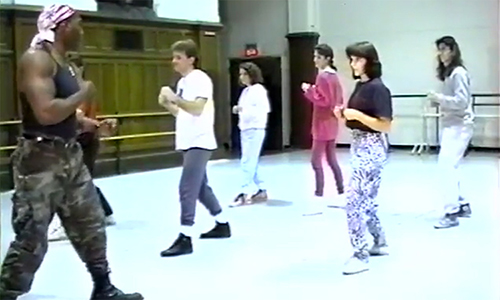
A good-girl student at an Ohio high school of maybe four or five people, Kathy enrolls in a $41 karate class after hearing about the video store’s recent stickup, in which Bookwalter cameos as the unfortunate clerk. Her tight-ass mother (Barbara Katz-Norrod, an on-the-reg Bookwalter player) is aghast at her daughter’s decision: “They karate people in there!” Uh, hardly. In a class of six, Kathy proves a natural in (this movie’s idea of) martial arts, despite participating in a Hard Rock Cafe sweatshirt — Chicago, in case you were wondering.
Meanwhile, the robbers (Maximum Impact’s Ken Jarosz and Ozone’s Tom Hoover) are actually full-blown criminals who blackmail Mayor Cornblatt (one-timer Dennis K. Murphy) into picking up a suitcase filled with $5 million in cocaine. In an imperfect storm of clubfooted plotting, their felonious follies tie into the disappearance of Kathy’s karate classmate (Melanie Todd, Robot Ninja) and the accidental overhearing of nefarious plans by Kathy’s effeminate BMOC crush (James L. Edwards, Her Name Was Christa).
Luckily, Kathy has the solution: Only Chickboxer can help!
Oh, looks like I failed to mention Chickboxer, the TV show within the movie. It’s Kathy’s fave; she’s obsessed with it to an unhealthy degree. So she calls Chickboxer actress Greta Holtz (scream queen Michelle Bauer, Sorority Babes in the Slimeball Bowl-O-Rama, showing her comedic chops in the movie’s best scene and showing her other attributes on its cover art). Now, if Kathy isn’t supposed to be touched in the head, I’d like to know what frequent Bookwalter collaborator Scott P. Plummer, in his directorial debut and death, was thinking. Someone made a choice and committed to it; whether said someone told anyone else remains a mystery. (What’s not a mystery is why so many characters wear shirts emblazoned with the logos of various Bookwalter titles.)
With Greta too busy trying to keep her breasts contained within her skimpy outfit, it’s up to Kathy to become, in her own words, “a superhero.” Although her karate experience amounts to one class — and her kickboxing experience unquestionably nil — she nonetheless chickboxes murderous adults twice her size into submission. The end.
Shoelacing included, all this occurs within a pat 61 minutes. Also crammed into that hour is an unrelated coda with a fully nude Bauer — but not as Greta — in bed, grinding on some dude’s crotch as guest director David DeCoteau (who footed Chickboxer’s $2,500 budget) can be heard telling her to cover the lucky guy’s penis. She must not have heard — and DeCoteau must not have wanted to purchase another blank Maxell — because the unit is unobstructed and, befitting of everything else in the movie, limp. —Rod Lott
For Murder Weapon, one of David DeCoteau’s first mainstream films after a half-decade in gay porn, the director goes incognito via his “Ellen Cabot” nom de plume. However, there’s no mistaking DeCoteau’s penny-stretching, runtime-padding work from the get-go: a superfluous 10-minute wordless prologue that at least establishes, re-establishes and establishes again one character’s fondness for rubbing and re-rubbing and rubbing again tanning lotion onto her big-haired, big-breasted self.
To celebrate their simultaneous release from a sanitarium, mafia princesses Amy (Karen Russell, Vice Academy) and BFF Dawn (Linnea Quigley, DeCoteau’s Sorority Babes in the Slimeball Bowl-O-Rama ) invite all their boyfriends — ex and current — over to their house. Except for the metal rocker (Mike Jacobs Jr., DeCoteau’s American Rampage), who looks like Jerry Seinfeld dressed as Mötley Crüe for Halloween, they appear entirely interchangeable. One of them (Allen First, also American Rampage) has a shaving fetish and convinces Amy to let him Schick her legs while she sits on the toilet.
Then the guys start to get killed, in bursts of gore so unexpected that the first instance — sledgehammer, meet head — is bound to catch you off-guard, even though I just told you. That makes Murder Weapon unique among the DeCoteau oeuvre and, amazingly, the unpredictability doesn’t stop there. Now, that doesn’t mean he fails to deliver his usual completely gratuitous and entirely overlong softcore sex scenes; in fact, each starlet gets her turn, with Quigley’s being the most memorable. Russell may be more beautiful, but only Quigley gives a rousing round of what appears to be “seizure sex,” concluding with nipples so out-and-about, they look like pop-up turkey timers.
For virtually any other movie featuring a post-Carol Burnett Show Lyle Waggoner (Danger USA), mentioning Lyle Waggoner’s appearance would be among its 10 most odd elements. Not with Murder Weapon, so strange it almost approaches a surrealistic genius of happy accidents. Knowing what I know now, wondering what the flick would be stripped of all abnormalities is something I don’t want to consider. To borrow a quote from Amy, it “makes my tits shrink just thinking about it.” —Rod Lott
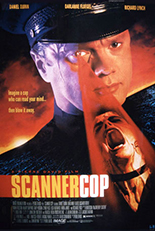
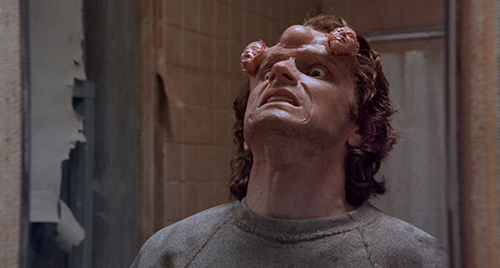
With Scanner Cop, we have one of the five greatest films about psychic powers due to an enlarged hypothalamus. Essentially an unnumbered Scanners IV, its title character is wimpy Sam Staziak (Daniel Quinn, Spiders II: Breeding Ground), a second-generation scanner who becomes a cop after 15 years living under the adoptive, scannerless wing of an LAPD commander (Richard Grove, Army of Darkness). In order to keep his scannerbilities under control, Sam must take meds daily; otherwise, he could suffer wild and ultimately fatal hallucinations like baby-doll faces bursting through his forehead.
However, the rookie Sam is asked to forgo his pills to help Dad crack a string of murders, in which cops are killed by random citizens brainwashed to mistakenly see all officers as tarot-card corpses, giant insects and assorted pants-sharting whatnot. The madman behind this plot? Why, whomever perennial villain Richard Lynch (Invasion U.S.A.) is playing, of course! And this time, as Glock, he’s got a metal plate in his head — all to make his eventual defeat-by-a-scannin’-Sam scene about 10% more daunting, yet 100% more awesome.
For those who’ve never seen David Cronenberg’s original Scanners — or even just the instantly famous clip that launched a million playground conversations in 1981 — a scanner basically scrunches his face and looks at an enemy really, really hard until the foe seizes up and shakes uncontrollably to the point of an exploding noggin. With a violent mess of blood, bone and brain tissue, this is the money shot of the Scanners franchise; no sequel is complete without one, although Scanner Cop sure bides its time before getting around to a one-two punch.
With the series producer Pierre David taking the directorial reins here, he expands Cronenberg’s concept to more of a general telekinesis from the case file of Carrie White. Thus, Sam’s mind upskills to include piloting defibrillator pads to fly across the room, getting a stranger to hand over his car keys and, best of all, convincing a cafeteria patron to let Darlanne Fluegel (1988’s Freeway) call dibs on a slice of pie.
No powers are needed for you to enjoy Scanner Cop, about as unfussy and consistent as your Cinemax weekend premieres were in that glorious final stretch of time when that B-friendly movie channel meant something — right before the internet ruined everything. A near-end sequence in hell is a bit much, but at least it gives the movie an opportunity to turn the melon of Hilary Shepard (Turbo: A Power Rangers Movie) inside out and then some. —Rod Lott
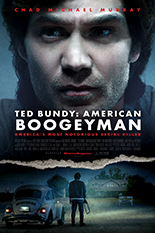
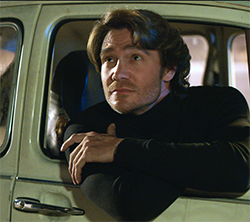
Between Mark Harmon and Zac Efron, what is it about playing Ted Bundy that causes pretty-boy actors to up their game? Whatever the answer, we’ll not be adding Chad Michael Murray (2005’s House of Wax remake) to that short list based upon his portrayal of the infamous serial killer in Ted Bundy: American Boogeyman, yet through no fault of his own.
Written and directed by Daniel Farrands (The Amityville Murders), American Boogeyman follows Bundy and his trusty VW Beetle through a four-year interstate murder spree, starting in 1974. Also following his exploits before they know his identity are FBI agent Robert Ressler and Seattle police detective Kathleen McChesney, respectively played by newcomer Jake Hays (son of Airplane!’s Robert) and Holland Roden (Escape Room: Tournament of Champions). The movie doesn’t do justice to either real-life authority figure, but especially McChesney, reduced to a cop-show cliché: “I’m going to get him … if it’s the last thing I do.”
The last third preps for a climactic sorority-house slaughter viewers know is forthcoming, even if they’re unfamiliar with the actual event at Florida State University, due to the multiple establishing shots of the Chi Omega house sign. Indicative of American Boogeyman’s production level, every scene is sparsely populated, no matter the location; even the Chi O home appears to have only half a dozen residents.
Farrands’ film is serviceable to a point: the point it’s clear the project is pure exploitation — somewhere around the pretentious, Dexter-stretching narration kicks in. American Boogeyman is interested only in depicting Bundy being Bundy, in essence becoming a greatest-kills reel of extraordinarily poor taste. It errs in not exploring its subject beyond a surface-level celebrity, perhaps wrongly assuming you have prior knowledge of his story.
With so many scenes that provoke titters instead of terror, it’s hard to believe the movie isn’t at least half a put-on. Fliers posted across the FSU campus read “HAVE YOU SEEN THIS MAN?” but instead of a police sketch of Bundy, the illustration is a pair of eyes behind your garden-variety ski mask. A feverish, seemingly meth-edited montage cuts between Bundy furiously masturbating and Bundy berating mannequins, ending with him awaking the next morning in a bed full of mannequin parts. Subtle! Creative choices such as those ensure Ted Bundy: American Boogeyman isn’t going to be — as a police sergeant shouts — just “another Zodiac hippie devil-worshipping Charles fucking Manson on our hands!” —Rod Lott


 What do you get when you cross schizophrenic singer Wesley Willis with an attack Schnauzer with an overflowing toilet with a white-trash pool party with a Jim Varney mask with dinner-roll shenanigans with a portly Boy Scout with a deep hole with a female ventriloquist with egg tricks with a remote-control biplane with a Pride parade with a baby-shower smoke break with a confident squirrel with a Pee-wee Herman doll with gratuitous carrot-eating with golfers in drag with a disembodied deer’s head with a testicle festival with low-calorie horseradish with 50-year-old tits with Howard Frum with a baby who totally sucks at swimming?





 Between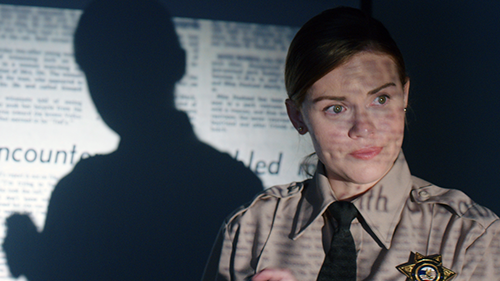
 Ironically, in failing to show a shred of Ted’s supposed charisma or give him a speck of humanity, it feels icky enough to be on his side, like how a