All posts by Rod Lott

The Oracle (1985)

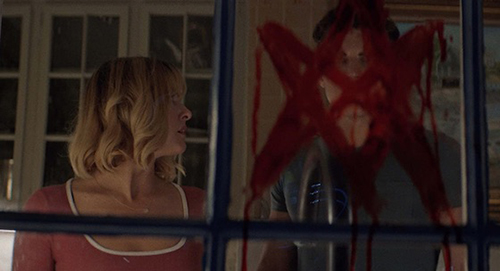
A year before Witchboard bewitched enough audiences to beget follow-ups and facsimiles, Roberta Findlay (Tenement) summoned similiar subject matter in The Oracle, but with nary a witch nor a board. Here, the evil antique in question appears to be the painted hand of a child mannequin clutching a calligraphy feather long enough to have been plucked from Captain Hook’s hat. Preloaded with ink, it scrawls simple messages from the beyond (e.g., “Help me” and “Nooo”) onto stationery. Its penmanship is ghastly.

When mousy housewife Jennifer (Caroline Capers Powers) finds it in the basement of her apartment building, the label on her overalls is practically her reaction: “OshKosh B’Gosh.” The kindly Italian maintenance man (Chris Maria De Koron, in full “I make-a the pizza!” mode) encourages her to keep it, not realizing it will ruin Christmas for her and her asshole husband (Scrambled Feet’s Roger Neil, who looks like an attempt to clone Tom Atkins at a Duane Reade photo counter).

After Jennifer communicates with the spirit world, results include a poltergeist tantrum, a runaway car, animalistic snarls in the elevator, claws emerging from the trash chute, things glowing Listerine-green — not coincidentally, all fit Findlay’s threadbare norm. That’s hardly a negative; rather, the in-camera action allows The Oracle to hit the sweet spot of ’80s indie horror, goofball faults and all.

Ending excepted, the money shot comes when a character stabs his own arms as he hallucinates them covered by tiny creatures — unmoving rubber things from a kid’s Fright Factory set (ages 8+, batteries not included). That Findlay puts more of her stamp on the single scene she could graft onto a porno — a hooker slaughtered by an androgynous killer (Pam La Testa, Findlay’s Blood Sisters) — says how little she cares for the horror genre. However, as framed by her XXX Liquid A$$ets collaborator R. Allen Leider, the story beams are just solid enough to overcome the director’s evident disdain.

For someone who never acted before or since, Powers brings what matters most: lungs. Has anyone ever screamed more on film? Hopefully a few of her cries were for a lozenge (“Riiiicolaaa!“), because they clearly weren’t asking for less dowdy dresses that didn’t look swiped from a community college production of Anne of Green Gables. —Rod Lott

Get it at Amazon.

That’s Adequate (1989)

Ever wanted to see Jerry Stiller and Anne Meara doing Anna Karenina? Don’t answer yet.

Actually, don’t answer at all, because That’s Adequate has just that — and more! — wanted or otherwise. File this project under “otherwise,” because it sat on the shelf for three years, which probably suited many of its cameo players just fine.

Having never quite conquered Hollywood, writer/director Harry Hurwitz (The Projectionist, Safari 3000) uses his penultimate film as a mockumentary to spoof the entire industry. With clips aplenty, penny-pinching producer Max Roebling (Scavenger Hunt’s James Coco, the Kmart Dom DeLuise) reminisces about the six-decade run of his fictional Adequate Pictures. In doing so, Hurwitz gives himself a chance to parody a slew of genres without committing to one.

This includes — take a deep breath — D.W. Griffith epics (but erotic), Shakespearean drama (performed in rabbit costumes) and medical dramas (with an accidental laugh track). The comedies of Charlie Chaplin (albeit one in which the Tramp-esque comic ate his pint-sized sidekick), the Marx Brothers (if they were rapey) and the Three Stooges (but with real-world consequences of violence). Plus African-American musicals, 1940s newsreels, Fleischer cartoons, goona-goona jungle adventures, John Wayne war pics, color-tinted serials, Hitchcockian thrillers, Cold War sci-fi, Star Wars and the follies-style films with a banjo player singing next to a dancing penis. (Those were a thing, right?)

Bits play quickly with jokes rapid-fire, but fast rarely equates to funny. Sometimes a segment feels double the length because not one line lands; ironically, these bits all feature big-name talent, from Bruce Willis and Robert Downey Jr. (presaging the Kid ’n Play hair) to yammering stand-up Richard Lewis as a yammering franchise character named Pimples.

Speaking of stand-up, a mystifying USA for Africa sendup assembles every other comedian of the late 1980s — Rick Overton, Ritch Shydner, Sinbad, Joe Alaskey, Robert Townsend, The Funny Boys — and not an off switch among them — which had to be an on-set nightmare. Don’t even get me started on dialogue built upon such bold concepts as “cut the cheese” and “feeling funny and tingly down by their pee-pees and poo-poos.”

Still, That’s Adequate contains a few inspired sketches, starting with a Western using the corpse of its deceased leading man for reshoots, à la Weekend at Bernie’s. Meanwhile, Young Adolf gives the future führer Hitler a George Washington-style biopic, right down to lying to his father about a chopped-down tree: “Father, I cannot tell a lie. The Jews did it.” Guilt-free hilarity arrives with an inspired montage of the movies of infant star Baby Elroy (“a has-been at 2″), lobbing grenades in Baby Elroy Goes to War and encountering a toddler Karloff in Baby Elroy Meets Baby Frankenstein.

Tony Randall hosts. Established filmmakers Martha Coolidge and Marshall Brickman appear as themselves, which may be the weirdest thing of all — and mind you, this is a movie in which The Partridge Family member Susan Dey goes down on a guy as she sings to him.

And that’s That’s Adequate. Only the Danny DeVito/Martin Lawrence vehicle What’s the Worst That Could Happen? bests it in the nonexistent race for the movie whose title best doubles as a review. —Rod Lott

Get it at Amazon.

Sorority Slaughter (1994)

Hey, everybody, it’s spring break! Never mind that we all look like we’re 30 and in vo-tech! Or that our old, gross neighbor lurking around the house in broad daylight is trying to kill us! Let’s party hearty! Woooooohoooooo!

There you have Sorority Slaughter in a nutshell (unsalted, mind you, due to budgetary constraints). It’s a relentlessly stupid, plotless exercise in misogyny, wicker furniture, wood paneling, shag carpeting, hairy arms, Korean deli-counter gore, American cellulite, acid-washed denim, pawed asses and lawn chairs for those asses. But mostly misogyny and wood paneling, given this is a shot-on-VHS production of the mail-order murder specialists of the New Jersey-based W.A.V.E. Productions.

I could and would forgive all that, except it’s so oppressively mundane. With W.A.V.E. impresario Gary Whitson ostensibly writing and directing, Sorority Slaughter stars stalwart Sal Longo as the neighbor who individually — and very, very slowly — sacrifices the cast members one by one to the devil himself. It also features more minutes of car washing than Car Wash, The Bikini Carwash Company and The Bikini Carwash Company 2 combined. (You know what? Imma throw Cool Hand Luke in there, too.)

Look for cameos from scream queen Titanic 2000’s Tina Krause, TV Guide and a shelf full of Reader’s Digest Condensed Books — or don’t look at all. That last option gets my highest recommendation. —Rod Lott

Get it at Amazon.

Hiruko the Goblin (1991)

After you’ve given world cinema a robotic penis drill, what’s left? For Shinya Tsukamoto, the answer had zip to do with terrifying genitalia and everything to do with spritzing neck stumps, poltergeist kitchenware and singing disembodied heads — among other, spindly legged things — in Hiruko the Goblin.

Based on a manga by Daijirô Morohoshi, Tsukamoto’s first post-Tetsuo: The Iron Man project concerns famous archeologist Hieda (Kenji Sawada, Samurai Reincarnation), grieving his wife’s accidental death. When a colleague contacts him with news of discovering an ancient burial tomb on the grounds of a school and said to appease evil spirits, Hieda suddenly regains purpose — not to mention a questionable slapsticky presence.

Needing the type of distraction only an invisible demon can provide, Hieda investigates with the chance assistance of the school custodian (Hideo Murota, Akira Kurosawa’s Kagemusha) and a student (Masaki Kudou, Tokyo Heaven). The teen knows a thing or two about curses, as his back occasionally smokes ’n’ sizzles — like a fresh package of Hormel Black Label bacon on an oily griddle, but with crispy faces emerging from the burnt meat.

Hiruko would be unmemorable if not for its creep du grace taking hold at halftime: human-headed spiders. Who cares if they’re a pair of legs short? Arachnophobes are guaranteed at least one serving of the heebie-jeebies as these unholy creatures skitter about, crawl up walls and — shudder — leap toward our heroes. All done with models, the spiders give Tsukamoto a stronger tool for conjuring horror than the film’s dull, drawn-out first block, which lifts the frantic-cartoon tricks from early Sam Raimi.

A senseless but gonzo adaptation (and/or approximation), Hirkuo the Goblin is reminiscent of Kiyoshi Kurosawa’s Sweet Home, with Tsukamoto having a slight edge in creativity and, of course, a surfeit of industrial steam-engine sounds. His movie feels like a dream, (in)complete with the gaps of logic that function as connective tissue, lending an additional layer of discomfort and otherworldliness. —Rod Lott

Get it at Amazon.

The Orchard End Murder (1981)

While young men play a cricket match, one team member plays with his girlfriend in an apple orchard directly across the street. After he’s called back to the field, Pauline (Tracy Hyde, Melody), bides her time wandering ’round the grounds.

A path takes her to a gnome-statued garden at a railhouse occupied by a pubic-bearded hunchback (Brazil’s Bill Wallis, almost too creepy) and a towering idiot (Clive Mantle, Alien 3), making for an even grimmer version of John Steinbeck’s Of Mice and Men. And if you want me to tell you about the rabbits, George, they’re as short-lived as the perilous Pauline.

At just under 50 minutes, The Orchard End Murder is a nasty little piece of work. The British picture heralds great promise for documentarian Christian Marnham in his fiction-film debut, particularly as a practitioner of crime and suspense, but to date, he’s made one lone feature: the 1988 rape-revenger Lethal Woman.

Too bad, because rare is the thriller whose suspense lever can be plotted like a diagonal line, rising in proportion with each passing minute toward a slow-burn end more satisfying than films twice its length. Designed to unsettle, hard to shake, The Orchard End Murder proves potent to the core. How ’bout them apples? —Rod Lott

Get it at Amazon.