
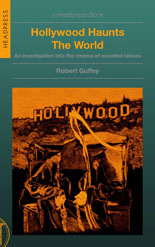

Line 1 of Robert Guffey’s latest, Hollywood Haunts The World: An Investigation into the Cinema of Occulted Taboos, reads: “The secret history of the world can be decoded through film.” Guffey makes good on that thesis across nine chapters (a third of which are new to this Headpress collection), fusing his interest in movies with that of conspiracies, to varying effect. On the plus side, he catalogues Twin Peaks’ extensive references to rocket scientist/occultist Jack Parsons, discusses the real-world government experiments informing such fictions (?) as The Manchurian Candidate, and posits the U.S. military supplied UFO secrets to the makers of The Man from Planet X and The Thing from Another World. You don’t even have to believe it to enjoy it. Elsewhere, a quasi-poem covering the whole of Invisible Ghost, a Bela Lugosi cheapie, baffles for five pages. A few rail-jumpers like that hamper an otherwise enjoyable trip from a tour guide likely (and proudly) on at least one agency watchlist.
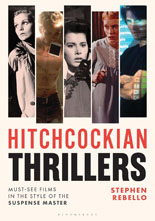
As readers of his classic making-of-Psycho book know, Stephen Rebello can write about an old movie like nobody’s business. What’s better than that? Him writing about 152 old movies! In particular, Hitchcockian Thrillers: Must-See Films in the Style of the Suspense Master. Pay no mind to the subtitle’s misnomer, as Rebello pans several entries, but as readers of his classic Bad Movies We Love book know, pleasure abounds regardless of the film at hand. This Bloomsbury hardback groups reviews by a dozen Hitch-ready themes (amnesia, voyeurism, doubles, etc.), IDs the MacGuffin of each and includes titles from the obvious to the obscure to the oddball. Rebello’s deep love for the medium (note the number of times he mentions the cinematographer) throbs on every page, as does his knack for turn of phrase (“a dozen other ‘You in danger, girl’ epics”). Pretty much essential.
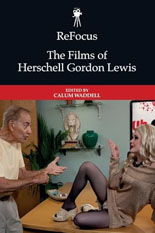
Edinburgh University Press’ ReFocus series has examined revered auteurs like William Wyler, Jane Campion, Robert Altman and now … H.G. Lewis?!? Yep! And ReFocus: The Films of Herschell Gordon Lewis is a splendid collection of essays on the Godfather of Gore. I was predisposed to Gary D. Rhodes’ chapter on Lewis’ work in Oklahoma (which our own book interviewed Lewis about), but who knew HGL’s Carving Magic industrial short could merit a fascinating piece on its own (courtesy Jack O’Dwyer)? That’s the type of expectation upender lurking within the contents. Another: Richard J. Hand’s history lesson on the HGL’s Blood Shed Theater, a Grand Guignol-style live venue in Chicago that sounds like a solid argument for time travel. From mannequin heads to chocolate milk, Kate Russell surveys the intentional comedy in Lewis’ post-Blood trilogy pictures, while editor Calum Waddell redeems Blood Feast’s Connie Mason and makes a convincing case for her Final Girl status. It’s refreshing to see Lewis taken seriously, even when he’s taken to task.
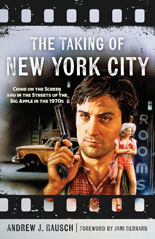
After watching Morgan Neville’s brilliant Netflix culture documentary, Breakdown: 1975, two thoughts tore circles through my brain: First, “I really need to see Executive Action and The Parallax View.” Second was, “Shit, I forgot to review Andrew J. Rausch’s The Taking of New York City: Crime on the Screen and in the Streets of the Big Apple in the 1970s.” (My apologies, Andy!) NYC may not have had the greatest of decades then, but those felonious activities and bankruptcy troubles informed some great cinema. And also not-great. You’ll find movies of both types covered, with each year’s crop of art prefaced by Rausch setting the historical stage so the reader has full context of the times, too; after all, the two are inexorably linked. The films you’d expect are here, of course, but so is forgotten fare like Super Cops, The First Deadly Sin and From Corleone to Brooklyn. Rausch’s exhaustive, scrutinize-all scope is the main reason to make room on your TBR pile.
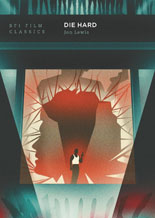
Nearly four summers ago, Jon Lewis knocked my Merino wool socks off with the excellent Road Trip to Nowhere: Hollywood Encounters with the Counterculture. Now, with his monogram of 1988’s Die Hard for the BFI Film Classics line, I was prepped to be blown through the theater’s back wall (to borrow the actioner’s marketing promise). I wasn’t. But don’t interpret that as time ill-spent. All in all, it’s yippee ki-okay. The initial section is more interested in global politics than I or the movie ever was; I more appreciated Lewis digging into the casting of Bruce Willis in the Schwarzenegger/Stallone era, then breaking down each and every “whammy” the movie delivers — all 17 of them, per a heretofore unknown-to-me theory of producer Joel Silver. In its closer, the slim volume considers the internet discourse on Die Hard’s merits as a Christmas movie.
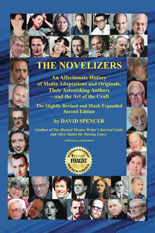
And finally, The Novelizers: An Affectionate History of Media Adaptations & Originals, Their Astonishing Authors — and the Art of the Craft: The Slightly Revised and Hugely Expanded Second Edition. Whew! This 644-page behemoth from David Spencer (and BearManor Media) boasts a cover as unappealing as its title is overlong, but also impressive breadth inside. The oft-derided (but not by me!) world of film and TV tie-in novelizations has one of its strongest defenders in Spencer. Whether you enjoy author interviews or author profiles, you’re in luck! That said, I was more drawn to the chapters that dive into the specialized, from tie-ins for Sherlock Holmes and British telly to the possibly counterintuitive novelizations of musicals — all illustrated in full color and detailed with full passion. —Rod Lott