

Having grown up sheltered and overprotected, I saw Tobe Hooper’s The Texas Chain Saw Massacre at the house of the kid across the street. Because his single mom let him rent any VHS he wanted. My junior-high self felt so dirty and so guilty, I never wanted to see it again. And didn’t, for decades.
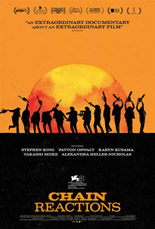
Turns out, the experience of losing my TCM virginity is hardly unique, bearing similarities to the guests discussing theirs in Alexandre O. Philippe’s Chain Reactions. As renegade filmmaker Takashi Miike recalls, “For the first time, I felt that movies could be something dangerous.” (Check.) Comedian Patton Oswalt remembers encountering stills in an issue of Fangoria: “These looked like crime scene photographs that had been stolen and then Xeroxed.” (Check.)
Told in five “chapters,” Chain Reactions is that type of documentary, asking you to commit to creatives waxing nostalgic for 15 minutes or so apiece. I gave myself over willingly and pleasurably.
Leave it to Oswalt to liken Hooper’s grimy, gutsy film to Terrence Malick, Stan Brakhage and Gone with the Wind, of all things. Later, Stephen King, in what plays like pages from his nonfiction classic Danse Macabre come to life, says Texas feels like a Cormac McCarthy novel. Film critic Alexandra Heller-Nicholas remarks that Leatherface “moves like Buster Keaton,” while director Karyn Kusama (XX) proclaims, “It has poetry, beauty.”
They’re all correct, and Philippe keeps up with them, slicing in not only glimpses from the scenes in question, but skillful, side-by-side juxtaposition to influences both concrete and fanciful. Past Philippe documentaries on terror benchmarks include Memory: The Origins of Alien and the wonderful 78/52: Hitchcock’s Shower Scene, yet Chain Reactions is my favorite of his works so far — and I don’t adore TCM like I do the source material of those studies.
Perhaps it helps not to have a space in your heart carved for the work of art; the distance and difference of perspective just might cause you to view it in a new light — human mask of skin blessedly optional. —Rod Lott