
Evil Dead Rise (2023)

Evil Dead Rise reminds us that when it comes to today’s popular horror flicks, fuck them kids.

Failing to follow up on 2013’s re-imagining before now was a cinematic sin. Directed by Lee Cronin (The Hole in the Ground), Rise is a welcome resurrection of the blood-soaked franchise. But a smooth 97-minute runtime, hilariously gory sequences and delightful new Deadites make this return well worth the decade-long wait.

After a few zoomers get scalped, dismembered and read some of Emily Brontë’s Wuthering Heights, the film rewinds a day prior to introduce Beth (Lily Sullivan, 2017’s Jungle). The career roadie takes a break from her band’s tour on account of her unexpected pregnancy. Meanwhile, Beth’s sister, Ellie (Alyssa Sutherland, Blood Vessel), struggles with an abrupt separation while raising three kids.
An awkward reunion at Ellie’s apartment is cut short by an earthquake. The high-rise complex’s parking lot splits open, revealing a vault of religious artifacts — including everyone’s favorite flesh-bound tome. Ellie’s son (Morgan Davies, TV’s The Girlfriend Experience) naturally opens the book. One vinyl recording of a curious priest reciting the magical words later, it’s off to the Deadite Derby.

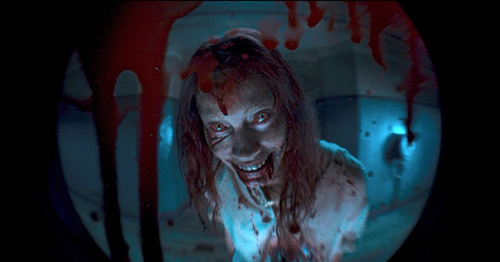
As the first possessed, Ellie takes the lead as the most fucked-up Evil Dead villain yet. (Linda’s a close second; Evil Ash never stood a chance.) Sutherland’s performance is as mesmerizing as it is maniacal. Her zombified zingers are a welcome return to the series’ marquee campiness, even though 2013’s entry was still stellar without it. Murder Mommy takes the depravity a step further as she tortures and even tattoos her children.
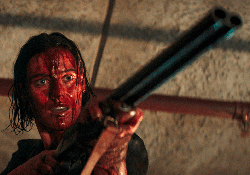
Most of the sequences capture the franchise’s frenetic pace despite the new setting. In lieu of a fruit cellar, Ellie spends a chunk of the film stalking the hallway outside her apartment. The unit door’s peephole sets the stage for a vivid bloodbath that makes the most of the movie’s limited budget. Continually, Evil Dead Rise delivers frights that far outclass movies like It Chapter Two, which had over four times the financial backing.

It’s rare that this film stumbles. The final act is just a little too bloated with callbacks — a group recital of “dead by dawn” is more than enough. Perhaps more egregious is when it diffuses its own dread. A portion of the recording reiterating all of the ways one can’t kill a Deadite is almost immediately followed by several scenes of — you guessed it — doing all of the things that definitely don’t kill Deadites. Though Cronin was likely shooting for comedy with a heaping helping of despair, a slight swap of scenes could’ve given the terror that much more bite.

Ultimately, Evil Dead Rise delivers exactly what the franchise’s faithful could hope for. Those unfamiliar with the Book of the Dead will painfully laugh and piss themselves all the same. Even the most reluctant viewer will spend a weeks trying to get the phrase “titty-sucking parasites” out of their head.

Please excuse me — I gotta go call my mom. —Daniel Bokemper

Get it at Amazon.

Beau Is Afraid (2023)

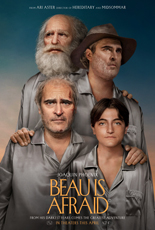
Beau Is Afraid isn’t somber, subtle or suspenseful. Nor should it be. Described by director Ari Aster (Hereditary) as a “nightmare comedy,” Beau is a bizarre odyssey through a twisted, unempathetic world. It’s also Aster’s most intimate and possibly important film to date.

Joaquin Phoenix (Joker) stars as Beau, a neurotic man living in an apartment on the corner of John Waters’ Desperate Living and John Carpenter’s Escape from New York. While leaving his apartment to visit his mom, Beau immediately loses his keys, luggage and sanity.

Describing much more of the film’s premise will almost certainly diffuse the magic. Instead, enjoy this sequence of events from 10 minutes of the film’s first act:
• A naked Beau rolls around with a sweaty man hiding above his bathtub.
• Beau is then hit by a truck and stabbed multiple times by an equally naked homeless man.
• A recovering Beau heals in the bright pink bedroom of a homophobic slur spewing teenaged girl who gives Sadie Sink’s character in The Whale a run for her money.

Beau’s life isn’t a comedy of errors; it’s a hilarious tragedy of worst-case scenarios. The punchline is often cruelty, and Aster’s sick sense of humor often lands with a few especially fucked-up exceptions.

Phoenix carries this three-hour I Think You Should Leave sketch masterfully. He dusts off a bit of the old Freddie Quell for a paradoxically rigid and explosive performance. Doubt, caution and, of course, fear complement the tortured traveler. Beau’s reluctant journey proves there’s no place like home — even when it’s hell.

Beyond the plot’s absurdity, Fiona Crombie’s (The Favourite) production design oozes with detail. Consider Beau’s setting an upgrade from the vivid (albeit rarely seen) interiors of Aster’s Midsommar (minus the runes in favor of misspelled expletives and graffitied dicks, naturally). The film flows into cookie-cutter suburbia, a beautifully animated dream within a dream and, finally, Beau’s mother’s house. Each transition is jarring in all the right places.

Despite being played for excruciatingly painful laughs, Beau also doesn’t shed the pit-in-your-stomach feeling that gave Hereditary its staying power. Even while the film’s universe is built on a general apathy around death, it carries an impact that builds to a dreadful crescendo. Granted, by the end, what few demises remain feel a bit weightless. But that probably comes less so from Aster’s writing of any one scene, and more from the exhaustion of a saga that’s about 15 to 20 minutes too long.

It’ll be years — possibly decades — before folks stop chewing on Beau Is Afraid. It’s everything you could expect from Aster, yet still filled with welcome (and sadistic) surprises. Beau is ultimately a lot of things. “Afraid” barely scratches the surface. —Daniel Bokemper

Opens in theaters Friday.

Man-Thing (2005)

In a gator-infested swamp town (played by Australia), the main employer is a greedy oil corporation drilling on Native American-owned land. According to tribal legend, a swamp monster — a Man-Thing, if you will — comes to life for vengeance on the honkies. And hey, whaddaya know, the myth is true!

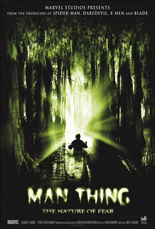
Played by 7-foot wrestler Conan Stevens, Man-Thing isn’t shown much until the film’s final quarter, when he’s revealed to look like an upside-down stalk of broccoli with glowing red eyes and ever-flowing tendrils. In the Marvel comic book on which this ecological terror tale is based, the character was more akin to DC’s Swamp Thing: a kindly creature with a human conscience. Here, he’s simply a peakaboo monster — window dressing for the sole purpose of bloodletting. More thought went into how to animate him than what to have him do. No wonder this one skipped theaters.

But Man-Thing’s biggest problem is it’s just a snore, mate. Director Brett Leonard (The Lawnmower Man) gives the flick a slick look, but the script by Hans Rodionoff (Deep Blue Sea 2) gives him so little to work with. This is ironic, considering Rodionoff turned in terrific work with Man-Thing: Whatever Knows Fear …, a then-recent comic miniseries that serves as this movie’s prequel (and its superior).

At one point, a wise, old Native America — you know he’s wise because he draws things with his finger in a pile of sugar — tells the sheriff (Matthew Le Nevez, 2005’s Feed), “Maybe he’s in the swamp. Maybe the swamp’s in him.” This totally reminded me of Wes Studi’s “until you learn to master your rage, your rage will become your master” aphorisms from Mystery Men. This fleeting realization gave me more pleasure than the giant-sized painful entirety of Man-Thing. —Rod Lott

Get it at Amazon.

To Catch a Killer (2023)

Auld acquaintance should be forgotten, not sniped. Someone in Baltimore failed to get the message, killing 29 celebrants on New Year’s Eve from a downtown perch several stories up. As soon as the authorities determine where, the place explodes, leaving no DNA for them to trace.
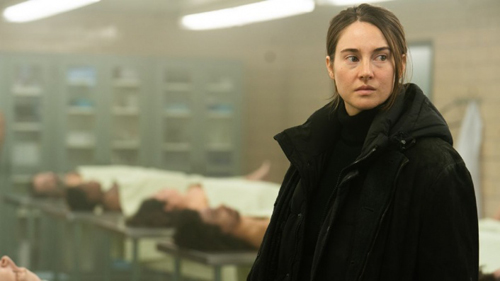
What’s an FBI chief investigator to do? If you’re Agent Lammarck (Ben Mendelsohn, Ready Player One), you recruit beat cop Eleanor Falco (Shailene Woodley, the Divergent trilogy), because you sense the destructive force within her. Whereas the killer turns the harmful urge against others, she turns it against herself (i.e., she’s a cutter); therefore, she’s exactly who he needs.

To Catch a Killer, Wednesdays this fall on NBC.

Kidding about the TV part, although — generic James Patterson-esque title and everything — To Catch a Killer is the definition of crime procedural as comfort-food viewing. A couple of factors elevate it above network-tube fare. For one, Mendelsohn. Always fantastic, he’s a pleasure not only to watch, but to hear; his voice betters the material, as does the hands-and-fingers acting on display here — magnetic once you notice.

I run hot and cold on Woodley, but she’s fine as what is essentially a more paternally influenced take on Jodie Foster’s iconic role in The Silence of the Lambs. Woodley’s pairing with Mendlesohn is like Clarice Starling had spent hours with Agent Jack Crawford instead of Dr. Hannibal Lecter.

The movie’s other pinch of je ne sais quoi is Damián Szifron, the Argentinian director of 2014’s sharp, acidic anthology, Wild Tales, rightly Oscar-nominated for Best Foreign Language Film. His camera is fluid and adept at zeroing in on unusual angles; showdown sequences in a mall and a drugstore ring with discomforting tension and demonstrate an impeccable control of timing. That’s why it’s so disheartening to watch Szifron give the eventually discovered killer the opportunity to deliver the de rigueur speech on Why He Is Who He Is.

Oddly, To Catch a Killer represents Szifron’s first gig since Wild Tales — an alarming, near-decade gap! How he went from something so unhinged to something that could end with Dick Wolf’s production company logo (not to mention a three-hour programming block along its spin-off series, To Catch a Killer: Seattle and To Catch a Killer: Behavioral Science Unit) is an even greater mystery than this one poses. Unlike Killer’s, it remains unsolved. —Rod Lott

Get it at Amazon.

Blood Covered Chocolate (2022)

Recovering drug addict Massimo (Michael Klug, House of Black Wings) credits his girlfriend (Christine Nguyen) with his sobriety. They’re madly in love and destined for a wonderful life together … until the “millennial soy boy” (to quote his racist stepfather) gets bitten by a vampire, which fucks everything up.

Look, if Monte Light wants to call Blood Covered Chocolate an homage to the 1922 classic Nosferatu, he has every right. This is his movie, after all. But I found it to be original (or as original as one can get within the vampire genre) — very much its own thing, Lynchian light zaps excepted. Garlic, sunshine, crucifixes — all mean diddly squat in this overall impressive indie.

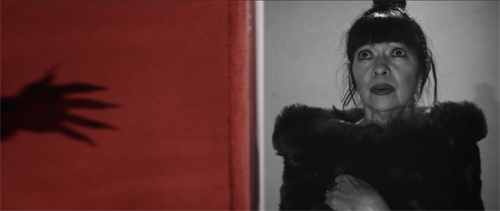
Doing a 180˚ from 2020’s Space, Light shoots Blood Covered Chocolate in crisp black and white, with the occasional nod to color in kaleidoscopic-pattern cutaways, Zoom calls, cartoon clips and tinted scenes. Most visually arresting among the latter floods the screen’s left side blood-red as a shadow of a vampiric hand (the most overt Nosferatu reference) slowly nears Massimo’s oblivious mother (Debra Lamb, Deathrow Gameshow), who’s standing in the frame’s grayscale right. In addition to flashing to public-domain works from Fritz Lang and Max Fleischer, Light cribs the iconic floating-head-and-spine monstrosity from the Indonesian oddity Mystics in Bali.

A staple of Fred Olen Ray and Jim Wynorksi erotic comedies (including the recent Bigfoot or Bust!), Nguyen uses her Blood Covered role to her advantage, proving she can act. She still has to take her clothes off, but for once, that’s secondary. I wish Klug were as skilled, but I found his affectations in timing and delivery awkward. Luckily, this flick flows fast, like a bladder draining a liter of water. Balls are required to begin your closing credits with the words “YOU HAVE JUST EXPERIENCED” filling the screen, but Light earns it. —Rod Lott

Get it at Amazon.

Random Genre & Cult Movie Reviews