
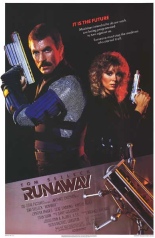
 Novelist Michael Crichton was famous for being somewhat obsessive about the subjects that caught his fancy, often studying them until he could be considered almost an expert in the field. Sadly, the 17 years he devoted to researching the art of filmmaking weren’t quite as fruitful. As a director, he never managed to be more than an undistinguished journeyman; as a screenwriter, he failed more often than he succeeded.
His sixth and penultimate film, Runaway, is a clear example of his cinematic limitations. Always more interested in the ideas presented in his work than the stories he was telling, his plots served as little more than perfunctory frameworks for specific concepts and set pieces. Because of this most of his films succeed as superficial entertainment, but don’t hold up to any kind of prolonged analysis.
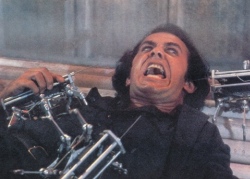 Set in an unspecified future where most menial tasks are now undertaken by non-anthropomorphic robots, Tom Selleck stars as the head of the local police force’s “runaway” squad, which is in charge of catching and stopping malfunctioning machines that pose a hazard to the public. When a robot murders three people, Selleck and his cute new partner, Cynthia Rhodes, uncover a plot by ruthless killer Gene Simmons to fuck everything that moves by selling a “smart bullet” capable of targeting an individual’s heat signature.
Caught up in this plot is a very hot pre-Cheers Kirstie Alley, Selleck’s young Flight of the Navigator son and a bunch of robot spiders that inject acid into their victim’s veins. Clearly in love with the film’s future-tech (most of which looks quite dated 26 years later), Crichton obviously wasn’t so enamored with his characters, none of whom are given any more depth than his robot creations.
Runaway has a few interesting moments and a good concept, but suffers from having been made by a man who was ultimately more interested in the idea of being a filmmaker than with filmmaking itself. —Allan Mott

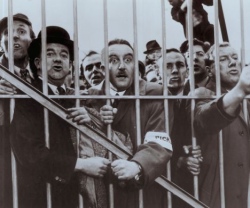 He gets a job as an efficiency expert working for his uncle whose company has landed a contract to build missiles for a Middle Eastern principality. Problem is, Uncle Bertie (Dennis Price) wants to lose the contract, which he underbid, so it will go to his nefarious pal Sidney De Vere Cox (Richard Attenborough), whose company will make a fortune to be split between the schemers.
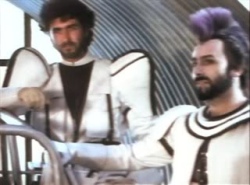 Stepping up to right wrongs and challenge the Templars is Scorpio, a disillusioned former member who looks like a hunky Peter Riegert. He’s joined by a vacant female love interest, a rock-slinging, tow-headed ugly kid and, best of all, crossbow-wielding Fred Williamson and his girly headband, rightfully playing a guy named Nadir.
 When I popped the
  Eventually, the demons appeared at the Halloween party and the characters grew less overtly hateful, and while I never actually found myself enjoying the film, it also never tortured me as much as the original. It is interesting to note that in the remake’s recreation of the infamous lipstick-in-the-tit scene, Diora Baird’s fake fake boobs look much more fake than Linnea Quigley’s original fake fake boobs, which suggests the art of fake-boob prosthesis is the one special effect that hasn’t advanced much in the intervening years.