
Indestructible Man (1956)

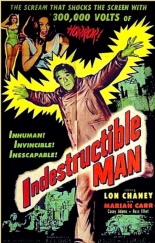
First of all, the Indestructible Man of the title is not indestructible. If that were the case, the movie would go on and on forever. And since he’s played by Lon Chaney Jr., I’m not all that sure he’s a man, either. But that aside, Chaney is “The Butcher,” a two-bit robber thrown in prison and sentenced to death after his accomplices double-cross him.

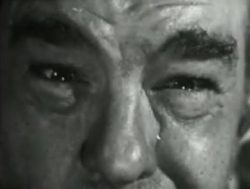
While attempting to cure cancer, a local scientist uses Chaney’s fried cadaver for research purposes, and accidentally revives him with 287,000 volts! Though the process has given him life and super-strength, it has burned out his vocal chords, thus playing to Lonny’s limitations for the remainder of the film. His acting from then on mostly consists of quivering his eyeballs in menacing close-ups.
The now-bullet-invulnerable Butcher’s order of business is to seek out and kill the men who put him in jail, but Chaney is such a sweaty, disheveled, lumbering ox that he looks like he’s constantly in search of a nice, quiet hole in which to take a grizzly-bear dump. Aiding the cops in their search for Mr. Indestructible is a voluptuous stripper (Marian Carr, Kiss Me Deadly), who toils at a burlesque house introduced with a quasi-disturbing establishing shot of a sign reading “TAQUITOS – CHILI SHOP.”

This nice-girl stripper tells the lead detective, “For the past six months, I’ve only known you as Lt. Chasen. Don’t you have a first name?”

“Uh-huh,” he says, pausing for sexual effect. “Dick.”

She smiles mischievously while rubbing a finger along her lips. Yowsa!

Eventually, The Butcher is turned into a bacon-faced meatball via flame-thrower. This death, like the movie, is fun and efficient — a pulpy crime tale with an outrageous sci-fi bent. Dig the incredibly chauvinist ending! —Rod Lott

Buy it at Amazon.

The Choppers (1961)

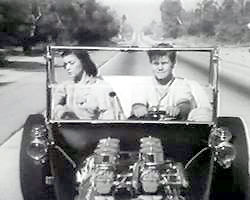
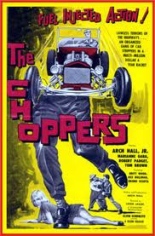
It may not be as priceless as Eegah!, but The Choppers is another unintentionally hilarious Arch Hall Jr. vehicle worthy of your time and derision.

The whiny Hall stars as “Cruiser,” a teenage punk with sculpted hair and a chassis fetish. He heads a JD gang known as “The Choppers,” whose other members are Torch, Snooper and Flip; all of them talk such thick lingo they should be carrying green cards. When they’re not hanging out at the Chick-A-Dilly, they’re hunched in a poultry truck, waiting for someone to run out of gas along a short stretch of highway, and then move in to strip — or “chop,” as the kids say — the car clean as the driver leaves to fetch fuel. (Apparently, this is an everyday occurrence.)

The Choppers then sell the parts to a fat salvage-yard owner named Moose, whose assistant is a senile fool named Cowboy, who often shoots toward the camera with his finger. If you hadn’t noticed by now, this is the kind of movie where no characters have real names.

The cops are on their trail, however, so for the big stakeout, they invite a local radio reporter to cover it as a live broadcast! It leads to a chase, a game of chicken and ultimately a junkyard shootout that looks choreographed by 8-year-olds.

If you think this story doesn’t allow time for Hall to bust out one of his ridiculous, self-penned songs on the guitar, you’re wrong! Just before the big climax, lil’ Arch takes some time out to sing “Monkey in My Hatband,” the first five lines of which go, “Come, baby / Come on, baby / Come on, baby / Come on, baby / Come on, baby.”

Yep, he wrote that all by his lonesome! —Rod Lott

Buy it at Amazon.

Shaolin Wooden Men (1976)

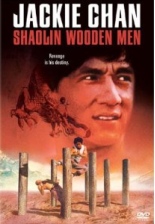
Certainly not the best of Jackie Chan’s string of Lo Wei films early in his career, Shaolin Wooden Men casts him as an orphaned mute and the least popular student at the Shaolin temple, where he can barely perform the most rudimentary tasks, like lugging huge buckets of water on his back up an ungodly amount of stairs.
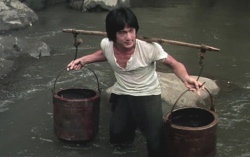
It isn’t until he secretly befriends the temple’s prisoner that he learns kung fu. The script doesn’t give him many chances to use it, with the notable exception being the film’s best scene, in which Jackie must face a gauntlet of 108 of the titular wooden men, which are like robots with cannonballs for fists.

If you’re surprised to discover the prisoner who schools Jackie in the way of the fist and the foot is the same guy who killed his father many years ago, you need to see more kung-fu movies. But Shaolin Wooden Men is not a recommended starting point. —Rod Lott

Buy it at Amazon.

End of Watch (2012)

Disclaimer: I don’t usually watch cop movies. I find them to be of one extreme or the other. Either the cops are portrayed as noble and by-the-book, even if it means the perpetrators are allowed to go free (which veers so far from reality that you may as well affix the “fantasy” label), or portrayed as so corrupt that the film descends into ridiculousness, like Training Day.

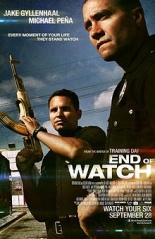
Speaking of Training Day, its screenwriter, David Ayer, is the writer and director of End of Watch, starring Jake Gyllenhaal (Donnie Darko) and Michael Peña (30 Minutes or Less) as two uniformed patrolmen in South Central L.A. The movies have several points in common: the street language, sudden eruption of gut-wrenching violence, and the portrayal of the police as modern-day cowboys attempting to tame an ever-increasing lawless territory.

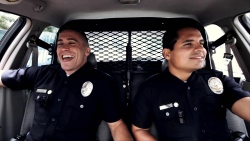
The heart of the film is the bromance between Gyllenhaal and Peña, partners who aggravate and pick on each other like brothers and, of course, love and trust each other unconditionally. Although the movie periodically strays from gritty realism into Hollywood hyperbole, the chemistry between the two leads sparkle. Both actors shine.

Unfortunately, much like Training Day, the movie lost me during its third act, when it trades realism for the needless and implausible plot development of a Mexican drug cartel putting a hit out on our street-cop protagonists. There are some jarring time jumps that may have you wondering if the story is unfolding in a matter of days, weeks or months. And can we retire the handheld camera mode of storytelling?

Some parts come perilously close to being a recruiting film for the police (much like Top Gun drummed up enlistees for the military), but don’t see it for that or the tacked-on violent climax. See it for the Gyllenhaal and Peña, and some scenes that will make you wish they had never stepped foot out of their squad car. —Slade Grayson

Buy it at Amazon.

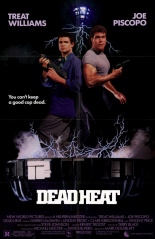
Dead Heat (1988)

Not to date myself, but I remember a time when Joe Piscopo told punch lines instead of being one. He was great on Saturday Night Live, very funny in Johnny Dangerously and surprisingly endearing in Brian De Palma’s criminally ignored comedy, Wise Guys.
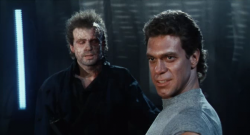
Dead Heat, however, provides ample evidence for the continued absence of Joe on the celebrity stage. If there is a prize for Comedian Who Should Be Least Allowed to Improvise One-Liners, Joe wins hands-down, besting even the immortally awful Pauly Shore. Every single line Piscopo grunts out falls to the ground and dies an ignoble death. As a cop who becomes a zombie, poor Treat Williams suffers death, rebirth and decomposition, but that’s nothing compared to having to smile at every ill-timed goddamned gag that slips out of the witless jokesack that is Piscopo. When Joe finally gets murdered, the feeling is not one of sadness, but utter relief.

The rest of Heat’s a mixed, low-rent bag. A routine tale of buddy zombie cops (seriously, why should that be routine?), it has some pleasingly goopy gore, wastes appearances by Darren McGavin and Vincent Price, and at least gave Williams a paycheck to feed him until Deep Rising.

Other than Piscopo, the main claim to fame for Heat is being written by Terry Black, brother of writer/director Shane Black (Kiss Kiss Bang Bang). On the spectrum of movie people with more talented siblings, Terry is far from a Tony Scott, Beau Bridges or even Eric Roberts. He’s not even a Charlie O’Connell.

No, Terry’s a Stephen Baldwin. I didn’t want to go there, as there are just some things you can’t take back, but Dead Heat forced me to. —Corey Redekop

Buy it at Amazon.

Random Genre & Cult Movie Reviews