1. El DeBarge, “Who’s Johnny (Short Circuit Theme)”
2. Rod Stewart, “Love Touch (Theme from Legal Eagles)”
—Rod Lott

1. El DeBarge, “Who’s Johnny (Short Circuit Theme)”
2. Rod Stewart, “Love Touch (Theme from Legal Eagles)”
—Rod Lott
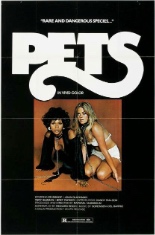
 Pets introduced audiences to not only one of the B-movie world’s most beautiful debutants, but also its eventual queen in Candice Rialson (billed here as “Candy”). In an approximate five-year stretch before choosing early retirement, the buxom blonde made a string of low-budget hits, most notably in three Roger Corman productions: Summer School Teachers, Candy Stripe Nurses and the self-aware sublimity that is Hollywood Boulevard. While not as well-remembered or -reviewed, Pets got there first, showing what the gorgeous, all-American girl could do with ease to a grimy, sugar-stained screen: light it up.
As with The Centerfold Girls the following year, Raphael Nussbaum’s Pets eschews the route of plot for an episodic structure of three stories; other than sort of ending without an ending, the only element they share is Rialson, front-and-center throughout as Bonnie. Even the last scene gives up on closure, asking, “THE END …?” as if Bonnie’s misadventures were ready to play out in a weekly prime-time slot. (We should be so lucky.)
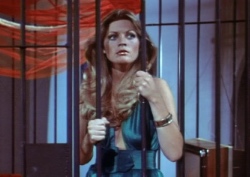 Having just fled her abusive brother (Mike Cartel, Runaway Nightmare), the presumably teenaged Bonnie meets Pat (Teri Guzman, Five Angry Women), an African-American woman who teaches her street-survival skills by making her an unwitting part of a kidnapping and robbery. Their target: a married man (Bret Parker, This Is a Hijack) all too willing to give them a ride, presumably in exchange for another.
Then Bonnie wanders from that bad situation into another, entering a live-in business-and-boudoir arrangement with Geraldine (Joan Blackman, Macon County Line), a lesbian painter whose jealousy flares brighter than the colors on her canvas. Finally, Bonnie accepts an invitation to hang out at the home of wealthy art patron Vincent Stackman (Ed Bishop, TV’s UFO), whose hidden basement doubles as a private zoo. This final segment lends Pets its title, as well as its meant-to-shock marketing depicting Guzman and Rialson chained at the neck — something that never occurs and primes the viewer for a bucket-brimming serving of vile, debasing pornography. This is not that movie …
… but it more than earns its R rating. Nussbaum (The Amorous Adventures of Don Quixote & Sancho Panza) clearly knew he was holding dynamite with Rialson carrying the picture, so the TNT is pushed into scenes of T&A often. This being her first speaking role, Rialson is not as comfortable and charismatic as she soon became, so she lets her pink blouse do much of the heavy lifting. Pets is just sleazy enough to placate drive-in crowds, yet smart enough to not let the sex and violence entirely drown out its message of — yep, believe it! — female empowerment and its questions of who’s possessing whom. —Rod Lott
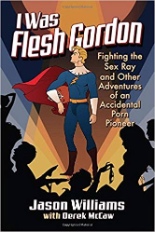 Even if you’re not a fan of the 1974 parody Flesh Gordon (and I’m not), the autobiography of leading man Jason Williams makes for an eye-opening read on the member-raising adult film industry. In I Was Flesh Gordon: Fighting the Sex Ray and Other Adventures of an Accidental Porn Pioneer, the all-American Williams (with an assist from blogger Derek McCaw) shares how he went from near-starving actor to the titular role in an instantly infamous, X-rated mainstream hit … and yet remained just outside Hollywood’s periphery. Just as intriguing as his on-set remembrances are his at-home ones, when he tiptoed around how much he should (or should not) tell his then-girlfriend about his workday — in particular, the scene in which he was mounted by a German stranger who guided him inside her when they could have gotten away with, y’know, acting. Published by McFarland & Company, the slim and breezy volume loses steam toward the end, because Williams’ follow-up film, the 1976 pornographic musical version of Alice in Wonderland, has neither the wealth of juicy stories nor the cultural impact of Flesh. It’s this summer’s bio you didn’t know you wanted to read!
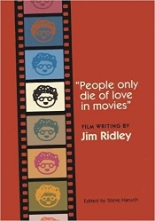 The only thing unsatisfying about People Only Die of Love in Movies: Film Writing by Jim Ridley is that the author isn’t around to see it. A longtime force of nature behind the influential alt-weekly Nashville Scene, Ridley was editor when he passed away unexpectedly in 2016; this Vanderbilt University Press hardback exists as a tribute and wasn’t in the planning stages during his lifetime, but it was bound to happen, posthumously or not, for one reason: The way he put words to page was — and is — the very definition of craft. For this collection, co-worker/close friend Steve Haruch assembled nearly 100 of Ridley’s reviews — a generously representative swath that includes a defense of Jackass, a pan of Schindler’s List and liner notes for the Criterion Collection’s release of The Umbrellas of Cherbourg. My favorite piece, however, isn’t a review at all, but a long-form look back at the making and legacy of Robert Altman’s Nashville on the eve of the divisive classic’s 20th anniversary that makes a revisit immediately tempting, even if you were lukewarm on the picture. That he could do the same for works on as wide a range as Howard Hawks and Rob Zombie is indicative of his immense gift.
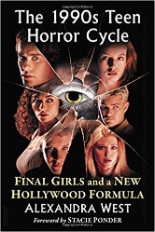 Two years after writing the très informative Films of the New French Extremity, Alexandra West looks closer to home with The 1990s Teen Horror Cycle: Final Girls and a New Hollywood Formula. Kicked off by the word-of-mouth phenomenon that was Wes Craven’s Scream, the dead-teenager subgenre that briefly flourished thereafter is a fascinating movement in modern pop culture, and certainly one worth studying. This McFarland release isn’t going to be the definitive word on the trend, but for now, it’s as close as we have. If you were sober through much of the Nineties, you can skip the history refresher of the introduction and somewhat redundant first two chapters, and delve right into the chronological countdown of carnage, from comedic flirtations with the genre (My Boyfriend’s Back) to the all-out spoofs (Scary Movie) and inevitable reboots (Scream 4). West demonstrates a firm grasp of the material and presents it across pages that flow with ease, no matter how many uses of “codified.” I just wish her attention to names were as mighty; in discussing Teaching Mrs. Tingle (likely in more depth than anyone on the planet), she double-mangles Jeffrey Tambor as “Jeffery Tambour,” while 40th POTUS Ronald Reagan is rendered throughout the book as “Regan,” no fewer than thrice. —Rod Lott

 Despite sharing a writer/director, several cast members and even the frickin’ typeface for the posters, Kevin S. Tenney’s Witchtrap is not a sequel to Kevin S. Tenney’s Witchboard, as the publicity took great pains to remind prospective viewers. Whatever its parentage, the name matters not/squat; Witchtrap is a fiendishly entertaining example of 1980s horror: not “good” enough for a theatrical run, but perfect for a weekend’s VHS rental (or Blu-ray purchase, as the case may be today).
Parapsychologist Dr. Agnes Goldberg (Witchboard alum Judy Tatum) scores a choice opportunity to test her ghost-vacuum theory (seriously) when she is hired by Devin Lauder (Tenney) to investigate strange goings-on at the mansion he’s inherited. The 19th-century Gothic abode is haunted by his multitasking Uncle Avery (Witchboard alum J.P. Luebsen), a psychic magician illusionist warlock. Devin would love to make bank renting the place out, but Avery’s ghost — and his accompanying “horrible, ungodly shrieks and moans” — scares people away and occasionally sends them to their death.
 Dr. Agnes recruits several teammates to assist, including physical medium Whitney (Kathleen Bailey, 1989’s Night Visitor) and acid-washed video technician Ginger (Linnea Quigley, Tenney’s Night of the Demons). As mandated by Devin, three security operatives tag along to provide protection — most notably the loudmouthed Vincente (Witchboard alum James W. Quinn, having an absolute ball, which sets the proper vibe for viewers). Vincente gets all the great lines, from “You. You are a real Neanderfuck, do you know that?” to “I always knew you were a scumbag, but I never knew how scummy a bag you could be!”
Security was a good call, what with the inverted cross and pentagram-emblazoned altar still assembled in the attic. However, they don’t exactly excel on the job, as team members expire in quick succession, each in a method wholly unique from the one before, but all accompanied by Whitney flailing about in a whip-my-hair combo of grand mal seizure and mind-blowing orgasm as her body channels Uncle Avery’s malevolent spirit; Bailey does an admirable best to sell this peculiar blend of gyrations, but Tenney needle-drops a theme of maddening bombast as if in doubt.
Whether his characters are done in by bullet, vehicle or showered, Tenney clearly relished staging every demise — the very reason films like Witchtrap exist, of course. (Also, now is as apt a time as any to say that Ghostvacuum would make a more fitting title.) The practical effects are standouts even at a cut-rate level, in particular a final scene that recalls Vincent Price’s candle impersonation at the end of Tales of Terror. As with Tenney’s other horror highs, Witchtrap plays like a plastic pumpkin overflowing with Halloween candy, with nary an apple or any other good-for-you alternative in sight. You’d have to be a Neanderfuck to think otherwise. —Rod Lott
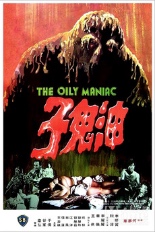 Based on a Malaysian tall tale, if the credits are to be believed, The Oily Maniac proves Hong Kong’s esteemed Shaw Brothers Ltd. studio didn’t just make historical epics about hitting and kicking. Once in a blue moon — 1976, to be exact — it made a movie about a meek handicapped lawyer by day, petroleum-based monster by night.
And just to make it crazy, part of it takes place at a coconut oil garden.
Danny Lee (Infra-Man himself!) is Ah Sheng Yung, the legal eagle confined to arm crutches and braces, thanks to a childhood bout with polio. He’s quite self-conscious about his disability, bleating “Why am I crippled? Why?” as he beats his useless legs with balled fists. Just as his Uncle Bah is about to be executed for murdering a guy in self-defense, Sheng learns some news about his late father, Bah’s bro:
• Papa was an exorcist and a shaman.
• He tattooed Bah’s back with a spell to protect the less fortunate.
• If the spell is used for other reasons, Bah warns, you die “in a very, very bad way.”
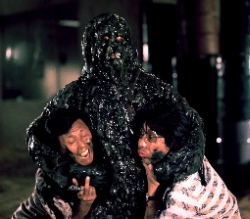 Naturally, Sheng traces Bah’s back on paper, goes home, digs a hole in the middle of the house, gets shirtless, lowers himself in, prays for peace and power, and — voilà! — transforms into The Oily Maniac. (Later switcheroos are brought about by dousing himself in diesel fuel straight from the gas-station pump and taking an impromptu bath in a barrel of tar at a construction site.) With superpowers not dissimilar to Swamp Thing, ol’ Oily looks like a bowel movement with yellow gumballs for eyes and a near-external heart that glows red as it beats. He can liquify into an animated blob — all the better to seep into cracks, slip under closed doors and glide across asphalt while chasing cars. He can regenerate body parts that get sliced off in the heat of battle. He can leap into the air with featherlight ease. And, like Hulk, when he turns back to Sheng, he always comes out of it with britches in place and intact.
Fighting injustice in its various forms, Oily’s first order of business is saving his disinterested love interest, Yue (Ping Chen, The Mighty Peking Man), from attempted rape. Director Meng Hua Ho (The Cave of Silken Web) seems to revel in the sexual ickiness, or if not, he sure amps it up as the film proceeds. Another target is a suspect doctor who specializes in vaginal rejuvenation for prostitutes; Oily drops in on the operating room in a manner eerily prescient of David Cronenberg’s The Fly interrupting his beloved’s abortion, stirrups and all. Outdoing that may be the scene in which a pop-music starlet complains about her botched boob job; as she says, “She screwed it up totally,” she opens her shirt to reveal one gnarly, swollen, purple teat with enough topographic texture to rival a 3-D map of the moon.
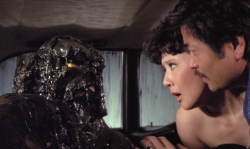 I’m not even sure why the movie features a courtroom scene of a Rashomon-esque rape trial, but it does, with the following exchange between perverted prosecutor and perjurious plaintiff:
“Did he touch your breasts?”
“He did.”
“Was it the right one? Or left?”
“Both sides.”
Anyhoo, Oily enters her bathtub through the faucet, inflates like a water balloon, and kills her, so I guess that’s why it’s there. Reason or no, the filmmakers must have been hitting the opium den pretty hard. As if the title didn’t scream as much, The Oily Maniac is so utterly insane, it comes bundled in its own straightjacket. If nothing else, you’ll love this psychedelic pile of comic-book pulp for that reason alone.
Oh, one more thing: If Troma co-founder Lloyd Kaufman didn’t see The Oily Maniac before creating The Toxic Avenger, then someone damn sure told him about it. The evidence is too messy to ignore, your honor. —Rod Lott