
Werewolf in a Girls’ Dormitory (1961)

The surprisingly Italian flick Werewolf in a Girls’ Dormitory — originally titled Lycanthropus — is nowhere near as exploitative as the American moniker sounds, but still has some solid scares and solid stares, mostly thanks to ingenue Barbara Lass as Priscilla.

As a handsome new science teacher arrives at a girls’ reform school somewhere in the hills of what I’m guessing is Italy, students are being slaughtered by the apparent wolves that roam the area after dark. As we soon learn, however, it’s a slightly hirsute werewolf that knows a sprightly form of proto-parkour, leaping tree-trunks in the wilderness.

But when Priscilla’s equally comely pal is murdered, she decides to get to the bottom of this mystery with the new teacher; the school’s caretaker, with his gimp arm, is nearly beaten up by drunken townspeople in a tavern for their troubles. Red herrings abound!

Typing all that out, it ultimately saddens me that this entire madcap premise wasn’t the basis for a novelty hit by a Bobby “Boris” Pickett rip-off — possibly Italian as well — that bubbled under the Hot 100 in the early ’60s. I think it would have gone something like this …

Priscilla was walking back to the dorm after class,
When she heard a howl that made her heart beat fast,
She investigated with the new science teacher,
And wondered aloud “Who is this groovy creature?”

It was a werewolf … ah-hooooo!
It was a werewolf … where can he be?
It was a werewolf … ah-hoooo!
It was a werewolf … in a girls’ dormitory!

Every few weeks when the moon would turn,
Pitchforks will rise and torches would burn,
The townsfolk would circle the old reformatory,
Just to capture the werewolf in the girls’ dormitory!

It was a werewolf … ah-hooooo!
It was a werewolf … where can he be?
It was a werewolf … ah-hoooo!
It was a werewolf … in a girls’ dormitory!

Could it be the caretaker who is nobody’s fool? (Wha-wah-oooh!)
Could it be the girl causing trouble in school? (Wha-wah-oooh!)
Could it be the old woman hiding in the woods? (Wha-wah-oooh!)
Or maybe the teacher, giving Priscilla the goods! (Whha-wha-ah-hoooo!)

It was a werewolf … ah-hooooo!
It was a werewolf … where can he be?
It was a werewolf … ah-hoooo!
It was a werewolf … in a girls’ dormitory!

Or maybe not. —Louis Fowler
Get it at Amazon.

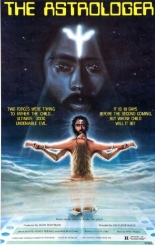
The Astrologer (1975)

Last weekend, while visiting my daughter at college, she asked if I had heard about the FBI study determining that the famous serial killers were all born under the zodiac signs of Sagittarius, Gemini or Virgo. I had to admit I had not … because, of course, it’s not true (God bless Snopes.com). Turns out, however, that’s more or less the concept at the core of The Astrologer, the ambitious, never ostentatious debut for filmmaker James Glickenhaus (The Exterminator).

Tuned to the frequency of The Final Conflict, the moody end-times piece operates on the idea that astrologer Alexei Abernal (Bob Byrd, meekness personified) has cracked the code of determining the “zodiacal potential” — better get comfy with hearing that phrase — of anyone in the world, simply by knowing one’s birthdate. This has enabled him to open the InterZod organization, secretly funded by the U.S. Department of Defense to keep tabs on burgeoning evil ’round the globe.

That task is extra-critical now that a mere 10 days remain before the second coming of Christ, and Sequel Jesus is in a real My Two Dads sitch, in that he could be fathered by one good dude or one bad mofo. Falling into the latter camp: Kajerste (Mark Buntzman, Posse), a mystic Indian with formidable beware-the-stare powers.

If you’re hoping all that starts to make sense at some point, stop. It doesn’t. And that’s A-OK because Glickenhaus, in adapting his father-in-law’s novel, has layered so much mindfuckery into the mix that the science — pseudo it may be (and, oh, do it be!) — need not hold up in court. Watchers of The Astrologer can make an educated guess as to the 23andMe paternal ID revealed in the final seconds, yet also have no clue of what’s coming in each scene before then. For what is essentially an airport paperback of a motion picture, that’s a laudable achievement.

Glickenhaus overcomes the limitations of a five-figure budget with the simplest of solutions; it’s amazing what a few computer blips and photo-negative transitions can do for bizarro ambience, not to mention a score by The Terminator composer Brad Fiedel and some truly unsettling edits by Victor Zimet (The Sex O’Clock News). Only Glickenhaus’ actors let him down; Byrd hatched no other credits, but as Alexei’s incelibate wife, Playboy centerfold Monica Tidwell (1979’s Nocturna) at least exudes a freckle-faced charm.

The Astrologer is not to be confused with another movie with the same name from the following year. The Astrologer is to be confused with Suicide Cult, an alternate, nonsensical title. The Astrologer also features a groovy fondue pot with real zodiacal potential. —Rod Lott

Get it at Amazon.

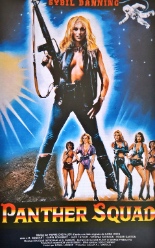
The Panther Squad (1984)

In this Belgian waffler, sex symbol Sybil Danning assembles a team of six tough ladies to help take out an eco-terrorist group. Together, they form … The Panther Squad! Individually, they have … no names — one of a bounty of cues director Pierre Chevalier (Orloff Against the Invisible Man) put less effort into the movie than it takes to watch it.
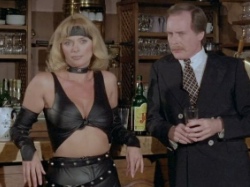
When the U.N.-esque New Organization of Nations (N.O.O.N., get it?) announces a move into space exploration, the aforementioned anti-pollution activists/signal jammers who brand themselves Clean Space kidnap an astronaut in protest, hoping to convince N.O.O.N. to put the kibosh on their star-trekking initiative. After many scenes of Important White Guys shop-talking the crisis over the phone, Ilona (Danning, Cuba Crossing) is called into duty to administer swift, sultry defeat.

Partial to root beer “on the rocks” and a curves-hugging, black leather getup not too far removed (wink) from Howling II, Danning’s ass-kicker takes down thugs in regular speed and slow motion. It’s a toss-up which more fails to hide her lack of combat skill. In a battle of cleavage, however, she wins hands down — here, take mine.

For supposedly crackerjack commandos, Ilona and her fellow Panthers travel not-so-inconspicuously in a Jeep painted in the bright, bold colors of Pan-African nations’ flags. The girls don’t exactly wear camo, either, opting for showy bikinis, halter tops, cutoff shorts and matching headbands. Chevalier and producer Jess Franco (X312 — Flight to Hell) don’t bother giving any a distinguishable trait — pointed out when this film’s Bosley, Jack Taylor (Wax), is introduced to the lineup and deigns to demean each lady with a spoofy Seven Dwarfs moniker. I would not be surprised if the (alleged) script by Georges Friedland (Moonwolf) refers to them as Chlamydia, Gonorrhea, Genitalium, Syphilis, Trichomoniasis and Papilloma.

As with the items on that list, The Panther Squad should be avoided at all costs. —Rod Lott

Get it at Amazon.

The Legend of Spider Forest (1971)

What has eight legs and a man shoving a lit Bunsen burner to his neck? The Legend of Spider Forest, far from legendary.

While staying at a pub in a supposedly quaint English village, ascot-rocking painter/photographer Paul (Simon Brent, Love Is a Splendid Illusion) runs across an unusual young woman walking carefree through the woods. Named Anna (Neda Arneric, Shaft in Africa), she says little, screws lots and is often nude — all the better to tease you with, what with her left shoulder’s distinctive spider-shaped birthmark.

Paul excepted, the men who make love to her don’t survive the encounter, thanks to her summoning into action the forest’s breed of spiders, both highly venomous and immune to chemicals. Wouldn’t the arachnids make an effective weapon for a resurgent Nazi party? Director Peter Sykes (Hammer’s To the Devil a Daughter) sure thinks so.

Or so one may assume, since he doesn’t do much with it — and what he does do is muddled to a point of incomprehension. This Eurohorror oddity will tangle viewers in a web not of intrigue, but internment. At least its tarantulas — underused, sadly — are real. —Rod Lott

Get it at Amazon.

The House That Jack Built (2018)

I had a short-lived friendship with a person who once, while drunk and on a bridge-burning rampage, told me they were a disciple of Lars von Trier and believed in his supposed theories of “absolute depravity.”

I hauled ass out of that person’s life not too soon after.

I feel like I made more than the right choice to vacate after viewing the film The House That Jack Built and, even more so, after the fact that von Trier cast Hollywood meathead Matt Dillon as an unrepentant serial killer. True to form, it’s a 152-minute movie with the doltish Dillon trying his best to act menacing, a seemingly impossible feat that I can’t tell if von Trier is genuinely exploiting or caustically insulting.

Told in six chapters labeled “incidents,” the killer career of Jack is followed, in a typically detached way that will cause the smarter people in the audience to smirk in unison, as women are brutally murdered, including a mother who watches him slaughter her two small children, and a verbally abused girlfriend who get her breasts sliced off and made into a purse in purely pornographic detail.

The film only becomes slightly interesting in the epilogue where Jack finds himself in the afterlife with the poet Virgil (Bruno Ganz), traveling through an eerily low-budget version of the circles of hell, leading to the only truly satisfying moment of the movie: his well-deserved casting off into the unholy flames.

The main problem with The House is that by now, the boundaries that von Trier has supposedly pushed over the past few decades have become more rote and routine than anything else; this serial killer sex fantasy has been done by better directors with a far more meaningful takes on the subject matter rather than the angry middle-schooler scribbling that, per von Trier’s own words, “life is evil and soulless.”

I hate to say it, but, like I outgrew my former friend’s notable antics, I think I might have outgrown von Trier’s insignificant shock value as well. Is that maturity? —Louis Fowler

Get it at Amazon.

Random Genre & Cult Movie Reviews