
Category Archives: Sci-Fi & Fantasy

Phantasm: Ravager (2016)

By this time in the franchise’s history, Phantasm fans are either still all about that silver ball, happy to team up with ice cream man Reggie as he blasts his way through ghouls, or have given up their fear of the sphere a long time ago, tired of chasing down the Tall Man via numerous nonsensical sequels that seem to go nowhere.

Starting way back in 1977 or so, the hallucinatory series has detailed the adventures of Reggie (the affable Reggie Bannister, Bubba Ho-Tep), a locked-and-loaded ice cream man with a penchant for folk music and the ladies, and his best friend’s orphaned younger brother, Mike (A. Michael Baldwin, Vice Girls), and their fight against the reality-warping and dimension-hopping mortician nicknamed the Tall Man.

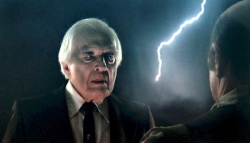
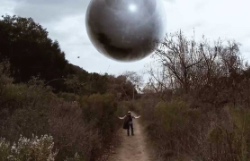
Portrayed with dour aplomb by the perfectly monikered Angus Scrimm (Always Watching: A Marble Hornets Story, the Tall Man seemingly has the sole goal of kidnapping the recently dead and turning them into diminutive Jawa-esque slaves — for what purpose, who knows. Try to stop him and he unleashes these iconic floating silver spheres that are programmed to drill deep inside your head and spew the contents in a shower of blood and viscera all over the darn place.

While subsequent sequels have managed to broaden the Phantasm mythology, they’ve also managed to confound even the most religious of viewers as well, operating on a totally collapsing reality that contradicts and swallows its own rules as soon as it makes them, kind of like what living in a waking dream slash nightmare must be like; this gaslit universe that finally has come to some sort of (in its own way) definitive conclusion with the long-awaited (almost 20 years) fifth and supposedly final entry in the series, Phantasm: Ravager.

Taking the directorial reins from franchise creator Don Coscarelli (John Dies at the End), new blood David Hartman (Roughnecks: The Starship Troopers Chronicles) does a good job of inceptioning himself right into the atmospheric dreamworld of the series. He even opens where we last left off, with a ragged Reggie wandering the desert, shotgun in hand and reiterating the basic plot points of the past few outings. After a few minutes of that, Reggie recovers his beloved Hemi ’Cuda, and the action starts with said silver spheres tracking him down and getting buckshot in the process.

Things take a trademarked bizarre turn, however, when he wakes up in a mental hospital, a clean-cut Mike in tow, telling a confused Reggie that he has been diagnosed with early onset dementia since the death of his wife and kids, and that the Tall Man and all that have been products of the psychosis. Unwilling to believe him, Reggie fights back and forth, alternating between both worlds — and maybe a few more — until, in a final twist of fate, they collide in a way that truly does finish the series off while still allowing it to continue for possibly forever, as we see in the red-tinted image under the credits.

If you’re confused, welcome to Phantasm. —Louis Fowler

Get it at Amazon.

Arachnid (2001)

On a medical expedition to a remote and seemingly uninhabited South American island, a team of researchers and their guides finds itself stranded when the plane loses power and crashes. That’s the least of the travelers’ troubles, as they’re soon deluged by giant, acid-spitting spiders — yes, that’s spiders, plural, despite Arachnid’s singular title — and the occasional toxin-filled tick.

These sorry saps include a spider researcher who practically orgasms as he’s covered in webbing spewed by one of the aforementioned mutated creatures, a doctor (Pedro Almodóvar regular José Sancho, Live Flesh) with a Spanish accent so theeck that you may need to enable subtitles to understand him, a quiet native who shoots poisonous darts through a blowgun, and an all-American tough guy (The Pacifier’s Chris Potter, who appears to have studied for this role solely by watching Mark Harmon’s old Coors commercials).

Lastly, there’s the female pilot. (Get it? Women can’t drive! Hee-haw!) Played by Alex Reid of The Descent, she has to remove her shirt when she gets webbing all over it, which is hardly an original creative decision on the part of once-reliable director Jack Sholder (The Hidden), yet you may not complain …

… because there is plenty left to complain about, including what sounds like constant electric sawing in the background of Arachnid’s early jungle scenes. Even that’s minor compared to the spiders — the movie’s reason for existing, mind you — which look thoroughly ridiculous and penny-ante, but at least they are not CGI. Everything you think will happen, does, right down to an ending that cries out, “Arachnid 2: The Arachining, here we come!” It’s not often we witness something with eight legs stumble so demonstratively. —Rod Lott

Get it at Amazon.

Empire of the Dark (1990)

Twenty years after beefy cop Richard Flynn (Steve Barkett, Bikini Drive-In) saves a baby from being sacrificed in a satanic ritual, the middle-aged man is no longer on the force. Now he’s a self-employed bounty hunter who takes weekly swordplay lessons from a female instructor he can’t help but sexually harass.

Then, because movie villains rise only like clockwork on round-numbered anniversaries, the cult leader, Arkham (Richard Harrison, Evil Spawn), resurfaces, either to drive a wedge between Flynn and his Hungry-Man dinner of Chipotle BBQ Sauced Boneless Chicken Wyngz, or to claim the now-grown child (Christopher Barkett, Steve’s real-life loin fruit). Although no longer beholden to the badge, Flynn and his bushy mustache protect the kid from Arkham and his army of ninjas, not to mention an eventual stop-motion monster cast in the Equinox mold. Like it or not, Flynn has found himself smack-dab in an Empire of the Dark.

In his second (and so far final) film as writer, director, producer, editor and lead (following 1982’s post-apoc The Aftermath), Barkett comes to the card table with a low budget and disproportionately high hopes. Ambition in making his bonkers fantasy a reality is not Barkett’s liability — talent is. Just because one can think it does not necessarily translate to doing it. Being visible, his work in front of the camera obviously demonstrates this theory best, beginning with his atypical action-star visage, more Ron Swanson than Indiana Jones. Donning denim jackets and lumpy-dumpy pants, Barkett appears to be a hero in the eyes of no one but himself and the regional manager of Hometown Buffet. Even more so, he wears a disconcerting amount of sweatpants throughout Empire’s two-hour reign.

Behind the camera, his style of editing boils down to the most editing. For example, how many establishing shots of a church are needed for the viewer to discern Flynn has arrived at a church? The reasonable answer, of course, is “one,” especially since you can allow that big, lowercase T outside to do the talking. Barkett’s answer, however, numbers four to six, even upon return visits! There is padding, and then there is ignorance. —Rod Lott

Get it at Amazon.

Bigfoot (1970)

James Stellar is Bigfoot, “The Eighth Wonder of the World,” as the opening credits of 1970’s Bigfoot state.

Meanwhile, you might state, “Who the hell is James Stellar?” And I already told you: He plays Bigfoot. Oh, you mean what other things might you have seen him in? Gotcha. And the answer is nothing. Per the IMDb, the man never appeared in a single movie or TV show before or since, and while I’m not necessarily saying you should take that as a sign, I’m not not necessarily saying you should take that as a sign, either.

All I took away from this sorry excuse of a sci-fi adventure is what is I already knew: Damn, Joi Lansing was hot! As pilot Joi Landis (lazy naming being a beacon of Bigfoot’s originality), the heaving leading lady of Hillbillys in a Haunted House is forced to evacuate her single-prop plane midair and parachutes her way to safety in a forest. Well, it’s safe until Bigfoot shows up to snag her and bind her to a pole, presumably for purposes of breeding. I can’t say I blame him.

Actually, there are several sasquatch hanging around, maybe even one per cast member. Director Robert F. Slatzer (The Hellcats) packs that cast with no one special, other than John Carradine (House of the Long Shadows) as a traveling store owner named Jasper, Doodles Weaver (Macon County Line) as a forest ranger, and two direct relatives of Robert Mitchum. In this fetid film’s case, more is less. —Rod Lott

Get it at Amazon.

Mutant (1984)

mutantEn route toward some much-needed R&R, the oil-and-vinegar brothers Josh (Wings Hauser, Vice Squad) and Mike (Lee Montgomery, Burnt Offerings) run afoul of a truckful of rednecks on the open road. The encounter ends with the sibs’ car in a ditch, effectively stranding the boys in this tiny town of Confederate flags, Royal Crown Cola and one alcoholic sheriff (Bo Hopkins, From Dusk Till Dawn 2: Texas Blood Money).

Oh, and blue-faced ghouls whose bodies leak pus the color and consistency of baby diarrhea — can’t forget those!

Thanks to a toxic waste facility on the edge of town, various residents turn into zombies of some sort: the kind imbued with the touch of death. Their hands can melt glass and contact with human skin causes burns — or at least a little sizzle o’ steam, like the kind you may see while ironing.

mutant1Personally, if I’m asked to choose a story of a small town under siege that also happens to be directed by John “Bud” Cardos, I’m picking Kingdom of the Spiders each and every time. No offense, Mutant, but you rate a not-even-close second. The troubled and final Film Ventures production, Mutant (aka Night Shadows, a redundant title similar to saying Wet Water) works as passable time-filler without becoming anything special, although Cardos does have the balls to pull a Marion Crane near the 20-minute mark. More notable about Mutant is that, like a certain brand of feminine hygiene products, it has Wings. And the intensity of his performance is matched only by that of his Afro. —Rod Lott

Get it at Amazon.