Category Archives: Sci-Fi & Fantasy

Brainscan (1994)

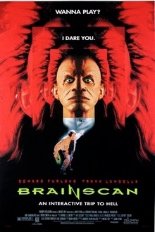
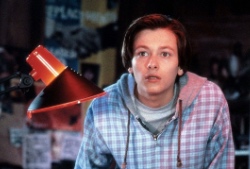
While minding his own business, peeping on the mostly willing girl across the street, young Mike (Edward Furlong) gets a call from his generic horndog buddy — probably named Doozer or something equally dumb — telling him about this great new video game he’s reading about in the latest issue of Fangoria, because every little bit helps, right guys?

The video game is called Brainscan and it promises to be the most immersive experience in horror gaming on your 16 32 64-bit system and, at the very least, it’ll let Frank Langella enter your subconscious, as he is wont to do. Mike plays the game and finds himself in a first-person world of murder and madness as whomever he kills in the game, is found dead in real life. Bummer, dude.

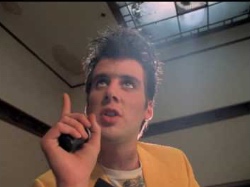
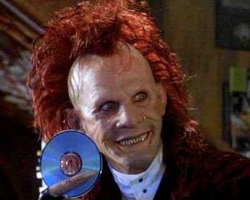
Beyond the silliness of the game itself, the movie Brainscan goes one better by introducing the wholly grating boogeyman known as the Trickster, a horrific sprite from the video game world (?) here to convince Mike to kill himself while eating all of his well-stocked stash of junk food. With a stretched-out face and a shocking-red faux-hawk, it’s very easy to see why T. Ryder Smith isn’t at very many horror conventions signing copies of the movie poster handed to him by pudgy Trickster clones.

Although many of you younglings might not remember it, Brainscan comes from a time long ago and far away when Furlong was the affable-enough boy-king of the first-run genre picture, riding somewhat high after Terminator 2: Judgment Day. But, sadly, too many silly scripts like Pet Sematary Two and this techno-trash caused his star to extinguish faster than a cigarette under Furlong’s well-worn Doc Martens boot heel.

Even worse, by the time this picture was out in theaters, the technology was already practically outdated, no matter how many cool-ish gadgets and Aerosmith posters director John Flynn (Rolling Thunder) threw on the screen. And even though the CGI was getting technically better, the actualized concept of virtual reality and cyberspace were still the thing of badly rendered William Gibson novels and horribly cartoonish Thomas Dolby screensavers.

Despite those winning attributes, realistically Brainscan isn’t even nostalgically good for the time, leading most viewers to check their futuristic Apple Watches and Fitbits to see how much time is left on the thing. To be fair, however, this flick does make a rather unwatchable double feature with Lawnmower Man 2: Jobe’s War if you truly hate yourself.

Or you can just take a nap. Whatever.   —Louis Fowler

Get it at Amazon.

The Martian Chronicles (1980)

“What the hell is this?”

That’s probably what acclaimed author Ray Bradbury said, concurrently spitting grape soda out of his nose, when watching a cowboy-suited Darren McGavin on the run from a group of Man Who Fell to Earth rejects, as I did, too.

Taking a handful of stories from Bradbury’s collection of the same name was a highly ambitious project, one that was probably a little too big for the dreams of director Michael Anderson (Millennium) and star Rock Hudson (Avalanche), but they gave it their made-for-TV all and delivered The Martian Chronicles, a cinematic oddity which includes, yes, Darren McGavin (Billy Madison) running around Mars while dressed as a flashy cowboy.

Originally broadcast in three long, excruciating parts, the first night’s section deals with the landing and subsequent explorations of Mars and how Martians, for really no good reason at all, like to elaborately screw with our puny human brains. Examples of this include astronaut Nicholas Hammond (The Black Cobra 2) finding his Illinois childhood home on the red planet and astro-nut Bernie Casey (Never Say Never Again) grabbing an alien gun (for lack of a better term) and proclaiming himself as the second coming of the Martians. Or something to that effect.

Meanwhile, Hudson looks on coolly as the greatest astronaut who’s ever lived.

In part two, we find former astronaut McGavin opening up a Wild West-themed diner, promising to serve hot dogs and chili at 1970s prices to all the future immigrants. (Where and how he got these wieners and sauce is never explained, but I would’ve liked an explanation.) Sadly, no one ever comes to said eatery except for an alien offering him a deed to a portion of Martian land, whom McGavin promptly shoots. All this is done in a sparkly, spangly cowboy outfit, mind you.

Meanwhile, Hudson looks on coolly as the planet Earth explodes into nothingness.

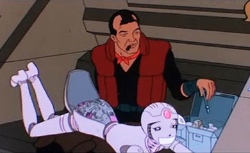
You’d think that after such a dark revelation, things would get a little more entertaining, but instead we find an old man and his robot wife and daughter making dinner and looking to the stars while a lovelorn Christopher Connolly (Hawmps!) flies a foot-pedaled aircraft around the planet, only to find an insanely grating Bernadette Peters, practicing for her upcoming role in Heartbeeps, no doubt.

Meanwhile, Hudson looks on coolly as the temporal gates collide and time becomes a figment of our imaginations.

With workmanlike direction from Anderson, he seemed to forget all the tenuous life lessons he learned on Logan’s Run and made the most by-the-book miniseries possible, all the while barely covering the book. Well, except for that one scene where Darren McGavin goes bonkers dressed a cowboy, which is kind of the worst story in the book, but hilarious on the screen. He should have gotten his own series after that.  —Louis Fowler

Get it at Amazon.

Jurassic World: Fallen Kingdom (2018)

After all the carnage and tragedy that befell so many humans in the events of 2015’s Jurassic World, not to mention three previous adventures, one would think the last thing those survivors would do is go back to that island. Yet that is exactly what they do in Jurassic World: Fallen Kingdom, for a reason returning screenwriters Colin Trevorrow and Derek Connolly do not work hard enough to sell credibly: because 11 species of dinosaurs need to be saved from extinction before an about-to-blow volcano covers Isla Nebula with a thick sheen of lava.

So off go former theme-park exec Claire (Bryce Dallas Howard, Spider-Man 3) and velociraptor whisperer Owen (Chris Pratt, Guardians of the Galaxy Vol. 2), back to the island that very nearly — and often! — served as their gravesite. This time, Claire brings two millennials from her new PETA-esque dino-protection nonprofit: a sassy “paleoveterinarian” (Daniella Pineda, TV’s The Detour) and a systems analyst (Justice Smith, Paper Towns) whose scaredy-cat act gets really old really fast.

Escorting them is a military team whose crusty leader, Wheatley (Ted Levine, The Silence of the Lambs), wields a pair of pliers to extract a tooth from each dinosaur they capture, so you know how that’s gonna turn out. His well-armed crew is tasked with shipping the prehistoric creatures to the palatial estate of infirm philanthropist Benjamin Lockwood (James Cromwell, Species II) for safekeeping, but Wheatley and Lockwood’s right-hand man (a wonderfully slimy Rafe Spall, Prometheus) have other, more personally lucrative ideas.

Although the back half of Fallen Kingdom taking place within the Lockwood mansion is unique to the five-film franchise, Jurassic-newbie director J.A. Bayona (The Orphanage) fails to spatially orientate the grounds to a level of layout that could foster and support suspense among audiences. Where and from what distance predator and prey exist is any viewer’s guess, yet also inconsequential, because any time Claire and Owen back themselves in a corner – metaphorical or otherwise — and face certain doom, Trevorrow and Connolly simply pilfer their cop-out climax from the previous sequel … and Bayona lets them, each and every time. It’s a lazy play on the page, and even more so on the screen.

Sloppy, choppy and as tired as the tranquilizers shot throughout, Jurassic Park: Fallen Kingdom simply goes through the motions, never fully engaging. Toward the end, the film grows as silly as Godzilla on Monster Island, then concludes with a frustrating cocktease of a coda that all but guarantees the worst minute of the next Jurassic movie will be of greater quality than this one’s best. As it stands (read: without tumble gymnastics), Fallen Kingdom is a virtual remake of 1997’s The Lost World: Jurassic Park, no longer the lone disappointment in the Steven Spielberg-produced series — a feat that took 21 years, give or take 65 million. —Rod Lott

Get it at Amazon.

Black Panther (2018)

As the titular superhero of Black Panther, Chadwick Boseman becomes to a generation of children what Christopher Reeve’s revelatory performance as/in Superman became to mine: an instant icon. Making this one all the more remarkable is that while the red-caped son of Krypton already had embodied truth, justice and the American way through decades of comic books, serials, TV shows and the like, Black Panther prowled about the pages of Marvel Comics in relative obscurity.

No more! This cool cat has been unleashed.

Inheriting the role of king of the African nation Wakanda, T’Challa (Boseman, Gods of Egypt) also inherits his late father’s secret identity as his people’s masked protector. Wakanda is masked as well — a village whose advanced technology and vast riches of vibranium (you know, that metal that powers a fellow Avenger’s shield) are hidden under a literal veil that, to an outsider’s naked eye, makes it appear Third World.

Such wonderful toys equip and enable T’Challa to be more than mere superhero — he’s the 007 of the Eastern Hemisphere! With his kid sister (scene-stealing Letitia Wright, Ready Player One) as his personal Q, T’Challa needs all the help he can get as a figure from his unknowing past (Michael B. Jordan, 2015’s less-than-Fantastic Four) attempts to take over the throne, by any means necessary.

While Black Panther’s rapturous success with audiences and critics is not at all surprising, the movie is overpraised. That’s hardly a knock on the film, because it’s still rousing entertainment for most of its two-plus hours. Much as he resuscitated the ailing Rocky franchise with the Oscar-nominated Creed, director Ryan Coogler usurps expectations by leaning heavily into James Bond’s territory. The movie belongs as much to the gadget-gotten spy genre as it does to the sci-fi adventure brand of the Marvel Cinematic Universe, standing on its own while making a snug fit into the MCU’s pre-existing serialized world.

The movie’s mere MCU-ness causes the most problems, with the usual overstuffed finale of foregone conclusions. Coogler and co-writer Joe Robert Cole, however, have a greater hold on their ensemble cast, giving so many talented people — Sterling K. Brown, Martin Freeman, Lupita Nyong’o, Andy Serkis, Angela Bassett, Forest Whitaker — a chance to act, rather than simply collect a nice paycheck. Special praise is reserved for Danai Gurira (My Soul to Take) and Florence Kasumba (Wonder Woman) as T’Challa’s spear-armed bodyguards; they roar and resonate so loudly, they deserve a vehicle all their own. —Rod Lott

Get it at Amazon.

Ready Player One (2018)

Ready Player One is the $175 million embodiment of the adage about wishing to possess cake and consume it. Like a cruel parent with bipolar issues, the film spends two hours sparing no expense to tout its virtual-reality construct as something BuzzFeed might headline “You Guys! This Game Gives Me So Many Feels, I Can’t Even,” only to turn around and abruptly scold its audience for snapping at the cheese, let alone even sniffing it.

And that’s if you buy into the showroom model Ready Player One presents. If you don’t, which is my case, the experience is even worse: an empty vessel of sensory overload.

In the vast wasteland that is America 2045 (just you wait!), the populace has become what Pixar’s WALL-E prophesied in 2008: lazy asses. Instead of participating in real-world activities, people strap on goggles and hide behind chosen avatars to spend their days and nights roaming around in OASIS, an immersive, anything-goes environment of VR fantasyland games and high jinks. Drive the Batmobile or the Back to the Future DeLorean! Wage war against Freddy Krueger and the Iron Giant! It’s like Second Life with a thumbed nose at copyright law and intellectual property.

When OASIS’ dippy-hippie founder, Halliday (Bridge of Spies’ Mark Rylance, Oscar-winning porn star), passes away, he does not go gently into that good night. Rather, he makes his death and legacy a game, proactively bequeathing ownership of OASIS to one lucky player, Willy Wonka-style. Whomever can obtain the three keys hidden throughout his pixel-perfect world, wins.

Poverty-stricken teen orphan Wade Watts (Tye Sheridan, Scouts Guide to the Zombie Apocalypse) vies to grab that bounty. His most formidable challenger: the ruthless, bullying corporate CEO/control freak Sorrento (Ben Mendelsohn, Knowing). The innocence of youth and plucky know-how vs. unchecked power and vast resources: We all know how this one will end — fictionally, of course.

The first key goes to the victor of an improbably speedy road race. Coming essentially right out of the movie’s gate, it kick-starts Ready Player One on a propulsive, well-boding note. Then the movie downshifts into narrative banality until the set piece for the second key — without question, the film’s most enjoyable sequence, as Wade and friends (including a love interest played by Ouija’s Olivia Cooke) enter The Overlook Hotel from Stanley Kubrick’s The Shining (Jack Nicholson not included).

From that point on, with roughly half an elongated running time still to come, Ready Player One is a punishing sit. The quest for the third and final key occupies all of Act 3, culminating in an all-out CGI war among indiscernible sides and blink-and-gone pop-culture cameos (Robocop! Chucky! And, um, that guy!) Maybe this Trivial Pursuit: The 1980’s style works on the page — I have not read Ernest Cline’s 2011 best-seller on which this blockbuster is based — but given how the battle is entirely artificial, the effect is pummeling to a point of numbness. Your mileage may vary, dependent on how much you enjoy watching others play video games.

Ironically, the USP of Ready Player One becomes utterly meaningless well before the picture’s end: the four-word phrase “directed by Steven Spielberg.” America’s longest-reigning household-name filmmaker helped define the decade to which this film pays homage, if not worships. In the 1980s, a movie stamped with Spielberg’s name felt like a Spielberg movie, from the ones he directed (E.T., the first two Indiana Jones adventures, one-fourth of Twilight Zone: The Movie) to the ones he did not (Gremlins, The Goonies, Poltergeist,* Young Sherlock Holmes); whatever his capacity, each production bore That Spielberg Touch.

No more. If Ready Player One has a heart, it does not beat. Arguably half-animated, the film could have been directed by anyone, since it sparks no wonder, appears to confuse nostalgia with drama, and wastes the gifts of its actors. It is a chunk of digital plastic — tomorrow’s ColecoVision, today! —Rod Lott

Get it at Amazon.