
Category Archives: Martial Arts

Kung Fu Trailers of Fury (2016)

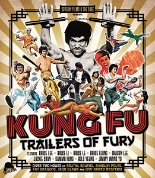
kungfutrailersA summary of Severin Films’ Kung Fu Trailers of Fury compilation can be found in the superimposed titles from the opening coming attraction for 1978’s The Ways of Kung-Fu: “There are fights! There are laughs! There are surprises! … We are not afraid of imitators, because we are the real deal!”

Comprised of a full two hours of trailers, the program presents martial-arts mayhem at its 1970s pop-culture peak, when public fascination with superstar Bruce Lee extended far beyond his untimely death to a flooded market of “chopsocky” imitations. Aside from the same “whoosh” sound effect to indicate appendages and/or limbs in motion, on their way to making contact with an opponent, the 31 clips collected here share another element in common: hyperbole.
kungfutrailers1Often rendered in broken English, the genre’s peculiar brand of ballyhoo is responsible for half the fun. When you have projects as insignificant as 1978’s Shaolin Iron Claws calling itself “a stunning production in Chinese cinema history” or as transparently money-grubbing as the same year’s Bruce Le’s Greatest Revenge claiming that it “reinvents action cinema,” one thing is undeniable: Embellishment and exaggeration are all over this like snot on a salad bar sneeze guard during flu season.

Think about the Don Draper pitches that resulted in these indelible ad lines:
• “Intrigue! Mystery! Intrigue and mystery!” —Fists of Bruce Lee (1978)
• “He must fight the YIN YANG SHEMALE!” —Kung Fu vs. Yoga (1979)
• “100 minutes of pure, nonstop sensory explosion!” —The Happenings (1980)
• “It has both the fights and the laughs! … It’s hardcore! It’s Ring vs Pole like you’ve never seen before!” —Enter the Fat Dragon (1978)
• “More exciting than the Western! More suspenseful than European films!” —Blacklist (1972)
• “A COMEDY WITH ACTON [sic] … GOLDEN NEEDLE PEERING [sic]” —Chinese Kung Fu (1973)
• “Chinese bumpkin wreaks havoc in Europe!” —Chinese Kung Fu Against Godfather (1974)
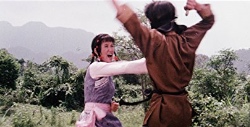
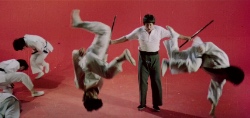
kungfutrailers2So from where does the other half of the fun come? The visuals, coward! Primarily, I speak of the fights that utilize bamboo poles, rice bowls, playground equipment, baby powder, Q-tips, flying logs, legs wrapped behind one’s head, sewing supplies, ramen noodles, human urine, erect nipples, Dutch windmills, firecrackers, yo-yos, slippers with pop-out saw blades, stolen 007 scores, and something called the Golden Turtle Fist — just not all at once.

And “all at once” is not how I recommend taking in Trailers of Fury, however kick-ass (literally and figuratively) it may be. While the promo for Lee’s 1972 film, The Way of the Dragon, may be the only spot the average viewer is likely to have seen before, martial arts pictures are not known for variety. You have to sit through, say, several punched testicles before getting to the novelty of, say, an earlobe getting torn. Or a snake doing battle with a pussycat (from the ’78 Jackie Chan vehicle Snake in the Eagle’s Shadow). Or acupuncture needles stuck into a dude’s eyes — a cringe-inducing feat worth more exclamation points than I’m willing to type! —Rod Lott
Get it at Amazon.

Blind Fist of Bruce (1979)

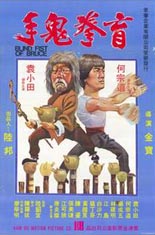
blindfistbruceFrom Brave Young Girls’ Bong Luk, Blind Fist of Bruce represents Bruceploitation at its most basic! And of course it stars Bruce Li, arguably the most prolific / infamous Bruce Lee imitators / wannabes barfed out by the Hong Kong film industry after the icon’s death.

Li stars as a banker who needs to defend himself against a gang of robbers. His friends claim to practice cat- and dog-style kung fu, but whadda they know? So the requisite old, blind guy (Simon Yuen, Drunken Master) teaches Li the ways of the blind fist, and you just know that trick works. Gets the job done.

Blind Fist of Bruce followed Fists of Bruce Lee, another Li vehicle. Boy, the Bruces sure had a surfeit of fists. —Rod Lott

Get it at Amazon.

Bloodsport (1988)

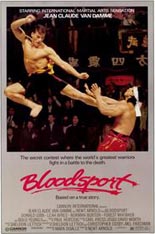
bloodsportJean-Claude Van Damme’s first lead role sends the Muscles from Brussels to Hong Kong, to compete for glory — and a big-boy sword — in a real Bloodsport. For a supposedly super-secret tournament, everyone speaks freely, openly and publicly about the kumite (pronounced koo-muh-tay), a full-contact, anything-goes competition held every five years among martial artists worldwide.

For reasons never shared, Frank Dux (Van Damme, Welcome to the Jungle) has to go AWOL from his U.S. Army post to get to the overseas contest, so he’s constantly having to evade two military cops tasked with hauling him back. Both of the cops are dumb, yet only one of them is played by Forest Whitaker (Taken 3). Ditching them proves a cinch, as does the kumite itself; Frank shatters a world record in his first-ever round. Look, Ma — nothin’ to it!

bloodsport1The cumulative combat scenes make Bloodsport worth the watch, as they showcase a variety of fighting styles. Amid many others, we witness one man circling his opponent like a crazed monkey; the backfiring, beer-soaked machismo of Frank’s fellow Yank (Donald Gibb, aka Revenge of the Nerds’ Ogre); and the brute intimidation of the legendary Bolo Yeung from Enter the Dragon, whose template this film flagrantly swipes. Of course, we can’t leave out Van Damme’s own patented splits or his character’s genius move: the slow-motion nut punch. That attack alone redeems the star’s (I hesitate to call him an actor) curious dress and overall appearance as every collar-popped preppy villain in every ’80s teen comedy. Like those guys, Frank succeeds in bedding the hot blonde (The Burning’s Leah Ayres, as a journalist yearning to break the kumite story).

Directed by Newt Arnold (Blood Thirst) and scripted by Sheldon Lettich (who went on to write four more Van Damme vehicles, including Double Impact), the Cannon Films hit bears the predictability of an orange-vested highway worker waving a flag to alert drivers of construction just ahead, past all those blinking lights. But, hey, those guys operating the machines are delivering kicks to the face and clenched fists to the testes! You better believe I’ll slow down for that! —Rod Lott

Get it at Amazon.

The Blind Swordsman: Zatoichi (2003)

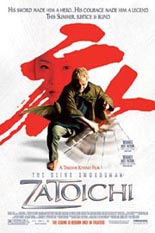
zatoichiThe Blind Swordsman: Zatoichi, Takeshi “Beat” Kitano’s brilliant update of the enduring Japanese cult hero, is quite an achievement — not just for the writer/director/actor, but contemporary Asian cinema as a whole. All too often in the continent’s genre pictures, arguably even more so than America’s dumbest rock-’em-sock-’em blockbusters, the story takes such a backseat to the action — if there’s even a story for starters — that it renders itself impenetrable or invisible.

With wave-of-the-hand ease, the 2003 Zatoichi could have done the same thing, lazily relying on its target audience’s fond memories of the character as shorthand (as he has no fewer than two dozen features built around him, starting with The Tale of Zatoichi in 1962 and later followed by a popular television series). Instead, Kitano (perhaps best known on these shores as the teacher of 2000’s Battle Royale) first infused the character with a real emotional pull and then fashioned a plot around it that fits as well as a sword in its custom sheath.

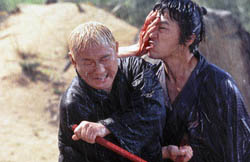
zatoichi1More or less homeless, the aging masseur Zatoichi wanders village to village, coming upon a farming community where he settles with a kind family. He soon finds enemies, however, at the local gambling parlor. As the title reveals, Zatoichi may be blind, but wields a mean sword — as swift as it is sharp — only when he needs to. And when he does, the combat is brief — a few seconds and it’s over; no massive, Kill Bill-style set pieces as showdowns to be found here.

What really makes this Blind Swordsman adventure work with Greenwich Mean Time precision is Kitano’s utterly charming and even funny performance. He’s wholly winning. I loved the film so much that even its decision to end in a musical number failed to change my mind. Hell, it even cemented it. —Rod Lott

Get it at Amazon.

Redeemer (2014)

redeemerRedeemer is your standard vengeance-is-mine tale with an above-average lead in Chilean fight choreographer Marko Zaror, the screen’s brightest martial artist most people don’t know about. Had he been born at the right time — say, 10 to 20 years earlier — he would have been a late-’80s action star in the ranks of Dolph Lundgren and Jean-Claude Van Damme. As is, he’s quietly making fight flicks that have yet to catapult him beyond a cult following. Most fruitful is Zaror’s collaboration with Ernesto Díaz Espinoza, who’s directed him in four films to date, all wild and most recently the one at hand.

As the savior of the title, a heavily tattooed and soft-spoken Zaror brings a portable altar and a knack for Russian roulette with him to a coastal town that effectively shuts down after the summer season, save for the drug cartels lording over its slopes and slums. While an American hustler (Noah Segan, Looper) pulls the strings, the Redeemer’s true nemesis is the grease-slicked goon known as Scorpion (José Luís Mósca), who killed our hero’s pregnant wife.

redeemer1In structure, the film is almost mockingly repetitive: The Redeemer approaches a group of bad guys, takes them down with hand-to-hand combat and swift kicks that land with a violent crunch, goes away for a bit, repeat. (We must ignore the fact that his signature hoodie would impair his peripheral vision.) Espinoza casts these sequences in his flashy, ultra-kinetic style that revels in a veritable ballet of blood spurts, yet leaves one with the belief that an essential ingredient of previous efforts was overlooked; Redeemer lacks the metaphorical punchiness of their 2007 superhero story, Mirageman, and the zip of Mandrill, that 2009 tweak of secret-agent thrillers, and soaks in the well of self-pity a few minutes too long.

Zaror isn’t that good of an actor to pull it off; physically, he’s a stick of dynamite, and that is what he’s put in front of the camera to do. More of a sense of humor, which Segan provides in his every scene, would bring Redeemer up to Zaror and Espinoza’s usual level. —Rod Lott

Get it at Amazon.