Category Archives: Martial Arts

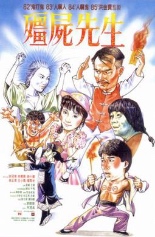
Mr. Vampire (1985)

Kung fu and horror movies go together amazingly well. From the Shaw Brothers/Hammer Films coproduction The Legend of the 7 Golden Vampires to 1980s classics like the Chinese Ghost Story series, nothing quite scratches the itch of ancient evil like a kick to the face. It’s even better when you mix in broad slapstick comedy, and 1985’s Mr. Vampire did everything so well that it created a whole genre of sequels and rip-offs featuring jiangshi, Chinese hopping vampires/zombies. It’s also a case study in how sometimes actors can make some serious coin if they lean into typecasting.

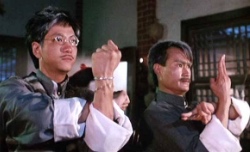
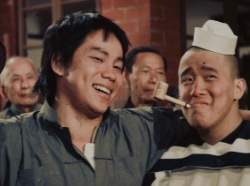
Set in a sleepy small town that looks nothing at all like the towns in all of Golden Harvest’s other ’80s movies, Mr. Vampire stars Ching-Ying Lam (Mr. Vampire II, Mr. Vampire III, Vampire vs. Vampire, Magic Cop, Encounters of the Spooky Kind 2) as our main hero, a Taoist priest named Master Gau who also knows a kung fu or two. And of course, he’s got some bumbling, but earnest assistants, played by Siu-Ho Chin (Vampire Cleanup Department) and Ricky Hui (The Haunted Cop Shop, the guy who goes “Whaaa?” for comic relief in, like, 50 other movies). Everything seems to be going pretty good for Gau: He’s rolling through life, hanging out with dead bodies waiting to be hopped back to their hometowns for burial — you know, normal shit. Yeah, maybe his assistants go a little too far messing around with the corpses, but who’s going to know?

Everything goes sideways when Gau is hired by Mr. Yam, a wealthy local merchant (those guys are the worst) played by Ha Huang (A Chinese Ghost Story). Richie Rich wants Master Gau to relocate his dad’s body to ensure good fortune for Yam’s business. Yam’s daughter, Ting-Ting (Moon Lee, Fighting Madam), also hangs out with her dad a lot, which is weird, but whatever. Oh, also there’s a funny bit where Master Gau’s assistants think Ting-Ting is a prostitute, which is an hilariously embarrassing situation!

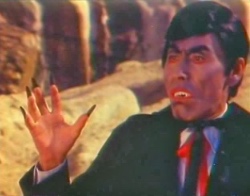
Anyway, they dig up Yam’s dad, but here’s where things get bad. The corpse hasn’t decayed. At all. And everyone knows that’s a surefire sign of Impending Undead Evil High Jinks. If Gau doesn’t make with the rituals and quick, Yam’s dad is totally going to turn into a kung-fu vampire (Wah Yuen, Mr. Vampire Saga).

On top of the vampire threat, one of Gau’s assistants falls in love with a spectral bride played by Siu-Fung Wong (New Mr. Vampire), who hops on the back of his bicycle one night while a creepy song called “Ghost Bride” is sung by a children’s choir. And things really go downhill from there. But amid all the kung-fu slapstick horror laid down by this masterpiece (which is even better on the recently remastered limited-edition Korean Blu-ray that I have, but you know, not everyone appreciates Film like I do), Mr. Vampire serves up some important life lessons:
Jiangshi have to hop everywhere, so take the stairs! It’s hilarious.
• These monsters are allergic to sticky rice. (As a side note, you should note that sticky rice costs more than regular rice, so beware unscrupulous merchants who might try to cut the sticky rice they sell you with regular rice. Again, merchants are the worst.)
• Like all of us, they’re repelled by mirrors. Are you not?
• They track humans by their breath, so keep a big bamboo tube by your bed as a vampire snorkel.

The first draft of this review had tons of explanation about the mythology behind jiangshi, but you’ll figure it out. I’m serious about the vampire snorkel, though. —Ryun Patterson

Get it at Amazon.

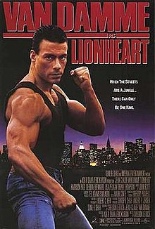
Lionheart (1990)

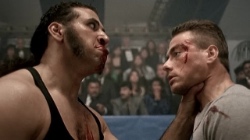
Based on a story and screenplay by action star, martial artist and Tostitos spokesperson Jean-Claude Van Damme, Lionheart casts Bloodsport’s Belgian bruiser as Leo, a serviceman in the multinational Foreign Legion and stationed in the fun-to-say Djibouti; he’s one lone, stone-cold warrior surrounded by a bunch of comical Col. Klink-style Germans always riding his ass for something or another.

When his brother is gruesomely immolated by drug dealers, Leo uses his high-kickin’ feet to say goodbye to his superiors (and his superiors’ faces), hitchin’ a ride on a 1930s steamship to New York City where, as soon as he gets off the boat, in a moment of prescient critique, he harshly compares and contrasts the drug-abusing homeless dudes on the ground with the wholly porcine moneymen in their glass towers — to which he shakes his head and dismissively says, “America!”

Good burn, JCVD.

Leo soon hooks up with Joshua (Harrison Page, Carnosaur), a jive-talking fight manager whose profanity-rich dialogue would be moderately offensive if the guy wasn’t putting his heart and soul into this mildly racist character. Together, after beating up the cast of Beat Street, they make it to Los Angeles and, in between helping his sister-in-law and her adorable 5-year-old, he manages to get into one high-paying blood brawl after another, knocking out the best Frank Dux-choreographed stuntmen in parking lots, racquetball courts and the near-empty pools of the rich and famous.

Lionheart does a good job in casting Van Damme as the ultimate good guy: a nice, caring man doing everything through excessive violence to help his friends and family, all the while eschewing the continuous advances of a rich benefactor who is unsubtly letting him know she’s looking for a good-ish time, and I do mean sexually.

But he’s having none of it, instead choosing healthy alternatives such as constantly jogging around his neighborhood, eating bean burritos and outrunning the bulky Foreign Legion goons looking for him. (Although, to be fair, he does gratuitously preview his well-buffed buttocks for the ladies, although I’d really like to meet the woman who fell in love with this flick, Jean-Claude Van Damme and action films in general simply because of three seconds of tightly toned foreign ass.)

I’m not giving away any well-guarded secret by saying there’s a final fight with a ’roided-out Paul Stanley look-alike, but make sure to stay for the final scene, as JCVD and his friends and family enthusiastically hug and laugh maniacally as the camera pulls back and the credits roll. You’ll instantly feel pretty bad about yourself and your life if you’ve never had one of those tender moments in your non-Lionhearted existence.  —Louis Fowler

Get it at Amazon.

The Dragon Lives Again (1977)

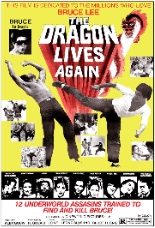
One wonders if Bruce Lee might have laid off the painkillers, if only he could have known how sullied his good name would be by the Bruceploitation wave that took hold soon after his untimely passing in 1973.

Take The Dragon Lives Again, for example. It’s one thing for a film to dedicate itself to “millions who love Bruce Lee,” but it’s another thing entirely for that film’s first scene to depict their hero (played by Bruce Leong, The Clones of Bruce Lee) burning in hell and lying dead while sporting a massive boner. To review this supremely silly quasi-parody scoop o’ chopsocky — directed by The Crippled Masters’ Lo Ke, which this film is anything but — is simply to share what happens.

Bruce is awakened by the King of the Underworld (Tong Ching, Bat Without Wings) and told he’ll have to fight his way back to earth and his beloved spouse. So Bruce goes about his way and makes allies with the One-Armed Swordsman (Chang Li, Dragon on Fire), Kane (as in David Carradine’s character in the TV series Kung Fu, but here played by an actual Asian) and Popeye the Sailor Man (Eric Tsang, Infernal Affairs). Meanwhile, the king bides his time chasing his topless wives around the bathtub: “Ooh, what a lovely pair of breasts you have!”

At a noodle restaurant — hey, even the deceased get hungry — Bruce meets two of his opponents: James Bond (played by The Mighty Peking Man’s Alexander Grand, a chubby Jewish guy with lamb-chop sideburns) and Clint Eastwood’s Man with No Name (The Tattoo Connection’s Bobby Cannavaro, clad in cowboy hat and poncho while chewing a thin cigar). They’re backed up by a team of goons in full-bodied skeleton outfits and all part of an evil squad whose members includes such ’70s film icons as Emmanuelle, the Exorcist and the Godfather (Shin Il Lung, To Kill with Intrigue).

The Exorcist wants to take over the underworld, so he gets Emmanuelle (played by a braless American woman named Jenny — that’s it, just “Jenny”) to try to fuck the king to death. “I’m such a silly pussy,” she seductively coos upon meeting him. As she attempts her fatal screw — fairly explicit for a kung-fu film — Bruce interrupts them and spills the beans on Emmanuelle’s devious plans. Shocked, the king replies, “Her pussy’s in this plot, too? She tried to use it to murder me!”

Out in the countryside, Bruce engages in an extended fight with Zatoichi, the Blind Swordsman (Wong Kar Hung, The Oily Maniac). Each of their moves is helpfully denoted with a super; Zatoichi’s techniques include “Blind Dog Pisses,” while all of Bruce’s are named after actual Bruce Lee films. Later, Bruce returns to the outdoor site after donning his Kato get-up from TV’s The Green Hornet in order to do battle with Dracula (Hsi Chang, Mad Monkey Kung Fu).

Then the king causes an earthquake by shaking a pillar and creates an army of mummies to take on Bruce. Our hero is nearly defeated until Popeye conveniently finds a can of spinach half-buried in the dirt and busts out his good shit. Finally, Bruce gets to go home and flies into the sky, all while you’re left to rub your eyes and pinch yourself to make sure what you’ve just watched is real.

It is. —Rod Lott

Get it at Amazon.

Enter the Game of Death (1978)

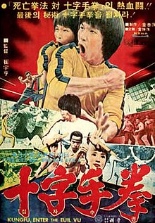
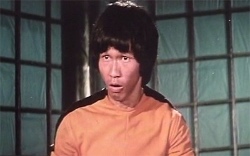
As Bruceploitation pictures go, Enter the Game of Death is hardly the craziest, but it still is semi-“out there.” Bruce Le (Challenge of the Tiger) dons Lee’s iconic yellow jumpsuit to play Chang.

After winning an arena kickboxing match (a nearly unbearable sequence at seven minutes), Chang is offered a job as a bodyguard. When he politely refuses, his would-be employer sics a team of shirtless fighters (reportedly including American Ninja’s Steve James) on him. Chang handily beats these wussy-dubbed hooligans, but then some Japanese guys rape his cousin, who’s so ashamed she kills herself.

So enraged at this turn of events, Chang joins the Blue Robe Organization and agrees to help its proprietors recover a stolen military document that will save his country. Said document is located at the tippy top of a pagoda, through each level of which he must fight:
• The first level finds him battling a bald guy who throws fistfuls of death marbles.
• Level two is inhabited by a guy tossing poisonous snakes. When he’s nearly defeated, he bites the head off one serpent and sprays Chang with its blood as if it were a water hose.
• On floor three, Chang spars with a white-haired fellow with nunchucks and lotsa candles.
• The gimmick of the fourth floor is a lame one: It’s all red.
• Finally, at the penthouse level, Chang tussles with the Asian version of Grizzly Adams.

Naturally, this five-story sequence is where director Joseph Kong (The Clones of Bruce Lee) rips off the real Bruce Lee’s Game of Death; naturally, this is where the film gets fun. Then it’s outside for even more punching and kicking more bad guys, including big bad Bolo Yeung (Bloodsport). You could do worse! —Rod Lott

Get it at Amazon.

Macho Man (1982)

Sorry, folks, but Macho Man is neither a biopic of wrestling’s Randy Savage nor the Village People’s follow-up to the flop Can’t Stop the Music, but a straightforward kung-fu extravaganza with a little bit of bloodletting and a whole lotta fighting. Plus, its original title is Duel in the Tiger Den — a moniker I could see adorning the label of a Village People 12-inch (pun intended), but still.

The titular Macho Man (Tien Te Hui, The Fatal Flying Guillotine) is a drifter who, in his first scene, snaps the necks of four hoodlums with ease and a smile, as if he were buying chocolate bars for orphans. With his goofy smile and semi-lazy eye, he looks exactly like how I would envision Brendan Fraser, had the Mummy man been born Asian.

Our hero is out scouting for the king’s stolen seal (not the animal), which has been stolen by not-as-macho men, who try to kill him with construction equipment. They do not succeed, but they are able to hit him with a log and stab him with a forklift. Later, director You Min Ko (better known as a prolific performer in this genre, including the immortal Fantasy Mission Force) stages a fight atop a moving train, which is more elaborate than the usual battles in the chopsocky films of this waning era. Scenes like these — and an utter obliviousness toward its humor — make Macho Man worth a watch. —Rod Lott

Get it at Amazon.