
Category Archives: Horror

The Boy Who Cried Werewolf (1973)

boycriedwerewolfHere is why parents should never get divorced: Wounds cut deep. Resentment boils and festers. Kids are hurt the most. Dad sprouts fangs.

Okay, so I skipped a few steps.

This happens first: Dad, aka Robert Bridgestone (Kerwin Mathews, The 7th Voyage of Sinbad), takes his only child, Richie (Scott Sealey, in his first and last movie), to his mountain cabin for the weekend. With trusty walking stick in hand, he and the boy saunter outside toward a juicy steak dinner they never get to order, because Robert is bum-rushed by a wolf man (Action Jackson stuntman Paul Baxley). They tussle until Robert is able to toss his attacker off the cliffside, fatally impaling the toothy stranger on a highway road sign.

Later, having been bitten in the scuffle, Robert sprouts fangs, as well as a black nose like my Shih Tzu has, gnarly fingernails, hair frickin’ everywhere — the works! Since The Boy Who Cried Werewolf is in the directorial paws of Nathan H. Juran (1958’s Attack of the 50 Foot Woman) and not of John Landis, the transformation plays out as a series of still photographs, with Robert increasingly appearing like The Shaggy D.A. stuck in an O-face.

boycriedwerewolf1To the authorities, Robert denies he was assaulted by anything other than fellow man, despite their face-to-snout encounter taking place in broad daylight. “Stop this monster nonsense!” he yells at Richie, who won’t shut up about the pee-your-pants awesomeness he witnessed. Robert’s occult-friendly shrink (George Gaynes, all seven Police Academy outings) tells him not to rush to judgment, because children can see monsters. (Or something like that. What other advice could Robert possibly expect from a man whose office shelves are stocked with tribal tchotchkes and a thick book whose spine is imprinted with the word “ALOE”?)

Turns out, turning into a lycanthrope isn’t just a one-off. With every “full moon” — I surround that in quotes because Juran has to hold the record for most scenes depicting darkness in the rays of the sun — the elder Bridgestone’s wild side emerges. In these sequences, a lot occurs: Fleeing from his werefather, Richie cock-blocks a young couple. A makeshift commune of hippies (led by screenwriter Bob Homel) prays for Jesus to keep them safe. The curmudgeonly sheriff (Stripes’ Robert J. Wilke) blames the carnage on a puma. And, as Richie’s MILF of a mother, Elaine Devry (A Guide for the Married Man) makes parental concern appear downright sexy.

Looking every bit like a Universal TV series of its era, The Boy Who Cried Werewolf is executed quickly and cheaply, yet also competently. When he’s running around wearing the monster mask, Mathews is an inadvertent hoot; the juvenile Sealey, then around 12, gives the more believable performance — and trust me: He’s no Haley Joel Osment or Jacob Tremblay. But his presence and POV help make the movie equally fun for adults and their offspring, harmlessness and all. It’s cornball horror at its log cabin-comfiest. —Rod Lott

Get it at Amazon.

Blood (2009)

bloodFor 14 years, the murder of a maid in the home of a woman named Miyako (Aya Sugimoto, Flower & Snake II) has been a cold case. With the statue of limitations about to kick in, the young and not-yet-disillusioned Detective Hoshino (Kanji Tsuda, Ju-on: The Grudge) makes one last-ditch investigation effort for the sake of the victim’s still-grieving family.

Hoshino finds himself captivated by Miyako, and hell, no wonder: Asian actresses rarely arrive as sultry and curvy. (The Naked Killer herself, Chingmy Yau, is another of this rare breed.) Unbeknownst to Hoshino, a portion of his attraction is not under his control, because she’s not merely a vamp, but a genuine vampire. Practically deflecting questions about her maid’s death, the cunning Miyako points blame on a hedge fund manager (Jun Kaname, Casshern). Jealousy between the two men quickly breaks out, as do the eventual swords.

blood1Immediately, Shinobi: Heart Under Blade director Ten Shimoyama establishes a look for Blood that is dark and seductive. Peppered with bursts that action that incorporate a proper amount of martial arts without going full chopsocky, the story moves slower than it should. When the Japanese film starts to drag — and it does, inevitably — Shimoyama injects passion through several sex scenes, which are actually erotic. Certainly uninhibited in her dead-sexy performance, the gorgeous Sugimoto gets — how you say? — kneaded like bread dough. Call it gratuitous if you must, but the vampire, as it was created in literature centuries ago, was intended as a sexual creature. —Rod Lott

Get it at Amazon.

The Uncanny (1977)

uncannyIf horror masters from Edgar Allan Poe to Stephen King have taught us anything, it is this: Cats are no damn good. A compelling piece of supporting evidence is The Uncanny, a feline-themed triptych from Milton Subotsky, a producer who specialized in the horror anthology (with 1972’s Tales from the Crypt being perhaps the most enduring example).

In present-day Montreal, fidgety author Wilbur Grey (Peter Cushing, The House That Dripped Blood) shares the details of his latest book to his publisher (Ray Milland, Terror in the Wax Museum), who expresses misgivings about its commercial prospects — after all, who would believe that adorable kitty cats are actually vessels of unbridled evil? In an attempt to change his host’s tune, the pussyphobic Grey shares three such cases, all helmed by Naked Massacre’s Denis Héroux, in his final film as director.

uncanny1First up, in pre-WWI London, a miserable crone (Joan Greenwood, 1961’s Mysterious Island) excludes her ungrateful cad of a nephew (Simon Williams, The Fiendish Plot of Dr. Fu Manchu) from her new will, instead leaving the entirety of her estate to her cats. Electrified with a nasty wit, this segment entrances viewers, thus positioning The Uncanny from the start as a veritable buffet of horror and suspense.

Unfortunately, it’s all downhill from there. In 1970s Quebec, the middle story about a tween girl (Chloe Franks, Whoever Slew Auntie Roo?) being mean to her little sister (Katrina Holden, Death Wish 4: The Crackdown) is a patience-trier further hampered by the goofiest of effects. Slightly better is the trio’s closer, set in Hollywood’s Golden Age, with cats causing chaos on the set of a motion picture starring Valentine De’ath (Donald Pleasence, The Monster Club) and his lover (a slinky Samantha Eggar, Curtains). It ends with a joke that also appears to be its raison d’etre, as if screenwriter Michel Parry (Xtro) started there and worked backward. —Rod Lott

Get it at Amazon.

Hell’s Trap (1990)

hellstrapIrked over a round of paintball that went his archenemy’s way, preppy sore loser Mauricio (Toño Mauri) hopes to save face by proposing one final dick-measuring contest to mullet-helmeted good guy Nacho (Pedro Fernández, who squeezed this pic in between Vacation of Terror and Vacation of Terror 2: Diabolical Birthday). And that challenge is to see who can slay the bear that, according to the newspaper, is thought to have killed a few hunters over at Filo de Caballo (which, according to a crude Internet translator, is thought to mean “edge of the horse”).

Nacho agrees, bringing his girlfriend (Edith González, René Cardona Jr.’s Cyclone) and his obese, quesadilla-craving best friend (Charly Valentino) to the agreed-upon campsite at Filo de Caballo. Mauricio brings some eye candy and acid-washed jeans. Director/co-writer Pedro Galindo III (the aforementioned VoT2) brings a twist, because there ain’t no bear!

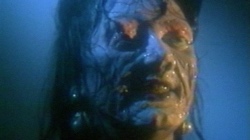
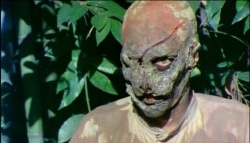
hellstrap1Credit for the hunters’ deaths is all due to Jesse (Alberto Mejia Baron in his lone acting job), a Vietnam veteran with maximum PTSD and a face mask that recalls Owen Wilson’s Zoolander character caught in a perpetual scowl. His weapon of choice is a homemade Freddy Krueger glove with serrated blades and, as backup, a machine gun when you absolutely, positively got to kill every motherfucker in the forest. That’s not really a problem for Jesse; he seems to have every branch and bush rigged with some kind of booby trap for the kids to trigger — hence the title of Hell’s Trap.

It is comforting to know that other countries — in this case, Mexico, if you didn’t discern that already — can make slashers as mediocre as we Americans. And as inane, as silly, as comfort-foody. Known as Trampa Infernal in its native tongue, Hell’s Trap has our nation’s decade-defining Voorhees formula down pat, then supercharges it with a shot of the equally ’80s Rambo. All that’s really missing: tetas. I refuse to pretend they are not missed. —Rod Lott

Get it at Amazon.

Clown (2014)

clownHow strange that Clown began as a 78-second joke, as a fake trailer purporting to be the work of Hostel’s Eli Roth. How strange that the actual feature has Roth aboard as producer. What’s stranger than both those things is that there was enough in that concept worth expanding into a feature.

When the clown hired to enliven the birthday party for young Jack (Christian Distefano, Cut Bank) cancels during the event, it’s Dad to the rescue: Kent (Andy Powers, TV’s Taken miniseries), a real-estate agent, all too conveniently finds and dusts off a clown suit in the basement of a home he has on the market. Jack and friends are pleased, and one can tell in the eyes of Kent’s dental-hygienist wife, Meg (Laura Allen, TV’s The 4400), that her hubby is so totally getting laid tonight.

clown1Or perhaps not. For some reason, the costume won’t come off! It resists scissors and serrated tools; the red, bulb nose is stuck to him like skin; the colorful curls of the wig have burrowed deep into his scalp; and that whiter shade of pale won’t wash off. And hell, what’s up with the rainbow-colored sputum? After medical treatment proves fruitless, Kent tracks down the former property owner (Peter Stormare, Hansel & Gretel: Witch Hunters), who offers three bits of worrisome news:
1. The clown of Nordic legend is not about twisting balloons into funny shapes.
2. It’s all about a demon bent on killing kids.
3. Kent’s turning into that.

Being presented without context — unlike, say, Roth’s Thanksgiving appetizer in Grindhouse — the fake Clown trailer of 2001 was difficult to peg as a pure put-on. At full-length, however, the intent of director Jon Watts (Cop Car) and co-writer Christopher Ford becomes Glass Plus-clear: scares above snorts. While the movie consistently works as a two-scoop cone of dark humor, its aim to disturb the viewer is primary; that it does so by putting kids in peril demonstrates that commitment, and Watts doesn’t use that lazily, like a short cut. Instead, aided by Powers and Allen’s real performances, he builds upon it, progressing with the aggression as poor Ken inversely descends from Dad jeans-wearing family man to hobo with trash bags duct-taped around his ankles to, ultimately, a face with a rictus carved in such a manner to haunt your dreams. —Rod Lott

Get it at Amazon.