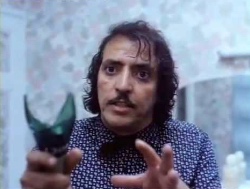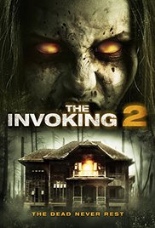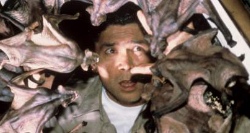

Made by Hallmark Entertainment — yes, the greeting-card company — in the VHS heyday and sold at its stores nationwide, Creepy Classics is one of many B-movie trailer compilations to emerge at the time. This one stands out for three reasons, only one of them good: that the legendary Vincent Price hosts. Not as positive is the 30-minute running time, although that keeps the proceedings from dragging; we’ll get to the remaining reason in a sec.
Among the previews our “Master of Scarimonies” (groan) introduces are the Amicus anthology Dr. Terror’s House of Horrors, Jack H. Harris’ Dinosaurus!, Freddie Francis’ The Day of the Triffids and Gorgo. (You know Gorgo, right? She’s the prehistoric sea monster whose baby is captured by “reckless skin divers.”) Price even touches on two of his own films, The Raven and The Pit and the Pendulum, both directed by Roger Corman. Every flick featured is from the 1950s and ’60s, except Oliver Stone’s The Hand — a decidedly odd outlier.
As promised, the tape’s third and final distinction: It came packaged with a 10-question trivia quiz on a single card; the idea was to tackle it after the show came to a close to see if you were paying attention. It would tax no one. No classic of compilations, Creepy Classics is for Price completists only. —Rod Lott
Shot on video in Baltimore, “Unitied States,” Scary Tales achieves 50% accuracy with its title, in that more than one story exists — three of them, in fact — yet none of what writer/director Doug Ulrich presents is even remotely frightening, except perhaps the men’s dated haircuts.
The opener, “Satan’s Necklace,” is about “no ordinary necklace — it’s Satan’s necklace!” Despite such a devilish pedigree, the cursed jewelry is found with a run-of-the-mill metal detector by a guy with more pockmarks than this movie has words. “Sliced in Coldblood” is your very basic tale of a husband going full-on nutso upon learning he’s being cuckolded; one of the victims of his resulting murder spree is a beer-swilling, Foodtown cap-clad schlub on whose cavernous belly button the camera dwells in increasingly nauseating close-up, yet blessedly not always in focus.
Finally, like The Lawnmower Man on $1.98, we enter “Level 21,” in which a man obsessed with a new video game (whose screens we are not privy to) gets sucked into it. The fantasy world of the game looks like a neighborhood greenbelt, but populated with a dwarf, an orc in a bald cap and one “dark overlord” clad in a purple cloak and sporting the widow’s peak made famous by Eddie Munster.
The less said about Scary Tales, the better — not because its narrative paths are laden with surprises aplenty (quite the opposite), but because at all of 68 amateurish minutes, it is too inconsequential to merit much discussion beyond saying what it is. Hey, I remember trying to make a Creepshow-style horror anthology with a VHS camcorder, too; my excuse is that I was 12 years old. I’m willing to bet my dialogue was better than “Hey, that Raisin Bran’s pretty good! Get a box,” but Ulrich does have one thing on me: the per-the-credits participation of “Dundalk Taco Bell.” —Rod Lott
When a comely coed is killed on campus and beloved community college dean Mr. Grubeck (René Assa, Deep Cover) is arrested for her murder, the fetching student and aerobics enthusiast Robin (Debbie James, 1997’s The Underground) can’t believe it. She refuses to!
Her locks may be golden, but her gut is not; Grubeck did do it, having been possessed by satanic forces after having dialed the titular party line for his “Horrorscope.” Robin tries to figure out just what’s up, enlisting the help of bad-boy biker Spike (Pat O’Bryan, No Holds Barred), the lone human holdover from the 1988 original, who consults an occult bookstore owner (Cobra woman Brigitte Nielsen, in a slinky cameo).
Meanwhile, more people die! Or come perilously close. Thanks to Grubeck’s spectral touch of death, the lone, alcoholic witness (George “Buck” Flower, Delinquent Schoolgirls) to the aforementioned homicide gets splattered by a semi, making him explode like a water balloon hitting hot pavement. Spike himself narrowly escapes an attack by an entire kitchen, including a refrigerator unit that spits out frozen pizzas like so many saw blades, while a lawyer (Monique Gabrielle, Amazon Women on the Moon) gets trapped in a runaway car in a strong action set piece that would not be out of place in a Final Destination sequel.
Whereas the first film was directed by Robert Englund (aka Elm Street’s resident boogeyman, Freddy Krueger), 976-EVIL II was entrusted to Jim Wynorski (The Lost Empire). His handling of the death scenes — particularly that vehicular one — proves the man has severely underutilized talents that go far beyond the one he’s primarily called upon to use these days: ordering actresses to “popyourtop.” Demonstrating true inventiveness is a black-and-white sequence in which Robin’s gal pal is trapped within two movies they were flipping between on TV: Frank Capra’s It’s a Wonderful Life … and then George A. Romero’s Night of the Living Dead: “Look, Daddy! Every time you hear a bell, a zombie takes a soul to hell!” Touches like that let Wynorski’s 976-EVIL II do the walking all over Englund’s vision of telephone-based terror. —Rod Lott
Mayday! Mayday! A Coast Guard chopper sent on a rescue mission for a small ship in the Bermuda Triangle find quite a ghastly sight: A dead guy hanging from the mast by his feet, another dead guy chucked through a window and, inside, yet another dead guy — suspended in midair! Only a former prostitute in a purple sweater lives to tell the tale.
That reformed call girl, Eva (Kim Novak, the Hitchcock blonde of Vertigo), relays her harrowing story of survival to her rescuer, Lt. Haig (Doug McClure, Tapeheads), making Satan’s Triangle first and foremost a flashback. One would think that a day of innocent marlin fishing wouldn’t go to hell once you come upon a priest (Alejandro Rey, The Ninth Configuration) floating in the ocean. Alas, ’tis not the case …
Just about any review the curious can find of this made-for-TV movie makes particular mention of its twist ending — namely, that it terrifies and induces shivers, if not pants-wetting. The big problem is that director Sutton Roley (Chosen Survivors) forces the viewer to sit through an awfully tedious hour to get there, where a bigger problem awaits: that the ending is vastly overrated and ridiculously predictable. It would work in the 30-minute span of a Twilight Zone.
I suppose Satan’s Triangle could have possessed the power to chill in its prime-time day, when real-life fear of that stretch of North Atlantic Ocean had crested to a tabloid peak. But I don’t wanna dwell on it; you’re better off watching Mexico’s Bermuda Triangle anyway. —Rod Lott
Although little Eddie Burber (Craig Bitterling) was told he was too young to participate in the Kentucky family’s haunted house, he dons a mask, slips in through the vents and does it anyway … and accidentally impales a pigtailed girl in the process. Oopsie! Time to flee the state!
A predictably even 20 years later, Eddie’s mother (a near-Xerox of Vicki Lawrence in full dress rehearsal for Mama’s Family) keels over and dies, making it time for a now full-grown Eddie (Ethan Adler) to return to his hometown of Regawas for Halloween — er, we mean HauntedWeen. (Apparently, Halloween already was taken as a night-he-came-home title.)
Eddie’s homecoming coincides with the financial foibles of Tophill State College fraternity Sigma Phi. As their leader, Kurt (Brien Blakely, Diary of a Serial Killer), explains, they face a revoked charter if they can’t pony up some $3,700 in unpaid dues ASAP. (It is worth noting that Kurt is the only one who looks like an actual member of the Greek community.) Fate — or perhaps all-too-convenient screenwriting — intervenes when the mysterious, mute Eddie shows up at the frat house’s door just long enough to deliver a key to the old Burber house in the hands of the cornpone-accented Hanks (Brad Hanks), who makes Gomer Pyle sound like a master of elocution. Hanks is also considered the frat’s resident “funny” guy. He is not funny, but he does make Jim Varney’s Ernest character look subtle in comparison.
Suddenly, the Sigma Phi bros have a can’t-miss plan: Revive the Burber family’s House of Horrors for one night and charge $5 admission! (Okay, so they’re not the brightest at math. Dudes, did you learn nothing from your $3-a-head beer blowout?) Andy Hardy-style, the guys and their gals in their ALF and Edie Brickell & New Bohemians T-shirts chug down some refreshing RC Cola and get to work. Even Kurt’s on-again/off-again girlfriend (Blake Pickett, The Erotic House of Wax) pitches in, despite them being squarely in the “off” position.
What these crazy co-eds somehow don’t know is that Eddie — whose face is not revealed until the final scene, for no logical purpose — also is working on his own room within the House of Horrors, which he will turn into his personal Grand Guignol stage. He paints “The Kill Room” on the wall and decorates the place with promo material purloined from the local video store, including posters for Nightmare on Elm Street 4 and The Understudy: Graveyard Shift II, not to mention the coup de grâce of a Pumpkinhead cardboard standee. Look, no one ever accused of slashers of excelling in interior design.
No one ever accused Wm. Douglas Robertson of being a fine writer, director and/or producer, either. Just as his lone IMDb credit fails as a slasher, much less a feature film, words cannot quite convey the rotted fruit of the Sigma Phi labors. It’s as if the guys never had attended a haunted attraction, because each room the patrons walk through requires them to pause and watch a skit. The only stop that matters, of course, is Eddie’s Kill Room. Even with its noggin-bonked collegians tied up for mortal torture, customers assume it’s all part of the show; one braces-faced boy even goads, “Batter up, dude!” as Eddie swings a baseball bat at a Sigma Phi, causing an instant decapitation and a neck geyser of blood that looks like chocolate pudding.
Although utter trash, HauntedWeen makes for enjoyable viewing any time of year, because it is utter trash, shot on 16mm film for an estimated $65,000. Not only could that amount eliminate nearly 18 of the frat’s IOUs, but it represents a fraction of the sheer entertainment value silly-seeking viewers will gain. —Rod Lott