
Category Archives: Horror

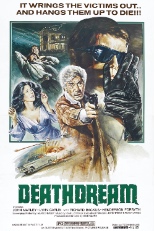
Deathdream (1974)

Black Christmas wasn’t the only horror film Bob Clark directed — just the best and most influential. However, let us not allow history to neglect Deathdream, at once an unofficial adaptation of W.W. Jacobs’ classic short story, “The Monkey’s Paw,” and a feverish allegory on the PTSD of our Vietnam vets.

The family of soldier Andy Brooks (Richard Backus, The First Deadly Sin) receives some tragic, not entirely unexpected news: The young man has been killed while fighting the unwinnable war in ’Nam. Hours later, an apparent miracle follows: In the Dead of Night (to borrow Deathdream’s alternate title), Andy appears in the entry hall, as if he’d come marching home.

He seems a bit, well, off, because he’s a member of the walking dead. The Brookses either are too overjoyed to notice or are in denial — perhaps a helping of both. As viewers, we are not privy to scenes of prewar Andy, but certainly he wasn’t always quite this pale or quick to strangle dogs, was he? Unremarked upon, the Scooby-Doo light switch cover in his childhood room serves as a nice contrast to his sinister new ways, and a reminder of the innocence irrevocably lost in the jungle.
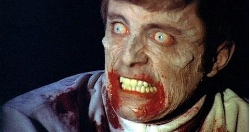
Although he ended up writing for daytime soaps, Backus is awfully good as the prodigal son who joined the Army as a boy and left it as a zombie. The movie doesn’t ask him to display, oh, range, yet as his character’s physical body gradually fails him and falls away, Backus need do little more than remain still and slowly turn his all-American smile into an unholy rictus. The more homicidal he becomes, the more horrifying his face, providing Deathdream with most of its shivers.

If Andy is one-dimensional — and he is — Clark and scriptwriter Alan Ormsby (Children Shouldn’t Play with Dead Things) let John Marley play far more shades. Assured a spot in cinema history for being That Guy Who Wakes Next to a Horse’s Head in The Godfather, Marley has this film’s most complex performance as Andy’s father. In many ways, it establishes the template for what Gregory Peck would do a mere two years later in the showier The Omen: Be torn between the allegiance to his only son and the responsibility for ending his bad behavior. His journey encapsulates the punch line of an old Bill Cosby routine: “I brought you into this world and I’ll take you out.”

With a Pepto-Bismol color palette that mirrors the uneasiness of his tale, Clark nails making the most of not a lot. That he did it twice in one calendar year (with Black Christmas following this to theaters about four months later) makes each picture all the more impressive. —Rod Lott

Get it at Amazon.

10/31 (2017)

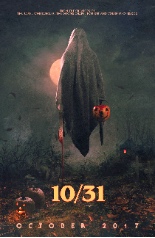
For a terrific horror anthology in which several directors contribute stories themed around All Hallows’ Eve … stick with 2015’s Tales of Halloween. Sorry to say, but 10/31 is an embarassment for the parties involved, most of all the viewer. Heck, let’s throw the actual date of Oct. 31 in there, too, and encourage it to sue for defamation; the movie is that bad.

The poster pegs the project as “from the creators of The Barn, Bonejangles, The Dooms Chapel Horror and Volumes of Blood.” If those titles resonate with you, perhaps you’ll get more out of the Indiegogo-funded 10/31 than the average bear. Expect very little; even the Elvira-“inspired” wraparound — bookends, really — is so barely there, it hardly merits mention.

The five stories contained within fall prey to the severe limitations of so many microbudgeted projects of the horror genre: They appear to have been made by men who are fans first, and filmmakers a distant second. What this means is that in each of their shorts, the directors (Justin M. Seaman, Zane Hershberger, John William Holt, Brett DeJager and Rocky Gray) seem concerned only with gore and makeup and John Carpenter-esque synths, to the detriment of acting, pacing and storytelling.

I’m certainly not against scarecrows and slashers and spooky hags who haunt quaint-but-unprofitable B&Bs. I am, however, opposed to padding a 15- or 20-minute segment with 14 to 19 minutes of filler. Among the worst offenders — in a flick so full of them, it’s practically a police lineup — are Hershberger’s “Trespassers” and Holt’s “Killing the Dance.” While the former offers first-date conversation so interminable, your mind will swipe left, it’s the latter that truly tries one’s patience; with its roller-rink setting, prepare for skating, skating and skating — and more skating! — before getting around to the inevitable stabbing.

I doubt neither the validity nor intensity of the guys’ love of horror — likely, it extends to being sacrosanct. But their infatuation clouded and doomed 10/31’s execution. —Rod Lott

Get it at Amazon.

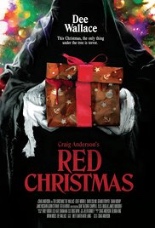
Red Christmas (2016)

’Twas the night of Christmas, and all through the house, not a creature was stirring … except for that aborted fetus who answers to the name of Cletus.

Twenty years ago, Diane (Dee Wallace, The Howling) chose to terminate a pregnancy. In the chaos of the clinic being bombed during her procedure, she and the doctors didn’t realize the remnant in the biohazard bucket wasn’t exactly DOA. Now, with Diane widowed and turning 60, she is grateful to have all of her adult children assembled for Christmas Day … well, the four she knew of, that is. Then, fifth wheel Cletus — wrapped in gauze, clad in a black cloak and hauling a pink suitcase — decides to crash the party.

He just wants to be loved — is that so wrong? Technically, no, but when they kick him out of the house, his retaliation spree of gory murder is something upon which society frowns.

Arriving gift-wrapped for gorehounds, Red Christmas is written and directed by Australian comedian Craig Anderson, but initial streaks of dysfunction aside, it is not a film to be categorized as funny. In fact, it is a bit of an odd bird — in a good way. For one thing, one of Diane’s kids is a Shakespeare-quoting young man with Down syndrome (Gerard Odwyer), a trait not only unexploited, but also vital to the plot. Unsurprisingly, Wallace gives a nail-strong performance, whipping into Mama Bear mode (à la Cujo) when push comes to shove and stab; on the unexpected side, the deaths portrayed come attached with a tangible, tragic sense of loss.

The seasonal slasher obviously has more on its mind than shedding blood, although that is done in explicitly gruesome bits. The interesting thing is trying to determine at first where Anderson’s politics reside, because pro-life viewers can side with Cletus (Sam Campbell) as he takes revenge on his mother’s actions, yet pro-choice viewers could see the film as an indictment of the hypocrisy of pro-life extremists who take “eye for an eye” to heart. As the cast narrows, Red Christmas’ true intentions become clear, yet if you need the message spelled out after all the spillage, the credits end with recommendations with further reading and viewing, including the black comedies Citizen Ruth and Obvious Child. —Rod Lott

Get it at Amazon.

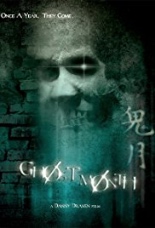
Ghost Month (2009)

Watching Ghost Month kind of feels like it takes that long.

The rather rote horror flick finds young Alyssa (Marina Resa, Roadside Massacre) fleeing an abusive boyfriend and finding work as a housekeeper in the desert home of one Miss Wu (Shirley To, Crank: High Voltage), a Chinese woman who lives with her elderly aunt. Little time passes before spooky things start happening around the place, and Miss Wu blames them on the spirit of her former maid.

In the same haunted-house realm of The Grudge, that angry specter keeps popping up, in several scenes with scares so telegraphed, William Castle would have superimposed a countdown clock in the corner. If one of the ghost’s forms looks like a science-class skeleton with a wig on its head, well, that’s because it is. The movie has an extremely low budget, some of it going toward some computer-animated effects that fall under “decent enough.”

Ghost Month’s story is too bare-bones, unenhanced by the Chinese “rules” Miss Wu relates (and from which the flick earns its love-it-or-hate-it title), but its chief problem is the all-around amateur acting, particularly by Resa, who resembles a poor man’s Jennifer Connelly both physically and in performance, making for a rather unappealing (and thus, unsympathetic) lead. If Connelly couldn’t keep us interested in Dark Water, how could Resa be expected to here?

One can admire writer/director Danny Draven’s persistence in even getting the film made, but not the end result. For proof that the man is capable of better work, plant your tongue firmly in cheek for the marginally better DeathBed or Reel Evil, his bid for a found-footage breakthrough. —Rod Lott

Get it at Amazon.

Jungle Trap (2016)

Whether working together (The Executioner Part II) or separately (Don’t Go in the Woods), actress Renee Harmon and director James Bryan never disappoint me in disappointing me. The last of their seven collaborations, Jungle Trap is the only one to have been considered lost, which is where it could inflict the least amount of harm. The duo wrote the script — yes, there is one — and commenced camcorder shooting in 1990, yet the movie remained unfinished until more than a quarter-century later, when the Bleeding Skull powers that be provided a meaningful assist.

Anthropologist Chris Carpenter (Harmon, Frozen Scream) prepares for a return expedition deep into the Amazon rainforest, although she’s hardly over the experience of losing two people on the previous trek. This mission takes her to the supposedly luxurious Palace Hotel, built over sacred burial ground of the indigenous tribe, whose members were slaughtered to make way for this “millionaire’s playground.” For some reason, Chris and her fellow white explorers fail to recognize any potential negative ramifications that might present.

Located in the middle of the jungle, the hotel — which looks like a semi-decorated, summer-seasonal corner of your local Pier 1 Imports — is haunted. A snake slithers up someone’s bed (pay no attention to the crew member’s hand giving the serpent a good shove at the upper-right edge of the frame). Shrunken heads and full-sized spectres appear willy-nilly. Members of the Carpenter party get decapitated. Feather-laden ghosts of the tribesmen attack, as does stock footage that would not match even if Bryan tried — not least because said clips were shot on film, whereas Jungle Trap could afford only VHS, as if you’d want it any other way.

I would not, because I fear that might jeopardize the movie’s most surreal touches, like the elderly bellhop who appears in the brush as if it’s the most natural thing in the world. Or that the production values might rise in turn, denying us such sights as cast members cramped together in what appears to be a box crudely pinched into a shape approximating the interior of the elderly bush pilot’s airplane. Or that Harmon would be costumed for the evening “horror con” party in something other than her pointy Kleenex dress. At least we know that no matter how many nickels Bryan put into this thing, Harmon still would be rocking her inscrutable, in-need-of-decoding German accent. —Rod Lott