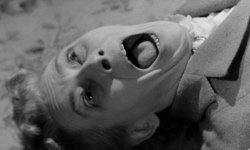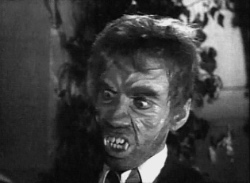
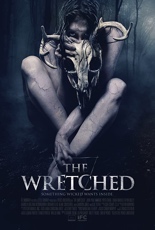
What has eight legs and a man shoving a lit Bunsen burner to his neck? The Legend of Spider Forest, far from legendary.
While staying at a pub in a supposedly quaint English village, ascot-rocking painter/photographer Paul (Simon Brent, Love Is a Splendid Illusion) runs across an unusual young woman walking carefree through the woods. Named Anna (Neda Arneric, Shaft in Africa), she says little, screws lots and is often nude — all the better to tease you with, what with her left shoulder’s distinctive spider-shaped birthmark.
Paul excepted, the men who make love to her don’t survive the encounter, thanks to her summoning into action the forest’s breed of spiders, both highly venomous and immune to chemicals. Wouldn’t the arachnids make an effective weapon for a resurgent Nazi party? Director Peter Sykes (Hammer’s To the Devil a Daughter) sure thinks so.
Or so one may assume, since he doesn’t do much with it — and what he does do is muddled to a point of incomprehension. This Eurohorror oddity will tangle viewers in a web not of intrigue, but internment. At least its tarantulas — underused, sadly — are real. —Rod Lott
I had a short-lived friendship with a person who once, while drunk and on a bridge-burning rampage, told me they were a disciple of Lars von Trier and believed in his supposed theories of “absolute depravity.”
I hauled ass out of that person’s life not too soon after.
I feel like I made more than the right choice to vacate after viewing the film The House That Jack Built and, even more so, after the fact that von Trier cast Hollywood meathead Matt Dillon as an unrepentant serial killer. True to form, it’s a 152-minute movie with the doltish Dillon trying his best to act menacing, a seemingly impossible feat that I can’t tell if von Trier is genuinely exploiting or caustically insulting.
Told in six chapters labeled “incidents,” the killer career of Jack is followed, in a typically detached way that will cause the smarter people in the audience to smirk in unison, as women are brutally murdered, including a mother who watches him slaughter her two small children, and a verbally abused girlfriend who get her breasts sliced off and made into a purse in purely pornographic detail.
The film only becomes slightly interesting in the epilogue where Jack finds himself in the afterlife with the poet Virgil (Bruno Ganz), traveling through an eerily low-budget version of the circles of hell, leading to the only truly satisfying moment of the movie: his well-deserved casting off into the unholy flames.
The main problem with The House is that by now, the boundaries that von Trier has supposedly pushed over the past few decades have become more rote and routine than anything else; this serial killer sex fantasy has been done by better directors with a far more meaningful takes on the subject matter rather than the angry middle-schooler scribbling that, per von Trier’s own words, “life is evil and soulless.”
I hate to say it, but, like I outgrew my former friend’s notable antics, I think I might have outgrown von Trier’s insignificant shock value as well. Is that maturity? —Louis Fowler
One otherwise sunny afternoon, Richard (Ocean’s Eight’s Richard Armitage) deserves a World’s Worst Estranged Husband award for telling his wife he wants to finalize their divorce and marry his new girlfriend — a one-two punch of info that drives the spouse to suicide. Six months later, over Christmas vacation, he earns a World’s Worst Dad trophy to add to that hypothetical mantle by forcing his two kids to spend time in their snow-covered mountain cabin with said girlfriend, Grace (Riley Keough, Logan Lucky), and then leaving them with her for a few days.
Not only is Grace a stranger, but they blame her for their mom’s death. Furthermore, they know she’s literally a psychopath, being the daughter of a Christian cult leader (played by her real-life dad, Danny) whose members killed themselves in a mass suicide à la Heaven’s Gate. Only Grace, befitting of her name, survived, yet bears heavy emotional scars, all of which Keough rightly and consistently plays in the key of dour.
What begins to happen in The Lodge once Richard temporarily vacates is best left to audiences to discover on their own. More eerie than scary, the picture marks just the second narrative feature for the Austrian duo of Veronika Franz and Severin Fiala, following up the acclaimed twin terrors of Goodnight Mommy. This one is even better; call it Goodnight Stepmommy-to-Be. Just when you think Franz and Fiala are pulling pages from their 2014 film for recycling, the course of events changes wildly, and viewers might not be willing to follow if the actors weren’t so good.
Keough is, in particular, excellent, but let’s not diminish the two other equally tricky roles of Richard’s children, played by Jaeden Martell (Knives Out) and Lia McHugh (Along Came the Devil). They interact like real siblings, with McHugh believably conveying grief for which Martell, in turn, provides the big-brother support she needs. And far from Clueless, Alicia Silverstone is terrific in a brief appearance that neither requires nor allows her to lean on her trademark charm.
As was the case with Goodnight Mommy, one important character goes unbilled: architecture. Franz and Fiala build so many shots starting from that foundation, giving The Lodge a touch of delicate elegance even in its darkest corners. Their compositions are crisp and symmetrical, much like the microscopic snowflake of this arthouse horror’s poster. —Rod Lott
In an alternate Earth populated by absolute jerks with loutish personalities, a white-masked killer is — and rightfully so — chopping the populace of Paddock County all to gory pieces, using the edge of his ax, of course.
After brutally attacking a woman in the middle of a car wash, two total dicks — computer fuck Gerald and womanizing exterminator Richard — find themselves in the middle of a murder spree of assholes being stalked and slaughtered. Of course, the prick sheriff — convinced these are all suicides — won’t do anything about it as the body count rises.
Meanwhile, Gerald meets a loathsome woman who asks his computer if he’s “gay.”
An unseen sex worker who has apparently pleasured the entire town is killed, a priggish nurse’s head is irrevocably severed and, even worse, the bucolic lady who plays the organ at church finds her dog butchered all to hell. More pre-1990 computer-based intrigue is had, with dot-matrix red herrings printed all along the way. Just give it a few minutes.
When the killer is quickly unmasked with a contemptible list of unseen clues that weren’t discovered until the last 10 minutes, director José Ramón Larraz (The House That Vanished) gives us the ol’ Spanish switcheroo, with the obvious hopes of Edge of the Axe 2: The Wooden Handle of Death to be immediately financed and put into production. It wasn’t.
A gratuitously bloody example of the depths that a somewhat respected horror director of the ’70s would sink to in the ’80s, the only way that I would run out to see Edge of the Axe is if a faceless killer is trying to chop me up, and even then I’d probably just briskly walk to my computer and Google their identity, because apparently it’s just that easy. —Louis Fowler
Genre enthusiasts will often champion Britain’s Hammer Films as the end-all-be-all of ’60s horror. After viewing Communist Russia’s Viy, however, I think it might be high time we start holding these hammer-and-sickle films up just a little be higher. Don’t tell Joseph McCarthy!
Sometime in the 19th century, a total jerk of a seminary student is attacked by a witch in the countryside; she actually climbs on his shoulders piggyback-style and rides him around the Earth. When they finally land in the soft grass, he gives her a few rights and lefts to the face, killing her instantly; it’s then revealed that she’s actually a beautiful local girl.
In deep borscht now, he’s forced to spend three nights praying with her corpse in a church. The first two nights, though rather spooky with her corpse flying around and such, is mostly all right because he has a protective chalk circle around him, creating a protective barrier. But that third night, the student — drunk out of his gourd, mind you — faces a bizarre cavalcade of diabolical imps, crawling ghouls and a globular blob that needs help from the emaciated zombies to lift his goopy eyelids up.
Viy is a well-done politburo of irreligious terror that, especially when viewed against the anti-Russian propaganda we Americans have been brainwashed with regarding Communism, it is surprisingly ahead of its time, filling the screen with more demonic imagination and unsettling imagery than most of the Western horror flicks that never made it past the Iron Curtain. —Louis Fowler