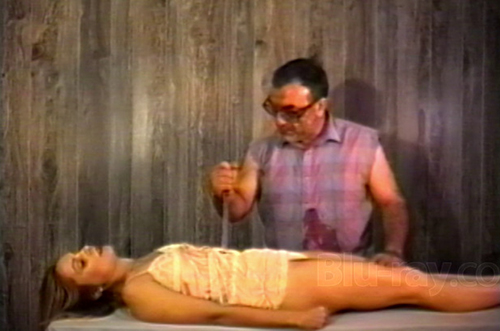
Hey, everybody, it’s spring break! Never mind that we all look like we’re 30 and in vo-tech! Or that our old, gross neighbor lurking around the house in broad daylight is trying to kill us! Let’s party hearty! Woooooohoooooo!
There you have Sorority Slaughter in a nutshell (unsalted, mind you, due to budgetary constraints). It’s a relentlessly stupid, plotless exercise in misogyny, wicker furniture, wood paneling, shag carpeting, hairy arms, Korean deli-counter gore, American cellulite, acid-washed denim, pawed asses and lawn chairs for those asses. But mostly misogyny and wood paneling, given this is a shot-on-VHS production of the mail-order murder specialists of the New Jersey-based W.A.V.E. Productions.
I could and would forgive all that, except it’s so oppressively mundane. With W.A.V.E. impresario Gary Whitson ostensibly writing and directing, Sorority Slaughter stars stalwart Sal Longo as the neighbor who individually — and very, very slowly — sacrifices the cast members one by one to the devil himself. It also features more minutes of car washing than Car Wash, The Bikini Carwash Company and The Bikini Carwash Company 2 combined. (You know what? Imma throw Cool Hand Luke in there, too.)
Look for cameos from scream queen Titanic 2000’s Tina Krause, TV Guide and a shelf full of Reader’s Digest Condensed Books — or don’t look at all. That last option gets my highest recommendation. —Rod Lott
I’ve always found the criminal hijacking of television stations intriguing, usually from a scarier frame of mind than most people. To the creators, it’s a fractured art project; to me, it’s the knob-turning product of manipulative fear I find myself watching in the dark over and over again when I really shouldn’t.
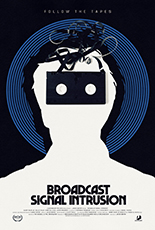
Disagree with me if you must, but I think director Jacob Gentry and writers Phil Drinkwater and Tim Woodall seem to agree with me, as their flick, Broadcast Signal Intrusion, repeatedly hits every play button of unrealized fear that I’ve never been able to fully express to anyone else.
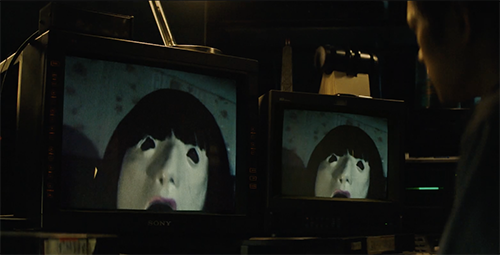
Hearkening back to the signal disruptions of years past such as the Max Headroom incident or the “I Feel Fantastic” video, here we find video archiver James (Harry Shum Jr.) as he’s found a few old broadcast interruptions of a mannequin in a strange room chanting something over and over again, played to great effect; disturbed, he ends up going down one rabbit-eared hole after another to find the smallest shred of truth behind it.
Pretty soon, creepy acolytes, disturbed video enthusiasts and the suicidal followers of these urban legends come out of the VHS woodwork under the guise of helping him out, but mostly end up terrorizing him. As this obsession stretches into his past and his long-lost wife, he appears to head this manic direction as well.
Whereas Broadcast Signal Intrusion seems to be desperately reaching for a finale that might — while not explaining everything — go for an incredibly outlandish ending that a bizarre film like this truly deserves. Sadly, it peters out in the most deflating way possible, leading me to want to spend my life feverishly hunting for the original ending.
But that’s crazy because that’s the original ending … I mean, it has to be, right? —Louis Fowler
Nostalgia is a powerful narcotic, especially in these COVID-riddled, globally warming times seemingly spinning out of control. With such a crummy present and a future too terrifying or unknowable, we comfort ourselves that the past — or at least a fictitious version of the past we yearn for — was better, simpler or maybe just cooler. In Last Night in Soho, a mostly successful psychological horror picture, such romanticism has taken hold of Eloise “Ellie” Tucker, a young woman who moves from the English countryside to London fashion school with a head swimming in the Swinging Sixties’ music and fashion.
But as William Faulkner famously observed, “The past is never dead. It’s not even past.” Or, as the almost-as-literate Billy Joel later put it, “The good ol’ days weren’t always good.”
Ellie isn’t your typical fashion student. First, she is winningly played as a wide-eyed ingénue by Thomasin McKenzie (Jojo Rabbit). Second, Ellie has psychic abilities, as evidenced by her penchant for seeing her deceased mum’s reflection in mirrors. Ellie’s doting grandmother (Rita Tushingham) cryptically references some past incident where such visions might have been overwhelming, but the granddaughter just shrugs it off and hurries to the mod London of her dreams.
The Carnaby Street of yesteryear is long gone. Instead, Ellie is met by a reality of alienating dorm parties, leering old men and a particularly mean-girl roomie (Synnøve Karlsen) who prompts our heroine to rent a room in the flat of an elderly woman (Diana Rigg of ’60s-era TV phenomenon The Avengers) in a nearby neighborhood.
Things start to look up. Even Ellie’s sleep gets exciting. In her dreams, she is introduced to the beautiful and sophisticated Sandy (Anya Taylor-Joy, TV’s The Queen’s Gambit), an ambitious singer determined to make her mark in 1960s Soho. Director Edgar Wright (Baby Driver) and cinematographer Chung-hoon Chung, as enamored of the past as Ellie, envelop their dreamscape London in sumptuous color, while the soundtrack is punctuated by the period pop of Dusty Springfield, Petula Clark and Cilla Black.
But don’t forget what Joel cautioned about the good ol’ days. Ellie’s dreams take a sharp turn as Sandy falls for a smooth-talking manager (Matt Smith) and gets an up-close-and personal experience with Soho’s seamy underbelly. As the proceedings grow darker, Ellie’s dream world begins to spill over into her waking life.
Last Night in Soho is most fun when Ellie and her glamorous doppelgänger explore 1960s London through a series of dazzling set pieces. Wright, a professed cinephile, pays homage to films of that period by using iconic Brit actors Rigg, Tushingham, Terence Stamp and Margaret Nolan, the gold-painted Bond girl of Goldfinger’s title sequence. The nostalgia narcotic proves to be an irresistible high.
Up to a point, that is. The stakes keep rising, but Wright and co-scripter Krysty Wilson-Cairns 1917) might have written themselves into a corner with a preposterous third act that dampens a little of the exuberance preceding it. I can forgive it, though; two-thirds of a great movie is nothing to dismiss, especially if you’re watching through rose-colored glasses. —Phil Bacharach
After you’ve given world cinema a robotic penis drill, what’s left? For Shinya Tsukamoto, the answer had zip to do with terrifying genitalia and everything to do with spritzing neck stumps, poltergeist kitchenware and singing disembodied heads — among other, spindly legged things — in Hiruko the Goblin.
Based on a manga by Daijirô Morohoshi, Tsukamoto’s first post-Tetsuo: The Iron Man project concerns famous archeologist Hieda (Kenji Sawada, Samurai Reincarnation), grieving his wife’s accidental death. When a colleague contacts him with news of discovering an ancient burial tomb on the grounds of a school and said to appease evil spirits, Hieda suddenly regains purpose — not to mention a questionable slapsticky presence.
Needing the type of distraction only an invisible demon can provide, Hieda investigates with the chance assistance of the school custodian (Hideo Murota, Akira Kurosawa’s Kagemusha) and a student (Masaki Kudou, Tokyo Heaven). The teen knows a thing or two about curses, as his back occasionally smokes ’n’ sizzles — like a fresh package of Hormel Black Label bacon on an oily griddle, but with crispy faces emerging from the burnt meat.
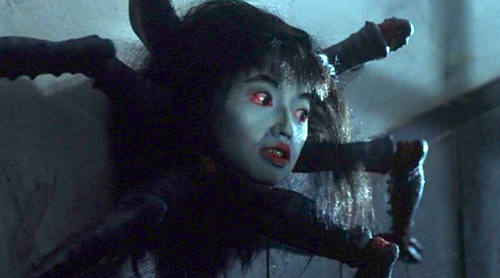
Hiruko would be unmemorable if not for its creep du grace taking hold at halftime: human-headed spiders. Who cares if they’re a pair of legs short? Arachnophobes are guaranteed at least one serving of the heebie-jeebies as these unholy creatures skitter about, crawl up walls and — shudder — leap toward our heroes. All done with models, the spiders give Tsukamoto a stronger tool for conjuring horror than the film’s dull, drawn-out first block, which lifts the frantic-cartoon tricks from early Sam Raimi.
A senseless but gonzo adaptation (and/or approximation), Hirkuo the Goblin is reminiscent of Kiyoshi Kurosawa’s Sweet Home, with Tsukamoto having a slight edge in creativity and, of course, a surfeit of industrial steam-engine sounds. His movie feels like a dream, (in)complete with the gaps of logic that function as connective tissue, lending an additional layer of discomfort and otherworldliness. —Rod Lott
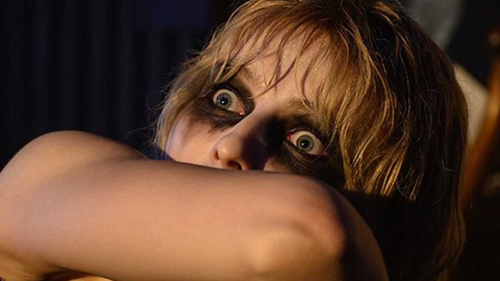
From the first few frames of the Malaysian horror film Roh (which translates to Soul), you’re surrounded with an intense form of backwoods dread that something is definitely not right. It continues throughout the entire running time, creating a beautiful form of subtle terror few films are able to keep up for as long.
A small girl with decaying features follows a brother and sister — who’ve just seen a deer hanging by its necks, mind you — to their ramshackle hut. Though suspicious, the sister tries to help the girl. But after the child gives a freaky warning that the whole family will die in a couple of dies, she expires herself in a cascade of blood, leaving the family to bury her and keep the whole thing a secret.
A secret, that is, until a creepy woman and an even creepier man are, well, creeping around their house, both closer to the dead-eyed dead girl than they will ever admit. As the family tries to desperately fight the sincerely spooky hauntings, by the end, we don’t know if we’re looking into a nightmarish daydream or a brutal reality you can never wake up — or worse, die — from.
In Roh, the scares easily move between wholly atmospheric surrounding to absolutely terrifying jump cuts — something that should be impossible for a first-time feature director. The so-called masters of horror in the West could take plenty of lessons from Emil Ezwan, because in the delicately scant running time of 83 minutes, he’s crafted a horrific new legend I’m surprised Americans haven’t tried to rip off yet. —Louis Fowler


 Hey, everybody, it’s spring break! Never mind that we all look like we’re 30 and in vo-tech! Or that our old, gross neighbor lurking around the house in broad daylight is trying to kill us! Let’s party hearty! Woooooohoooooo!