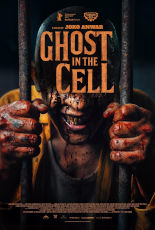
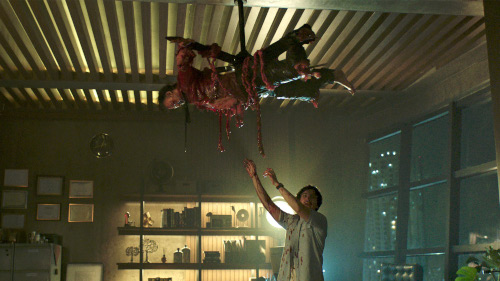
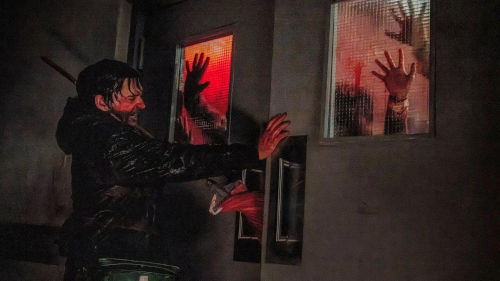
Jojo Anwar’s Ghost in the Cell trafficks in all the tropes of the male prison pic: a tyrannical warden, solitary confinement, drug gangs, slop as food, the threat of shower rape and so on. Its market differentiator, however, is a malevolent spirit that tears, twists and turns its murder victims into grotesque death tableaux à la TV’s Hannibal.
Enlisting several of his Satan’s Slaves actors, Anwar focuses on fresh meat Dimas (Endy Arfian), a meek journalist wrongly convicted for the killing of his abusive boss. The actual culprit is the wraith, which follows Dimas behind bars and takes the corporeal form of its targets during slaughter (thereby distinguishing itself from Renny Harlin’s Prison). It’s like seeing double, except only one is covered in trypophobic skin. As the ghost makes its way from prisoner to prisoner, they shout themselves hoarse over this supernatural force.
Predictably, Ghost in the Cell excels in these sequences, from the initial skirmish to the reveal of the resulting macabre centerpiece, borrowing pieces of Riki-Oh’s operatic insanity in between. As the minutes tick by, the level of humor increases, and unfortunately, that’s where the Indonesian film misses.
Perhaps chalked up to a clash of cultures, the comedy is broader and even slapstickier than what this country’s accustomed to — a pube-laden bar of soap for a sight gag, sure; a full-on dance scene choreographed by an effeminate inmate, you can keep it. And when the dancing extends to a joyous cast-and-crew montage during the closing credits, you’ve effectively neutered all the bite that came before. —Rod Lott
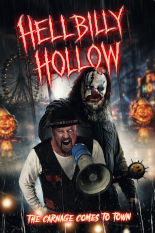
Four internet investigators known as the Paranormal Scream Team travel to check out Alabama’s Hellbilly Hollow haunted house and hayride. Reportedly, the woods around the property are haunted.
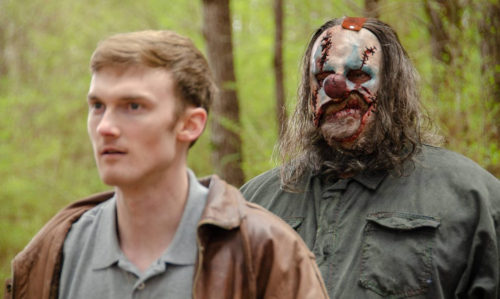
Would it surprise you to learn the attraction is home to a killer clown named Tickles? If so, Hellbilly Hollow might make you defecate your britches. Or so the miserable movie hopes, judging by three references to characters doing just that.
Running the place is a former carny turned hog and soybean farmer Bull, played by Kurt Deimer (2024’s Scared to Death) because Sid Haig is no longer available. The mute Tickles (Kevin Wayne, Malum), who lives in a school bus and eats from a cooler marked “MEEAT,” carries out Bull’s bidding, such as murdering three teens kicked out for messing with the talent, yet somehow are able to re-enter and spray-paint a spurting dick on the wall.
Any initial viewer interest is sapped by the sudden introduction of a supernatural element: the CGI specter of a vengeful voodoo priestess turned fortune teller (Kaila Little). In doing so, Hellbilly Hollow bites off more than it can chew, much less plug between its cheek and gum. It wants to be both a slasher and a ghost story, which operate differently. It’s not like Hollow couldn’t decide which to be; I suspect the idea of choosing never crossed the filmmakers’ minds.
Yet that split personality is not what sinks the pic. It’s simply relentlessly stupid, poorly written and performed even worse. Had it showcased the carnival games of darts and dunk tanks and the like as a hook, Hellbilly Hollow might have emerged as a gut-spiller worthy of “spooky season” priming, but these sequences are barely present and mostly incidental. One thinks Herschell Gordon Lewis coulda shoulda woulda milked that concept into a bloody good time. —Rod Lott
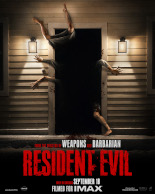
It’s easy for video game adaptations to feel uninspired. Hell, that tendency defines the bulk of Uwe Boll’s career. And save a handful of fun, but otherwise inconsequential animated features, Capcom’s Resident Evil suffered a similar fate at the hands of Event Horizon’s Paul W. S. Anderson and the six films he made starring his spouse, Milla Jovovich.
Though “uninspired” might be unfair. Anderson was definitely inspired by something when making his Resident Evil franchise, presumably The Matrix and Blade, rather than the video games themselves. Because while the presence of zombies, Umbrella Corp. and a few recognizable characters allude to Resident Evil, very little of Anderson attempts actually feel like it.
Introducing some new blood into the biohazard has been long overdue, and among modern horror directors, it’s hard to imagine much anyone who could capture the series’ signature and grotesque campiness better than Zach Cregger (Weapons). Outside of getting a little overzealous with some dialogue that falls flatter than intended, Cregger absolutely nails the vibe of playing Resident Evil without so much as namedropping Leon Kennedy, Chris Redfield, Jill Valentine or even Albert Wesker.
In other words, Resident Evilis definitely a film made for fans of the games, but its devoid of any of the overt, low-hanging fan service that would make it alienating to everyone else.
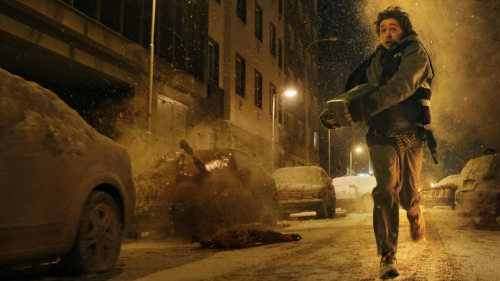
Bryan (Austin Abrams, Weapons) is kind of like an Uber Eats delivery driver. Except for organ transplants. As he starts to wrap up a snowy night’s shift, as well as a conversation with his girlfriend confirming her pregnancy, Bryan regrettably agrees to take a high-priority package to Racoon City. Unprepared to handle the road’s icy conditions, he plows into what he quickly learns is an infected woman in a sundress. One dead cop and a run-in with a mutated dog later, Bryan is desperately dumbing his way toward the top floor of a hospital at the heart of his tentacle-wrapped destination.
While this is technically a zombie flick, Cregger wastes little time fleshing out Resident Evil’s more monstrous leanings. For example, blasting off a zombie’s head might neutralize it. Or, unfortunately for Bryan, it could sprout some extra fleshy digits from the new opening, drag along a few nearby corpses and turn into its own perverse adaptation of another video game, Katamari Damacy. The variety is much appreciated, with each new sequence feeling like another level that Bryan can barely overcome, capturing the spirit of Peter Jackson’s Braindead, without the heroism.
Unlike its source material, Resident Evil is exceptionally good at showing Bryan go through the motion of being a hero without actually becoming one. This idea supports the film’s comically bleak ending, but it’s used throughout to subvert the expectations you’d feel playing a Resident Evil game, or any video game at that. Typically, your actions are presumed justified. Every enemy you mow down or cut in half deserves it, especially when they’re zombies that can transform into outright monsters.
That last part is true for Bryan’s predicament, but he’s far from a cool and collected slayer, nor does he ever really become that. He trips over himself. He misses most of the shots he takes. He accidentally shoots the people he’s trying to save and even promises to rescue a little girl before realizing she’s far too gone, ultimately killing her, too.
Likewise, when we pick up a controller, we’re never actually a hero. We’re pretending to be one. Realistically, we’d tragically end up us monsters ourselves, an idea Cregger uses to put a pin in his adaptation that’s as faithful as it is a rebuttal to Resident Evil as a concept. It’s a paradox that’s well worth the ride. —Daniel Bokemper
Wayward hitchhiking hippie girl Robbin (the Relentless Meg Foster in an early role) skinny-dips in the ocean, albeit trespassing on private property to do so. The landowner, middle-aged madman Jason Henry (Harvey), puts down his peeper binoculars long enough to introduce himself to Robbin and invite her to a steak dinner at his estate. He lives there with his pretty — and pretty protective — sister (Joanna Pettet, Double Exposure), who confesses to their naive guest, “Jason’s very fond of succotash.”
And for dessert? Possibly a rag soaked in chloroform. See, as an epigraph spills and spoils in the film’s opening frames, Jason’s not merely a Korean War veteran, but a full-fledged cannibal. Who can tell us why? Certainly not R&B/telethon legend Lou Rawls, crooner of Arrow Beach’s Sammy Cahn-penned theme song, “Who Can Tell Us Why.”
Harvey’s movie isn’t so much ham-fisted as spit-roasted, with his own arm subbing for the stick. Perhaps sensing he wasn’t long for this world, and thus applying a “fuck it” attitude, he’s unafraid to get his hands dirty — figuratively or otherwise — as his silver spoon-fed character increasingly unhinges himself from the frame of reality. And Pettet, forever underrated, makes one helluva match as a sibling of questionable behaviors herself.
Rather amusingly, the pic feels a decade too late and a half-decade ahead of its time, straddling both sides of the border between Hollywoods old and new. On one hand, you’ve got grizzled ol’ Stuart Whitman (Cuba Crossing) as the law; on the other, ’70s star Jesse Vint (Macon County Line) as one of the lawless. No matter which side Welcome to Arrow Beach favors, it certainly marks the first time I’ve heard a physician pronounce “Quaalude” as “kwah-lude.” It’s hip to be square, but not that square. —Rod Lott
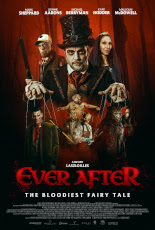
This Ever Afteris no Cinderella Story, like the 1998 Drew Barrymore hit. However, it does have a Prince Charming (Ghost Bastard’s Philippe Reinhardt), albeit one who roofies women and plays with rocks.
It also has a Little Red Riding Hood (Borderlands’ Riana Emma Balla) who quips, “Happy ever after, motherfucker!” before shotgunning someone, but I’m getting ahead of myself.
From Hungary, this storybook slasher smorgasbord concerns seven young women on a bachelorette trip to a rental house in a desolate forest. None of the ladies bears a character trait beyond “horny,” but that’s okay since Ever After is interested in entrails, not introspection.
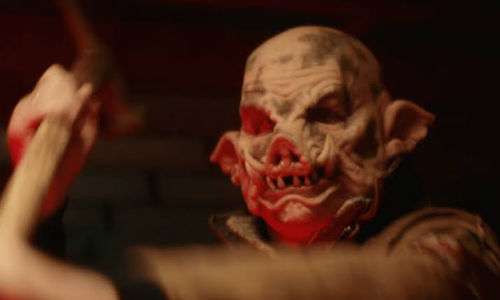
As the bloodletting begins, the girls encounter: • three pig-masked men whose instruments of death include a sledgehammer, flamethrower and massive bare belly • a redneck huntsman (Michael Berryman, 1977’s The Hills Have Eyes) • a big bad wolf (voiced by Kane Hodder, Jason X) clad in leather vest adorned with kitty cats and an “I’M SPECIAL” patch • a frog king (voiced by Malcolm McDowell, 1982’s Cat People), complete with crown • a witch (Bonnie Aarons, 2018’s The Nun) • and a circus ringmaster (Mark Sheppard, TV’s Supernatural) who speaks in riddles and rhymes
Although I’m not against paychecks, I’ve come to despise the Expendables-of-horror casting approach in which Ever After and so many indie fright films indulge. Generally, because doing so suggests that’s all the movie has going for it. That’s not quite the case here. Director and co-writer Laszlo Illes (Haunting Trophies, get it?) lines his fucked-up fairy tale with dialogue that’s either spoken in jest or lost in translation: When a bear trap snaps around a woman’s ankle, her friend shouts, “Quick! The tweezers!” If the result of a language barrier, at least it kept me mildly interested.
Gorehounds won’t be satisfied, considering the acts of carnage occur off-camera — retractable-blade knifings notwithstanding. Illes clearly has ambition, but perhaps way too much. His greatest sin is overstuffing the story. Seriously, why is this more than two hours long? By comparison, Christopher Nolan’s epic The Odyssey runs nearly three, but that covers 20 years to Ever After’s, oh, 36 hours.
Slashers should leave you wanting more, not less — just not wanting everything more because it has zip to offer, à la the similar public-domain path-trodding Winnie-the-Pooh: Blood and Honey. Unlike that dump, this is bearable. —Rod Lott