
Category Archives: Horror

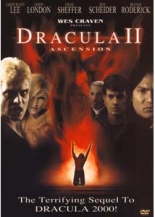
Dracula II: Ascension (2003)

Not a single cast member from the Wes Craven-presented Dracula 2000 returned for Dracula II: Ascension, the first of two straight-to-video sequels, and who can blame them?

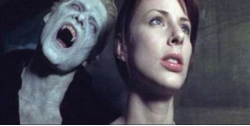
Picking up where D2K ended, with the count burnt to a crisp on a neon crucifix, Ascension wheels the charred corpse of the vampire lord into a morgue, where the enterprising workers steal the body, sensing an opportunity to make some money. They take it to the conveniently vacant and isolated mansion of their professor, played by Craig Sheffer. He’s confined to a wheelchair because of cerebral palsy and has his left hand drawn up and turned in a way that looks like he’s constantly playing charades and no one has yet guessed “hieroglyphics.”

Sheffer — like Stephen Hawking without the RoboVoice and the charisma — believes the key to his cellular regeneration lies within the blood of Dracula, so he has his students revive the body by literally giving him a bloodbath. It works, and the first to die is former Playboy Playmate of the Year Brande Roderick, who briefly comes back as cinema’s only vampire to sport matching red bra and panties from Victoria’s Secret semi-annual lingerie sale. Eventually dying (but not soon enough) is the token black guy who, after sprouting fangs, exclaims with no irony, “I got the hooyah power in me!”

Meanwhile, the increasingly oval-faced Jason Scott Lee tracks them down. He’s a priest-cum-vampire hunter, as quick with the scythe as he is with the scripture, and he is as intent on saving souls as he is severing heads. Oh, and what of Drac? He’s tied up for nearly the entire movie, freed of his chains only at the end to set up Dracula III: Legacy, leaving one to hope it has more bite. —Rod Lott

Buy it at Amazon.

The Thing (2011)

It’s obvious that the people behind The Thing remake studied John Carpenter’s gruesome masterpiece before they began their prequel. But studying ain’t the same as mastering; while Thing 2011 plays the same notes as Thing 1982, there’s barely any music to be heard. Maybe it’s an unfair comparison, but when you produce a prequel to one of the genuine horror classics of all time, you know the risks going in.

Carpenter attached the scenario of an alien that perfectly mimics other life forms to an isolated arctic base and amped the claustrophobia, resulting in a paranoid classic that is also one of the great practical effect showcases. Matthijs van Heijningen Jr. follows the template, but leeches away any hint of tension. It’s not that the audience knows the ending going in; it’s far more that you should never trust a brand property to an unproven talent (see also: anything produced by Platinum Dunes, Michael Bay’s production company). There isn’t one moment in this Thing that isn’t completely predictable.

Where does it go wrong? It’s the overuse of painfully obvious CGI where practical effects would have been a far superior choice. It’s the unnecessary Americans that join a group that we have, for 30 years, assumed to be completely Norwegian. It’s the marked lack of Kurt Russells, Wilford Brimleys and Keith Davids. It’s the oversights of particular plot points in the original (what happened to the thermite charges?). It’s the replacement of Ennio Morricone’s eerie score with a bombastic symphony that telegraphs every scare. It’s the disappointment of seeing that the inside of the spacecraft is just stereotypical weird tunnels. It’s rejigging the idea that anyone could be the monster to, “Oh, I think I know who the monster is: that two-headed guy running down the corridor.”

It’s all this, and more. When only one scene even approaches the level of terror and/or coolness of the original (think face-melting), you don’t have a true sequel, an adequate prequel, a loving tribute or an energetic fan film; you have a sweaty-faced Elvis impersonator in a polyester suit, fighting a heart attack while he bellows “Suspicious Minds” to a group of bored tourists in Nevada.

That said, it’s still better than anything Platinum Dunes has ever released. —Corey Redekop

Buy it at Amazon.

The Girl in Room 2A (1974)

Women’s prison was a cinch compared to the boardinghouse for Margaret, aka The Girl in Room 2A. And not because of the blood spot under the carpet or the god-awful wallpaper. It’s the guy in the red-pantyhose mask and matching cape who steals the babes who live there and takes them to a torture dungeon, where they are whipped, electrocuted, prodded and poked.

Margaret (Daniela Giordano, Mario Bava’s Four Times That Night) was busted at a party where grass and pills were being consumed; while she didn’t partake, guilt by association landed her behind bars for a short time. Upon release, one of the guards steers her toward a place to stay, ran by the kindly Mrs. Grant (Giovanna Galletti, Kill Baby, Kill). On her first night, a nerve-addled Margaret “hallucinates” the pantyhose man coming into her room.

The brother (John Scanlon, Escape from Alcatraz) of 2A’s previous occupant investigates his sister’s out-of-character death: “Cut the jazz! What’s she talking about?” Could it be Frank (Angelo Infanti, The Godfather), Mrs. Grant’s nerdy son whose workshop is filled with mannequin heads and miniature guillotines? Or perhaps that strange cult that holds meetings on the ground floor, hmmmmm?

The final film directed by sex-pic auteur William Rose, The Girl in Room 2A doesn’t quite reach the Hostel-ility posed by its prologue. Whenever the L’eggs-clad villain shows up, the Italian thriller fills with a little life for scenes of death. Whenever it doesn’t, the movie feels like a series of red herrings biding time until the inevitable conclusion. —Rod Lott

Buy it at Amazon.

Just Before Dawn (1981)

Unless you’re a real horror movie geek, I think it’s probably a safe bet for me to describe Jeff Lieberman’s Just Before Dawn as the best slasher movie you’ve never seen. Why it remains so obscure is something of a mystery, since the people who have seen it tend to get very excited when talking about it, and you’d figure that their enthusiasm would be contagious, but it’s never quite worked out that way.

It’s almost tempting to theorize that Lieberman might be suffering from some sort of curse, since his often-outstanding work never has gotten him the attention he deserves. His great sci-fi/horror satire, Remote Control, has yet to make it to DVD and his most famous effort, Squirm, has the dubious distinction of being the best film to have ever been mocked by Mystery Science Theater 3000 (and, yes, I happily would say that right to This Island Earth’s face).

Combining the standard elements of the slasher genre with the backwoods horror of Deliverance and The Hills Have Eyes, Just Before Dawn succeeds thanks to skillful direction, effective atmosphere and — most importantly — a cast of likable characters whose endangerment causes us to feel actual anxiety and empathy, rather than the usual slasher-movie schadenfreude.

The plot is bare-bones simple: Several campers in search of an inherited mine in a dangerous forest find themselves being hunted by the demented offspring of the area’s requisite family of religious freaks. But the beauty of the slasher genre is that the plot is always secondary to the execution, and by that standard, this neglected gem easily ranks as one of the best of its kind. —Allan Mott

Buy it at Amazon.

The Last House on the Left (1972)

Attention, The Last House on the Left: Your reputation as a horror landmark is at stake. I call shenanigans! “Keep repeating: It’s only a movie …” and not a good one.

Yes, it has blood. Yes, it has rape. Yes, it has scenes of more unrelenting violence. But it also has slapstick comedy with rednecks, complete with “wacky” music. And a near-toothless African-American woman who would seem at home on a MADtv sketch. And dare I even mention the banjo-pop soundtrack with songs about the villains? Bad guys’ themes should not be played on the instrument most associated with TV’s Hee Haw.

But onto the story, which marks the screenwriting and directorial debut of Wes Craven, who later would birth terror icons in Freddy Krueger, Ghostface and whoever Meryl Streep played in that violin movie: Virginal 17-year-old Mari Collingwood (Sandra Cassell, Teenage Hitchhikers) and her best pal (Lucy Grantham) have the unfortunate experience of trying to score pot, but instead running into a felonious foursome led by Krug (David Hess, instantly typecast).

Krug’s so evil, he got his own son (Marc Sheffler) hooked on heroin. Weasel (Fred Lincoln) is a child molester, and Sadie (Jeramie Rain, later Mrs. Richard Dreyfuss) is merely a psycho bitch from hell. Rape and murder ensue, then the tables are turned when car trouble puts Team Krug as guests in the Collingwood home.

Craven and company’s absolute amateur-hour efforts kill whatever power was intended. That’s not to say what Krug and f(r)iends do isn’t horrible; it is. But torture of characters doth not a good movie make, and there’s nothing offered — original or otherwise — to elevate Last House. I even think some of its many rip-offs do the same story far better — Italy’s Night Train Murders, for one — and Hollywood’s vastly superior 2009 remake boasts suspense and style. Yeah, I said it. —Rod Lott

Buy it at Amazon.