
Category Archives: Horror

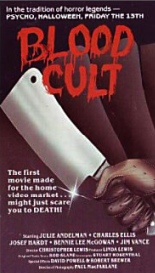
Blood Cult (1985)

bloodcultWhether Blood Cult was the first movie made expressly for the home-video market as it claims does not matter. What does is that the Tulsa, Oklahoma-lensed picture is the perfect example for what shot-on-video projects do wrong and right — mostly wrong, starting with enough padding to rival a Tempur-Pedic mattress.

For example, a college student is horrified to find two chopped-off fingers in her cafeteria salad, and the scene fits into the plot. But what we don’t need is what director Christopher Lewis (son of actress Loretta Young) gives us beforehand: the coed being welcomed by the cafeteria worker; the two engaging in idle chit-chat; the coed selecting the broccoli and meat patty; the worker placing said meat patty on a tray; the coed selecting a diet Coke; the coed approaching the register; the cashier asking for $2.90; the cashier giving her a dime in change; the coed approaching the salad bar; the coed stirring the cottage cheese; the coed opting not to take any cottage cheese; the coed instead choosing your regular garden salad.

bloodcult1It’s all done to fill out a standard story of a black-gloved killer who carves up sorority girls with a glisteningly sharp cleaver and takes limbs as souvenirs. Investigating is Sheriff Wilbois (Charles Ellis, who returned for the following year’s sequel, Revenge), a rotund, elderly fella who looks like a TV pitchman for suspect Medicare supplements, and talks to himself a lot about the clues he finds. We call this “exposition.”

For shooting on Betacam with a $27,000 budget, Lewis achieves some interesting angles and tricks, but lacks in the other areas that carry equal weight, from credible performances to establishing tension. For the latter, witnessing the sheriff chow down on food from Arby’s while on stakeout does not count. Still, Blood Cult certainly is watchable — and not just for being a footnote in film history within the chapter titled “VHS Revolution and the Mom-and-Pop Video Store” — although saddled with the weakness that marks so many SOV efforts: a genuine love of movies that shows through, but not necessarily the know-how to pull one off. —Rod Lott

Buy it at Amazon.

The Night of the Devils (1972)

nightdevilsRight from the start, The Night of the Devils is a room-clearer, announcing its intentions to the audience with a nightmarish montage of full-frontal nudity and graphic violence, complete with an exploding head and a ripped-out beating heart. “Don’t like it?” the film seems to say. “It’s best you leave now.”

Indeed, the Italian Gothic horror film from director Giorgio Ferroni (Mill of the Stone Women) is envelope-pushing for its time, rubbing your face in close-ups of unflinching gore and pressed flesh.

nightdevils1Gianni Garko (Devil Fish) literally stumbles into the story as Nicola, an amnesiac brought to a mental institution. Taking up most of the running time, a flashback reveals how he got there: Swerving to miss a woman in the woods, he experiences car trouble, and ventures to a nearby, rundown village for help. There, they keep the windows barred as protection against what plagues the night.

The Night of the Devils draws inspiration from Aleksei Tolstoy’s “The Wurdulak,” a story that also informed the Boris Karloff-starring segment of Mario Bava’s 1963 anthology film, Black Sabbath. The similarity isn’t readily apparent until the flashback begins. Whereas the Bava adaptation feels a little long in the tooth, this feature-length version ironically is the more successful telling. —Rod Lott

Buy it at Amazon.

Silent Night, Bloody Night (1972)

snbnOn Christmas Eve 1950, the only thing roasting at the Wilfred Butler mansion was Wilfred Butler himself! Mysteriously dying by fire, he left his estate to his only surviving family member, grandson Jeffrey (James Patterson, In the Heat of the Night), with explicit instructions to leave the house untouched. Twenty years later, Jeffrey and his attorney (Patrick O’Neal, The Stepford Wives) — neither of whom has stepped foot inside the place — come to town to negotiate its sale.

Coinciding with their yuletide arrival, the sleepy small town is terrorized by an escaped lunatic out for revenge, citing the ol’ crimes-commited-years-earlier reason. What director Theodore Gershuny (Sugar Cookies) attempts to pass off as suspense is actually poor story structure. By not revealing pertinent facts until the second half, viewers are left to wonder just what the holy hell is going on.

snbn1That’s why the back half of this mouse-quiet shocker is better, if not gorier. The extended asylum-revolution flashback is genuinely disturbing, as is the finale. Alternately stylish and amateurish, Silent Night, Bloody Night is often slow-moving, but effective in building atmosphere that’s palpable even in the shoddy public-domain prints.

Over the years, I’ve found it’s a movie that improves a bit with each viewing — all but its gratuitous Mary Woronov voice-over — once you come to peace with what it is and what it is not. And it is most definitely not Silent Night, Deadly Night, so don’t confuse the two. —Rod Lott

Buy it at Amazon.

X Game (2010)

Rumor has it that a recent rash of suicides among young people in Japan is due to a bully taking revenge for past transgressions. Why else would the victims have a large “X” branded so crudely onto their faces?

After his sixth-grade teacher “leaps” to his death, Hideaki (Hirofumi Araki) strongly suspects it to be the work of Mariko, a pale, homely girl who was teased mercilessly that year of grade school before transferring. Her abusers engaged in a game called “X Game,” in which Mariko was made to pull slips of paper from a pink box; whatever demeaning act was scrawled on those scraps was what they would do to her, from forcing her to sit atop thumbtacks to lighting her hair on fire.

Karma’s a bitch, as Hideaki and three former classmates find out when they find themselves trapped in a caged room made to look like their elementary school room and guarded by two hooded men armed with cattle prods. Mariko has infused ye olde X Game with modern technology; as monitors explain to our captive quartet, they’re to enact 13 punishments, with the victim of each determined at random. Whether that’s being force-fed gallons of milk via a tube or eating a meal of fried rice and maggots, they have three minutes to comply or they’re whisked away for a branding, then returned to the game.

I need not tell you that X Game is a J-horror response to Saw; you might surmise that simply from reading the title. So was director Yôhei Fukuda’s earlier pair of Death Tube movies, but this effort is more polished in both script and sights. At a hair under two hours, it’s still too long by a quarter, yet devious enough to satisfy fans of the madman-run-contest subgenre. —Rod Lott

Buy it at Amazon.

Bloodbeat (1983)

Fabrice A. Zaphiratos’ directorial debut and swan song, Bloodbeat, is confused, yet unique. Name one other regional horror film in which rednecks encounter a woman possessed by the spirit of an ancient samurai warrior. Why such a setup? “Why the eff not,” Zaphiratos seems to answer.

It’s Christmastime, and at a rural Wisconsin home just good enough for indoor plumbing, the grown children of artist Cathy (Helen Benton) — she of the ever-present rainbow shawl — have come for a visit. Ted (James Fitzgibbons) has brought along his new girlfriend, Sarah (Claudia Peyton), to whom his mother takes an instant dislike. Sarah reciprocates, telling Ted that she feels like Cathy is invading her mind. Later, Cathy confesses she swears she’s met the girl before: “It’s more than déjà vu.”

What it is remains unclear, but an armored, helmeted samurai who glows blue and brandishes a sword starts killing countryfolk, including an overweight man who wears a dirty CAT Trucking cap to bed. As the samurai penetrates flesh, Sarah is wrapped up in the sheets, writhing in such orgasmic bliss that her pelvis would practically touch the ceiling fan, if the family had one. In Cathy’s home, lights flicker, windows open, groceries shake; her live-in hunter beau, Gary (Terry Brown), is nearly killed by flying packages of Lipton Tea and Quik.

Zaphiratos displays some serious bravado by daring to score the film’s climax with “O Fortuna” from Carl Orff’s Carmina Burana, a staple of action-film trailers. Make no mistake, however: Bloodbeat is no work of operatic tragedy. Amateurish on all levels, it has more in common with the deer entrails Gary pulls out with his bare hands: messy, smelly, something you’d rather not see. —Rod Lott

Buy it at Amazon.