

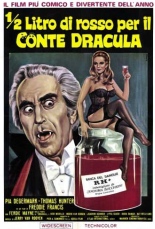
 After an incognito viewing of herself in an adult movie shown on a commercial airline (!), American actress Betty Williams (Pia Degermark, Elvira Madigan) lands in Transylvania, where she has just inherited the requisite spooky old castle whose basement is laden with torture devices specifically for use on naked women.
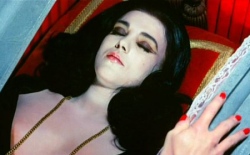
The place also bears — bares? — a nude portrait of her great-grandmother, Baroness Clarimonde (also Degermark), who looks just like her, except that Betty’s hair is blonde to her ancestor’s brunette. Also, Clarimonde is a vampire who emerges from her coffin and corrupts nearby villagers, in particular the leering Catholics next door. Seduction follows, several times over.
 All this culminates in quite the swingin’ party-cum-orgy where the guest of honor is none other than Count Dracula himself (Ferdy Mayne, Conan the Destroyer), who swoops in on his own branded helicopter, flashes the devil’s horns to his admirers, and goes inside to enjoy a banana. If you couldn’t tell by now, The Vampire Happening is a stab at sexy horror comedy à la The Fearless Vampire Killers, but minus the touch of Roman Polanski. (In his place is Hammer/Amicus vet Freddie Francis.)
In the most riotous scene, Betty flashes a monk from her window, prompting the lust-suffering holy man to the imagine all the surrounding trees as naughty parts, moss and all, like something from the height of the Zucker/Abrahams/Zucker era. Speaking of, the gay male flight attendant gags in the opening scenes are as un-PC as Stephen Stucker’s running ones in Airplane!, but not as funny. In fact, little in Vamp Hap is truly funny, but the movie is so odd, so laden with nudity, so goofily self-aware, you gotta see it anyway. —Rod Lott
 Speaking of

 Eurotrip aims for crude laughs and earns some in gags involving a cymbal-playing monkey, David Hasselhoff and the aforementioned Armisen. But much of it is just being vulgar or stupid for vulgar and stupid’s sake. I guess either you find a near-incestuous encounter between inebriated brother and sister incredibly humorous or you don’t. Ditto a kindergartener who apes noted Jew-killer Hitler, or a impoverished girl peeing while standing up on the sidewalk. I’m sure the kids will eat it up.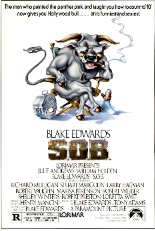
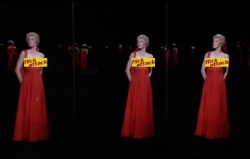 Unlike the film within the film, the sight of Julie Andrews’ breasts didn’t cause anyone to rush to the box office, but that doesn’t mean S.O.B. isn’t a classic satire of early ’80s Hollywood culture. While occasionally overly broad and at least 30 minutes too long (I would have cut most of the last 20 minutes and everything to do with Loretta Swit’s gossip columnist), the movie is often laugh-out-loud funny and features an amazing cast doing what they do best.