
Category Archives: Comedy

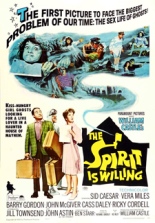
The Spirit Is Willing (1967)

Leave it to William Castle to turn a triple homicide into the basis for a comedy. The result is The Spirit Is Willing, a dispiriting effort from the usually reliable director. In fact, of all his films since Castle became a name brand with 1958’s Macabre, this is the only one I’ve seen that wasn’t at least mildly fun to watch. Even taking his minor works into account, from Zots! to Shanks, I didn’t think such an un-feat were possible.

At the same time, I wish it no ill will, because it’s entirely harmless and full of the good-naturedness that made Castle a matinee hero. Its focus is on a lovely, coastal, 19th-century home haunted by the ghosts of Ebenezer, Felicity and Jenny — a love triangle between a greedy man, his ugly wife and their attractive maid, all of whom kill one another in the jaunty, played-for-laughs prologue.

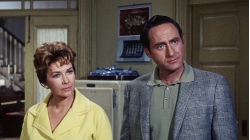
The trio of mute spirits has scared away residents for ages — depicted in a crudely drawn credit sequence — and the latest arrival is the Powell family, on an extended vacation: worrisome magazine editor Ben (Sid Caesar); his subservient wife, Kate (Vera Miles, Psycho); and their temperamental teenage son, Steve (Barry Gordon, The Girl Can’t Help It). As soon as the Powells move in, the ghosts get to work wreaking havoc, and Steve angrily shoulders the blame for all the damaged antiques and even sinking his uncle’s yacht.

With guest turns from John Astin, Harvey Lembeck and Doodles Weaver, Spirit offers nothing that merits more than the rare, occasional smile. In fact, from today’s perspective, Steve’s outbursts are so violent, they provoked stress and discomfort in this viewer. For ghosts swirling around the heads of befuddled characters, Castle offered 13 of ’em in a far superior spookshow. This one’s just a rare misfire for the man. —Rod Lott

Buy it at Amazon.

Sixpack Annie (1975)

Looking like Reese Witherspoon with actual breasts, Lindsay Bloom (TV’s The New Mike Hammer) fronts the sexy, saucy and supremely silly hick pic Sixpack Annie. The young filly drives a beat-up Ford pickup truck whose seat she often shares with pull-tab cans of Miller nestled snugly in a dirty Styrofoam cooler. And she’s so hot, I’ll forgive the title’s error of not self-hyphenating.

The AIP cornpone comedy focuses on Annie’s attempts to save her aunt’s diner, where Annie waitresses in short shorts, from bank foreclosure. Her solution is simple: Just find a “sugar daddy.” In the small town of — ahem — Titwillow where she lives, works, drinks, trespasses, skinny-dips and speeds, the pickings are as slim as her waist, although everyone wants to bed her. That includes the guy they call Long John, whose license plate reads “9 INCHES.”

So Annie and her BFF Mary Lou (Jana Bellan, American Graffiti) head to Miami Beach to land a rich man, and take tips from Annie’s sister (Louisa Moritz, Death Race 2000), who works there as a flatulent, busty hooker. The jokes wrung out of every situation are goofy, sometimes stooping to the level of literally banana-peel humor. But damned if Bloom doesn’t go at it whole-hog, injecting the white-trash shenanigans with as much bubbly effervescence as the periodic bottle of Dr Pepper. The soda giant must’ve paid for the product placement, because it’s practically a supporting character.

Plus, Sixpack Annie boasts the best ending in motion-picture history, when the Titwillow sheriff (Joe Higgins, Flipper) puts on his hat and doesn’t realize Mary Lou has filled it with milk! And then he walks into a midget (Billy Barty) carrying a tray of cream pies, causing the desserts to smash in the little guy’s face! And then the angry dwarf gets revenge by smashing a pie into the sheriff’s face! And the sheriff is so mad that steam practically shoots out his ears! (Should I have added “spoiler alert” before all that?)

Also, there’s a song called “Them Red Hot Nuts.” —Rod Lott

Buy it at Amazon.

A Guide for the Married Man (1967)

Directed by dancin’ man Gene Kelly of all people, this must be the only movie in history built on the conundrum of where, when, why and how Walter Matthau should use his penis for evil.

As investment counselor Paul Manning, Matthau is happily, lovingly married to the beautiful blonde Ruth (Inger Stevens, Hang ‘Em High), but his best pal, smarmy lawyer Ed (Robert Morse, TV’s Mad Men), boasts about having his cake and eating it, too. Why, due to Ed’s continuous but well-concealed affairs, he claims he hasn’t been irritated by his wife in about six years! Ed promises to show Paul the ropes of the effective cheating process, and does, which makes up nearly all of A Guide for the Married Man.

Ed’s quite the font of knowledge when it comes to infidelity dos and don’ts. He has dozens of stories to share, which Kelly depicts via all-star vignettes. These feature such luminaries — or “technical advisors,” as they’re credited — as Jayne Mansfield, Sid Caesar, Lucille Ball, Carl Reiner, Linda Harrison, Jack Benny, Polly Bergen, Art Carney, Joey Bishop, Terry-Thomas and more. Whether within or outside of these It’s a Horny, Horny, Horny, Horny World mini-movies, almost every bedroom features separate beds, which seems awfully prudish for the time, yet plenty of bosomy babes in their undies (most notably Whatever Happened to Aunt Alice?‘s Claire Kelly and Diary of a Madman‘s Elaine Devry), which seems awfully raunchy for the time.

Only 1967 could get away with such an icky premise, by rendering it completely charming, yet still be funny and sexy. Then again, this being ’67, and Matthau being Matthau, you also know before The Turtles even finish singing the catchy theme song that he’s not about to make an odd coupling with anyone else but his loyal (if too subservient) Suzy Homemaker. To that end, Stevens is perfect casting as a doting dream wife: smart, sociable and absolute dynamite in a bikini. You know Guide is fiction because the film opens with her wanting it bad, but the only thing Matthau opts to bury is his big ol’ nose … in a book. —Rod Lott

Buy it at Amazon.

Will Success Spoil Rock Hunter? (1957)

With cinema attendance then taking a licking at the antennas of free TV, director Frank Tashlin literally stopped the story of his 1957 comedy, Will Success Spoil Rock Hunter?, to take a swipe at his competition’s inferior nature to the magnificence of the movies. Delivered by star Tony Randall, the pointed jabs include mentions of a tiny picture, constant commercial interruptions and the nagging menace of horizontal hold.

Not mentioned is the main advantage movies had over TV: Jayne Mansfield. A year after they hit it big with The Girl Can’t Help It, Tashlin again called upon the bleached-blonde bombshell to infuse his sex comedy will all the sex it needed. She rose to the challenge with resolute effervescence and her trademark ditzy noises, which will either endear or enrage. The result, while subordinate to Girl, is one big ball of fluffy fun.

Although her character is named Rita Marlowe, Mansfield more or less plays herself — or her Hollywood public persona, at least — an actress whose “oh-so-kissable lips” mild-mannered ad exec Rock Hunter (Randall) wishes to exploit in a job-saving campaign for a cosmetics client. She agrees, but also uses him to get even with her high-profile boyfriend, a Tarzan-esque actor (real-life hubby Mickey Hargitay). Whereas most straight males would be unable to resist Mansfield’s advances, Hunter’s heart aches for his secretary (one-time Cary Grant spouse Betsy Drake), whose curves can’t compete because they’re practically nonexistent.

Forever underappreciated, Randall excelled at these kind of underdog, cog-in-the-system roles, and he provides Success with the majority of its laughs, both verbal or physical. Mansfield excelled at dumb, too, which unfortunately got her typecast, but this is one of her very best showcases. As satire, the film is lightweight — just like the Madison Avenue world it spoofs with kid gloves, and never more memorably than in the commercial parodies that wreak havoc with the opening credits. As with Help It, Hunter holds no “real” ending, yet it made me smile so wide, this guy can’t fault it. —Rod Lott

Buy it at Amazon.

The Girl Can’t Help It (1956)

Frank Tashlin’s background directing Looney Tunes paid off big — in more ways than two — in the rock ‘n’ roll comedy The Girl Can’t Help It, giving him the opportunity to work with the live-action cartoon that was Jayne Mansfield. At 40-21-35, her curves are so improbable, they make for the kind of exaggerated fantasy that existed only via pen and ink, not flesh and blood.

And yet, here she is, filling the frames of this vibrant, buoyant rom-com as Jerri Jordan, the shapely kept woman of gregarious gangster “Fats” Murdoch (Edmond O’Brien, D.O.A.) who wants to make her a singing star. To do so, he hires agent Tom Miller (Tom Ewell, The Seven-Year Itch) because he knows Miller is desperately in debt and has a reputation for keeping his hands off clients; Jerri’s chassis invites nothing if not eager mitts.

Tashlin obviously knew this, and thus, created a scene of Mansfield making a scene simply by strutting down a sidewalk. The resulting reactions — physical, chemical, what-have-you — comprise some of the funniest visual gags committed to film. Half of the movie’s point is how seriously people refuse to take a woman with a body like that; unlike much of her career afterward, Mansfield’s actually allowed to act, and does a wonderful job. Both she and her character are smarter than they’re given credit for, no matter how many thrifty erections they so inadvertently inspire.

Girl is equally known for showcasing a wealth of acts from the sock-hop era of pop music, and the flick’s jukebox is as well-stuffed as Mansfield’s sequined gowns. Those seen (and heard) in action include Little Richard, Gene Vincent (“Be-Bop-a-Lula”), Eddie Cochran and Fats Domino. Best of all is Julie London, who croons “Cry Me in River” in full while appearing as a ghost in Miller’s apartment. It’s as sexy as anything Mansfield does, without the torch singer even trying. —Rod Lott

Buy it at Amazon.