
Category Archives: Comedy

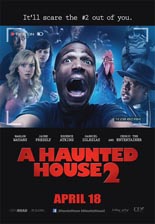
A Haunted House 2 (2014)

ahauntedhouse2In this politically overcorrect age, can one pan a Marlon Wayans project without being pegged a racist? No? Allow me to try anyway: Somehow, A Haunted House 2 is even worse than 2013’s A Haunted House, a parody so generic, its title perfectly matched. That a mere 15 months passed between the release of each suggests that “rushed” and “half-assed” were intentional. Give Wayans and director Michael Tiddes (Fifty Shades of Black) 15 months more and the sequel would fare no better; it might even play worse.

Wayans’ character of Malcolm has married — gasp! — a white woman (Jaime Pressly, DOA: Dead or Alive), thereby affording Wayans and frequent co-writer Rick Alvarez the single domino they need to push in order for the couple to move into a new home, which also is haunted. Cue the spoofs of The Possession (an evil box), Sinister (evil home movies) and whichever Paranormal Activity chapter happened to be around then.

But mostly it depends upon The Conjuring, because its creepy Annabelle doll shows up and — I hope you’re sitting down! — she won’t leave after Malcolm has sex with her. That bit stands for everything wrong with this sequel and Wayans’ one-track shtick in general: It’s not enough to let a few thrusts tell the joke; instead, we get to see Wayans hump (and perhaps rape) it in position after position, until the gag is beaten as lifeless as the damn doll. Elongating such a imagination-free joke doesn’t make it funnier — just more desperate.

If Wayans isn’t obsessing over penile whereabouts, he’s reinforcing stereotypes that smart comedies would break down. And if he’s not doing that, he’s going for the even easier laugh by shrieking. Those are his three moves and, over and over, they constitute one worthless movie. —Rod Lott

Get it at Amazon.

Cracking Up (1977)

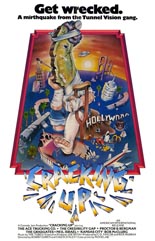
crackingupFrom 1983, the Jerry Lewis comedy Cracking Up is not to be confused with this other comedy titled Cracking Up. Whereas Lewis’ picture centers on a man with a plan to commit suicide, this 1977 sketch movie merely places all suicidal thoughts in the viewer.

Distributed by AIP, the Rowby Goren/Chuck Staley joint finds Channel 8 news reporters Walter Concrete and Barbara Halters (Firesign Theatre co-founders Phil Proctor and Peter Bergman, respectively) reporting live from the scene of what’s left after the world’s worst quake, measuring 9.7 on the Richter scale, levels California. They interview the people they encounter on the decimated city streets, allowing the movie to segue into unrelated sketches transferred from videotape and having nothing to do with the disaster. Starring in these ugly bits are members of such improv troupes as The Credibility Gap and The Ace Trucking Company, whose rosters included such now-familiar, then-unknown faces as Fred Willard, Harry Shearer, Michael McKean and David L. Lander.

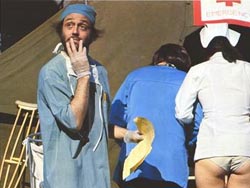
crackingup1Judging solely by the skits, each measuring 0.0 on the laughter scale, no one would predict actual showbiz careers were in store for any of the performers. Although for years, McKean and Lander made for a popular duo as Lenny and Squiggy on TV’s Laverne & Shirley, they stun the viewer into silence with a humorless Polish talk-show parody. Lander and Shearer attempt to update Abbott and Costello’s legendary “Who’s on First?” routine with discussion of a concert lineup featuring The Who, The Guess Who and Yes. One can see Willard trying in vain to liven up shit scripts (if scripts existed) on an overenthusiastic diner staff and an office full of execs with exaggerated tics, but to no avail.

Same goes for The Tubes singer Fee Waybill, utterly grating as a scientist; future Cheers barfly Paul Wilson, coaching guys on the care and hygiene of the penis; and especially Edie McClurg (eventual school secretary of Ferris Bueller’s Day Off), unmemorable both as a televangelist and a rootin’-tootin’ cowgirl who, for a dime, showers men with positive comments about their genitalia as they urinate. (Don’t get me started on the fake — but truly racist — commercial for “N****r Boppers.”) Everything about the material, the delivery, the presentation and so on suggests that lines of cocaine were the whole of craft services’ offerings.

Like Tunnel Vision, The Groove Tube, Loose Shoes and other counterculture-minded sketch films of the era, the contents are as such that if something doesn’t gel, you can wait a few moments in hopes that the next segment will. However, in the case of Cracking Up, none does. The project is so aggressively unfunny, it accidentally becomes an enemy of comedy. —Rod Lott

Get it at Amazon.

L.A. Slasher (2015)

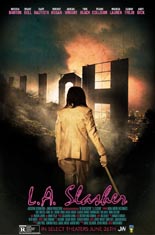
laslasherFilm critic Roger Ebert had a theory that any film featuring character actor M. Emmet Walsh can’t be all that bad. I posit a similar hypothesis in that any movie opening with the daughter of Hulk Hogan bandaged, bruised and bloodied can’t be all that bad. And yet L.A. Slasher is that bad and then increasingly worse.

Brooke Hogan is but one of the D-list “personalities” and/or tabloid fixtures cast in director/co-writer Martin Owen’s first feature and the targets of the titular, social media-savvy murderer. That he is played by NewsRadio alum Andy Dick, no stranger to the TMZ feed, is, one supposes, intended as chocolate-rich irony. The numbed narration he babbles throughout sounds like remedial Travis Bickle: “Reality TV: birthplace of the moron.”

laslasher1Clad in a white suit and a mask reminiscent of the pigment-washed Michael Jackson, this L.A. Slasher is a mover and a shaker; he has places to be, self-absorbed people to kill. On his radar for victimization are a vapid actress (Mischa Barton, TV’s The O.C.), a pop star (Drake Bell, Superhero Movie), a snotty heiress (co-writer Elizabeth Morris) and so on. Their labels double as their characters’ “names” — a creative choice that subs for true edginess, no matter how Tarantinoian the dialogue has been jerry-rigged to sound.

Owen can spruce up any given frame with enough neon to make L.A. Slasher gleam with a spiffy distraction, but no amount can cover the awful whiff of a flick trying way too hard to hang with the cool kids. Too enamored with itself to achieve dark humor, the movie may think it’s pushing the envelope, but doesn’t even get close enough to lick it. Utterly boring in its empty shell of execution, it has all the satiric bite of a retirement home resident so feeble, she has to gum her supper of creamed corn. —Rod Lott

Get it at Amazon.

Smosh: The Movie (2015)

smoshmovieIf you have the short attention span of the average millennial, here’s a three-word review: Shit: The Movie.

If you have more patience: Smosh: The Movie is an extension of Smosh, the YouTube channel of comedy duo Ian Hecox and Anthony Padilla. My 10-year-old son tells me — and the Internet confirms — that the two’s videos are among the site’s most popular. I haven’t seen any of their clips, so I can judge the Smosh brand only by this maiden feature. And in doing so, I can say three things with certainty:
1. I fail to see the appeal.
2. The bar on YouTube fame is set periously low.
3. I weep for the future of comedy.

smoshmovie1Assumedly playing themselves since they’ve retained their real names, Ian and Anthony are roomies in Ian’s parents’ home. Ian’s a total slacker; Anthony at least has a job, albeit delivering piping-hot pizza pies. With their five-year high school reunion looming, Anthony hopes to reconnect with his unrequited crush, Anna (Jillian Nelson, 1313 Giant Killer Bees!), but he wishes he could remove a embarrassing senior-year video of him that someone posted to YouTube.

Toward that most noble of pursuits, they appeal to YouTube prez Steve YouTube (Wet Hot American Summer’s Michael Ian Black, exerting more craft than the material requires), who sends them into the Internet — literally, via magic portal — to retrieve the offending file. This setup is all a silly, disposable comedy should need in order to take off running, poking fun at and deflating dozens of the web’s most infamous viral videos. It all but places the ball at the one-yard line on first down. A wealth of targets awaits the skewering … and stays that way, because the potential for Smosh: The Movie is roundly, soundly squandered.

Actor-turned-director Alex Winter (Freaked) is at a disadvantage from frame one, because the script by Steve Marmel and Eric Falconer (respective TV producers of Family Guy and Blue Mountain State) demonstrates an unwillingness to exercise imagination. Instead, the duo opts for least-common-denominator humor, with much of it depending on Ian’s recurring lust for the well-kneaded rear of Butt Massage Girl (Brittany Ross, TV’s The Middle) in his favorite vid, as well as your familiarity with the Smosh boys’ fellow YouTube celebrities (like Grace Helbig) who make cameo appearances. Let’s not even get into the atrocious opening animation, other to say it looks to have been the losing entry in a crowdsourced contest.

I only laughed once during Smosh: The Movie, and it arrived at the movie’s last line. I’m still amazed I was able to last that long. —Rod Lott

Get it at Amazon.

Saving Christmas (2014)

savingxmasTrue or false: The movie Saving Christmas begins with a three-minute lecture to the audience from Kirk Cameron.

The answer is “false.” It takes up four.

In that prologue — scooch, Alistair Cooke! — the erstwhile ’80s teen heartthrob of TV’s Growing Pains sits in front of a glorious fireplace next to a glorious Christmas tree in a glorious living room and, with awkward pauses to sip from a glorious prop mug, relays all that he appreciates about the most wonderful time of the year: “I love the cookies. I love the fire. I love the fudge. … And I love hot chocolate!” he exclaims. “But some people want to put a big, wet blanket on this.”

Yes, Virginia, Cameron’s talking about the nonexistent “war on Christmas.” And he’s here to narrate and star in a high-definition sermon all about it. Playing himself (and producing), Cameron attends a glorious Christmas party for wealthy people at the glorious home of his big sister (real-life sibling Bridgette Ridenour). The problem — other than Sis’ apparent addiction to Hobby Lobby kitchen decorations — is that Kirk’s brother-in-law with the punchable face (the movie’s writer/director, Darren Doane) isn’t feeling the spirit; he just can’t get over all the people partying because he’s too busy moping about how Christmas trees and Santa Claus aren’t in the Bible, for God’s sake.

savingxmas1True or false: The bro-in-law’s character name is Christian White. The answer is “true”; I’m guessing Christian Aryan was deemed too on-the-nose.

I won’t fault the Liberty University-funded Saving Christmas for its religious beliefs — not even the one justifying material things as being “right.” I fault Saving Christmas because it’s lazy and deceitful. Narrates Cameron toward the beginning, “Stories are tricky things,” which must be why Doane didn’t adorn his project with one. For an hour, Kirk and Christian sit in a car while the former reassures the latter that the Christmas symbols he worries about are indeed holy. Then they rejoin the party so a hip-hop musical montage (complete with Doane breakdancing) can extend the running time into a feature; Kirk jumps in to scream, “Let’s feast!”; the end.

That’s not a plot; that’s a commercial, essentially for itself. (Choir, you have been preached to!) I feel sorry for well-meaning people who paid good money to see “wholesome family entertainment” and soon realized they were hoodwinked into an audiovisual presentation, considerable stretches of which have no movement in them — just inanimate objects shot from rotating angles. If Doane’s digital camera and editing equipment didn’t allow for scenes in slow motion, Saving Christmas would be half the length, but interminable all the same.

Thou shalt not laugh, either, because Doane’s idea of comedy is summed up by an end-credit “blooper” in which the stereotypical black friend improvs, “I’m just gonna keep talking and move my hands until your camera gets what it needs.” Hell, even Cameron’s 2008 hit Fireproof is more accidentally funny.

True or false: I can achieve the same wonderful feeling that Saving Christmas wishes to espouse from Bill Murray’s epic monologue at the end of Scrooged. The answer is “true.” And I can get legitimate jokes with it! —Rod Lott

Get it at Amazon.