Category Archives: Comedy

For Those Who Think Young (1964)

By all appearances, melancholy title aside, For Those Who Think Young sure looks like an AIP beach movie. It’s packed with the series’ essentials: surfing, swimsuits, rock ’n’ roll, Susan Hart and that Frank Tashlin-esque gag of a super-sexy woman’s aggressive shake of her curves causing nearby objects to burst in a fashion typically blamed on poltergeists. Even male lead James Darren looks like Frankie Avalon, right down to that unmistakable helmet of hair.

Gidget graduate Darren plays Ding Pruitt III, a horny trust-funder whose successful seduction technique is basically the lyrics of “Baby, It’s Cold Outside” personified. His latest object of affection (toward penetration) is Sandy Palmer (Pamela Tiffin, The Fifth Cord), an orphaned college girl who’s “after a Bachelor of Arts, not a bachelor of bikinis.” She’ll have none of his coercive, date-rapey ways — until, of course, he becomes a changed man within 90 minutes, give or take. Unless, of course, the checkbook of Ding’s corpulent grandfather, B.S. Cronin (Robert Middleton, The Harrad Experiment), has anything to say about it; he literally wants Ding to dong as many girls as possible, rather than settle for the virginal Sandy.

That’s about all of the surfboard-skinny plot, another hallmark of the Frankie and Annette pics. Meanwhile, Pamela’s two uncles (corny comedians Paul Lynde and Woody Woodbury, the latter playing himself) struggle as musicians as unhip as your grandmother after a fall. They’re about to lose their filler club gig, where the understandable star attraction is the bump-and-grind act of stripper Topaz McQueen (Tina Louise, roughly a quarter away from Gilligan’s Island’s maiden voyage); in another Tashlin, um, touch, Topaz later descends a staircase with an extra-long wiener in each hand. Speaking of Gilligan, Bob Denver is here to serve as Kelp, Ding’s white slave. Denver’s big scene is a rather disturbing musical number that finds Kelp singing from a veritable coffin of sand up to his bearded mouth and chin, on which Nancy Sinatra has painted an upside-down face.

Although technically a Beach Party rip-off, For Those Who Think Young is a reasonable facsimile, with much of the credit owed to Pop Art-friendly Leslie H. Martinson (1966’s Batman: The Movie) in the director’s chair. The lovely Tiffin is a sexy and wholesome approximation of Funicello, although Darren isn’t nearly as likable as Avalon — because his character is a total ass! Not only is Ding not above stealing a woman’s crutches to pull a ruse for cooze, but he tells Sandy his ding-a-ling is “entitled” to a test run!

More than half a century later, that dated attitude unintentionally adds another layer of entertainment — as does future Exorcist mama Ellen Burstyn in her movie debut as a teetotaler unknowingly getting hammered by spiked fruit punch. Methinks Think Young exudes charm more discernible than all its in-your-face product placement for Pepsi and Baskin-Robbins combined. As the beach-bound extras chant at the close of Denver’s traumatizing tune, “Ho, daddy! Ho, daddy!” —Rod Lott

Get it at Amazon.

Twister’s Revenge! (1988)

Q: What do you get when you combine $200,000 of computer gear with a $20 budget?
A: Bill Rebane’s Twister’s Revenge!

That’s a terrible “joke.” Yet it’s better and more logical than those offered by the movie. I can prove it.

Kelly: “They can’t nail us for this. It’s not even our tank! Besides, I think it’s got something to do with habeas electi.”
Bear: “Does that mean we can’t have children?”

The defense rests.

Ostensibly a lighthearted caper in look and feel, Twister’s Revenge! — exclamation point entirely Rebane’s — gives us a setup seemingly straight from an improv’s show participatory “give me a word” portion: Dave (Dean West, Rebane’s Blood Harvest) seeks to rescue his brand-new wife, Sherry (Meredith Orr), from the clutches of kidnappers — and destroy their property while he’s at it — with the help of a talking monster truck (Mr. Twister). Said kidnappers — the greasy, bumbling Kelly, Dutch and Bear (respectively overplayed by David Alan Smith, Jay Gjernes and R. Richardson Luka) — have Sherry tied up with a serial-style load of TNT.

Meanwhile, Dave has his all-American guns and Mr. Twister, which his spouse has secretly outfitted with Knight Rider-style voice technology. Instead of William Daniels, however, Mr. Twister sounds like someone speaking into a desk fan. The intellitruck can calculate probability on the fly, even to the right of the decimal point. While Dave is clearly dressed to imply Indiana Jones, the viewer may infer Harry Anderson.

Watch in amazement as Dave steers Mr. Twister to level an outhouse — chalk-labeled with disturbing aggression as “SHIT HOUSE!” — in which the moronic Bear, a cork-on-fork version of Goonies’ John Matuszak, ducks to evade death by tire. Bear survives, but crawls out covered in feces — an apt metaphor for your experience as a viewer, potentially topped only by him going cross-eyed when kicked in the nuts.

This is, after all, a movie with:
• a morbidly obese bar singer (Liz Gray, Drop Dead Fred’s Namby Pamby) in blue spandex belting inane lyrics, e.g., “I stroke your feathers / While you do-do-do”
• men in that bar wearing gas masks and a bat’s head
• a running gag of Bear’s girlfriend (Tena Murray) fleeing Mr. Twister in fast-motion like a veritable Keystone Kop, struggling to keep her breasts contained with her dress and, at one point, sprinting through a Hardee’s for a sandwich on the go
• an opening-credits misspelling of its DP’s title as “photograpy”

And, hey, did I mention a monster truck that talks? Not unlike Al Adamson’s Carnival Magic, Twister’s Revenge! is Rebane’s amateurishly executed attempt at a comedy for families — specifically, the one sharing the surname Manson. —Rod Lott

Get it at Amazon.

Werewolves Within (2021)

With Werewolves Within, the big takeaway isn’t that it’s funny, but that it’s based on a video game. By that standard, it shouldn’t be good at all. And yet it is. Heck, even by regular movie standards, it’s great.

In quaint, quiet Beaverfield, there’s a new federal forest ranger in town: Finn Wheeler (Sam Richardson, TV’s Veep). His arrival coincides with the discovery of a torn-up corpse that has residents on edge. It’s hardly the last body that’ll turn up — and specifically, at a local inn, where Finn and about a dozen others find themselves trapped due to a spell of bad weather — or, as bumblefuck Marcus (George Basil, Desperados) puts it, “streets is all storm-fucked.” Oh, and some of the guests believe a lycanthrope is to blame.

From Keystone-shaded pipeline drama to sabotaged generators, director Josh Ruben (Scare Me) and first-time screenwriter Mishna Wolff (ha!) give their cast a heckuva lot of obstacles to play against. In look and feel, Werewolves Within suggests an old-fashioned drawing-room mystery, but did Miss Marple ever have to face geysers of goo? Luckily, unlike too many of its horror brethren from the same litter, this film doesn’t forget to wrap a story around the gore or neglect to imbue its characters with personalities — not even the most hapless of victims.

Who survives or doesn’t is negligible when the cast is this well-stacked, making for a thoroughly winning ensemble with crack comic timing. Supporting Richardson are such reliable talents as Saturday Night Live vet Michaela Watkins, I Love You, Man’s Sarah Burns and, as Beaverfield’s mail carrier and Finn’s romantic interest, internet troll magnet Milana Vayntrub (aka Lily, “the girl from the AT&T commercials”). There are many more, each having a hand in making the movie to be the light, enjoyable and bloody romp it is — complete with The Free Design joyously buoying the conclusion. Oh, and maybe a lycanthrope. —Rod Lott

Munchie Strikes Back (1994)

Munchie strikes back in Munchie Strikes Back, in which the butt-ugly alien introduced in 1992’s singular Munchie is now voiced by a thoroughly desperate Howard Hesseman (Private Lessons). In this third entry in Roger Corman’s plural Munchies franchise, Munchie is sent by the gods to befriend Chris, a boy whose dad is dead and whose mom (Lesley-Anne Down, The Pink Panther Strikes Again) just got fired after refusing the sexual advances of her boss, Carlisle. Points to her, considering Carlisle is played by The Seduction’s Andrew Stevens, playing a character different from his Munchie role, yet in the exact same way.

Munchie and Chris (Trenton Knight, The Skateboard Kid 2) become instant pals, even though Munchie — given the ineptness of his puppeteers and the limitations of a Corman budget — stays partially hidden behind beds and in trash cans. Together, they play a Death Race 2000 video game, rig a lawnmower to run amok and cause counterfeit money to rain from the sky. When Carlisle starts nosing around, Munchie sticks firecrackers down the man’s pants, while Carlisle retaliates using potatoes.

In this kiddie film, returning director Jim Wynorski (Sorority House Massacre 2) teaches his young audience some 1990s-style values:
• Money is everything.
• Destruction of personal property is okay if it’s your next-door neighbor’s.
• Car wrecks are really way cool.
• Prune-faced gnomes are to be loved.

In the end, Munchie is sent to help Bill Clinton, as the credits threaten a fourth installment that never came to be: Munchie Hangs Ten. The series should be commended for its commitment to its own mythos, in that each movie contains a scene in which Munchie is captured in a garbage bag. —Rod Lott

Get it at Amazon.

Just a Gigolo (1978)

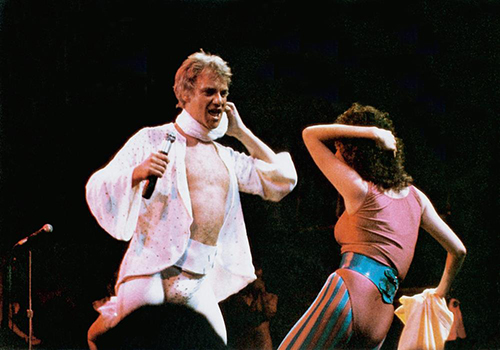
Not to be confused with the utterly terrible take on the torch tune by David Lee Roth, Just a Gigolo is a highly satirical starring role for a surprisingly gaunt David Bowie, coming fresh off the science-fiction head-scratcher The Man Who Fell to Earth.

Bowie is Paul von Przygodski, a young man who, like a lesser-known Candide, seems to fall in and out of life’s foibles, such as surviving a bombing in World War I, being mistaken for a French soldier in a hospital and so on and so forth. He seems to be the king of dumb luck.

He returns home with a porcine pal in tow, only to find Berlin in a truly crumbling state of its former self, filled with beggars and other miscreants. Still, Paul makes due with a job as a walking beer bottle, befriending an American actress (Sydne Rome) and his former commanding officer, Capt. Kraft (David Hemmings).

Eventually, she abandons him for possible stardom in America and Kraft pushes forward with his plans to rule Germany with a very Nazi-like movement. Heartbroken, Paul meets the Baroness (Marlene Dietrich) in a club and sets him on the path to becoming the world’s most unsatisfying gigolo, performing the title song on a darkened set.

As he works his way through a surprising Kim Novak and other ladies of the German upper crust — almost never finishing the job, mind you — things finally stop going Paul’s way, in the highly apropos finale, where, in death, he is held up as an unknowing scion to Germany’s growing fandom of Nazism.

Of course, the coke-addled Bowie is transcendent as Paul, even if the singer described the film as Elvis Presley’s 32 films “rolled into one” when it spectacularly failed at the box office. I truly don’t see it; I would have loved to have seen Elvis as a paid prostitute pleasing the women of pre-WWII Germany. Sadly, it was never meant to be.

What tends to hold the film back seems to be Hemmings’ velvet-glove direction. He seems unsure about the tone of the film, one second making it a dark comedy with serious underpinnings and the next, a bedroom farce with sexual overtones. It makes for a far more raucous experience than expected, but, then again, maybe that’s the point, mirroring Paul’s own wasted life. —Louis Fowler

Get it at Amazon.