
Category Archives: Action

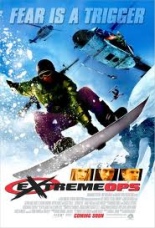
Extreme Ops (2002)

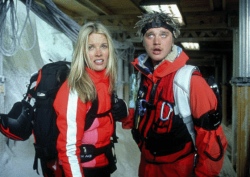
In Hollywood’s first extreme-sports-inspired action film (seemingly existing only to have a movie with “extreme” in the title), a group of crazy kids shooting a camcorder commercial in the Austrian mountains are mistaken for CIA agents by Serbian war criminals hiding out in the unfinished resort where they’re staying.

That’s just one of many of Extreme Ops’ glaring gaps of logic wider than the space between star Bridgitte Wilson-Sampras’ eyes. But sure enough, this criminal mastermind who could not be toppled by entire governments is foiled with X Games stunts; this terrorist is taken down by beer-guzzling, snot-nosed sports freaks. If that’s the case, shouldn’t we have sent Tony Hawk to Iraq?

Dark City’s Rufus Sewell leads the team and has the hots for gold-medal downhill skier Bridgitte Wilson-Sampras-Gums-Teeth. The others dare you to like them, debuting with such lines as “I’m cramping and bleeding like a stuck pig!” and “Wassup, bitches?” That includes the rather unappealing Devon Sawa (Final Destination), whose baby teeth and bloodshot eyes suggests “reeks of skunk weed.” They’re so nutty and anti-authority that they’re always doing things like skateboarding atop moving trains and snowboarding off hotel roofs and laughing about it like it’s the funniest thing on earth. Why wasn’t Matthew Lillard in this?

It’s hard to side with the Extreme Ops team over the bad guys. And how do we know they’re bad? Because they’re bald and play chess … with bullets — how hardcore! The stunts are excellent, but that leaves no excellence for other aspects of the film. At least one character’s voice has been redubbed in its entirety. Directed by Screamers’ Christian Duguay, the flick has more falling snow in it than Chris Farley’s last party, and appears to have been made only for guys who use the word “bro.” Extreme Oops may be a more apt title. —Rod Lott

Buy it at Amazon.

Tarzan and the Great River (1967)

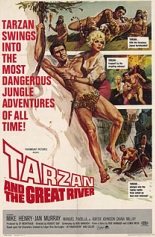
Tarzan and the Valley of Gold wasn’t the last Tarzan movie to be influenced by the ’60s James Bond phenomenon. Coming two years later, the series’ next entry, Tarzan and the Great River, also stars Mike Henry and opens with a groovy spy feel, but adds The African Queen and Apocalypse Now to its mix. The latter wouldn’t come along for another 12 years, so it’s probably more accurate to cite Joseph Conrad’s Heart of Darkness.

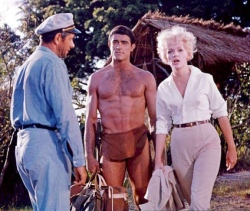
Either way, Tarzan takes a trip up a mysterious river to confront the mad, god-like ruler of a deadly cult. His ride is on a boat owned by Charlie Allnut-lookalike Sam Bishop (comedian Jan Murray) and his boy sidekick Pepe (Manuel Padilla Jr., who was also in Valley of Gold, but as a different character). There’s also a nurse (Diana Millay from TV’s Dark Shadows) who’s trying to get some medicine to a remote village that’s under attack by a jaguar cult and its leader, Barcuna (Olympic decathlon champion Rafer Johnson).

The Great River isn’t as over-the-top and sexy as Valley of Gold, but that’s what makes it so endearing. It has a different feel from its predecessor, mostly focused on the relationships between the travelers and their various reasons for going up river. There’s a great final battle between Tarzan and Barcuna, but what sticks with you is the movie’s humor and charm.

Boys may sleep with Valley of Gold, but they marry Great River. —Michael May

Buy it at Amazon.

Cotton Comes to Harlem (1970)

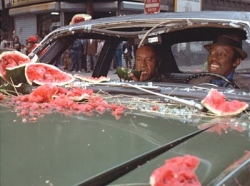
Although often lumped in with the blaxploitation films of the period, Ossie Davis’ Cotton Comes to Harlem feels a lot less Superfly and a lot more like a classic ’70s buddy cop movie, albeit one set in a Harlem where the possibility of a race riot is always just a few minutes away. The result is one of the most entertaining films the period produced.

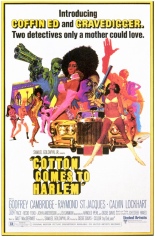
Based on a Chester Himes novel, Cotton stars Raymond St. Jacques and Godfrey Cambridge as Coffin Ed Johnson and Gravedigger Jones, two police detectives whose detached cynicism is only matched by their sense of justice. Viewed by the black citizens they serve as Uncle Toms in cahoots with a racist police force, and by their white co-workers as black troublemakers who don’t know their place, they’re classic outsiders who aren’t above breaking the rules (and law) to do what they know is right.

In this case, it’s finding the $87,000 “stolen” from crooked Rev. Deke O’Malley (Calvin Lockhart), who has promised credulous investors that their funds are going to the construction of a boat to take them back to Africa and away from the racism they have to deal with everyday. Once it’s determined that the money has been hidden in a bale of cotton retrieved by kindly street person, Uncle Bud (Redd Foxx), the race is on between Johnson and Jones to find it before the bad guys.

Despite touching on some rather heavy social themes, director/co-writer Davis keeps the tone light and often comic, thanks to the efforts of his talented cast. The soundtrack also features standout work by Galt MacDermott and is worth buying on its own. Two years later, St. Jacques and Cambridge reprised the roles in Come Back, Charleston Blue, a sequel Davis on which chose not to work. —Allan Mott

Buy it at Amazon.

Tarzan and the Valley of Gold (1966)  

The poster for Tarzan and the Valley of Gold shows Tarzan taking out a helicopter with bolas made from hand grenades. Since this actually happens in the movie, it is a perfectly acceptable thing to put on a poster. It is not, however, the most awesome thing to happen in it. That would be in the first 10 minutes, when Tarzan kills a henchman with an 8-foot bottle of Coke.

In the ’60s, the franchise ran out of ways to have white people plunder the jungle so Tarzan could stop them. Actually, they ran out of new ways to tell that story in the ’40s; it just took them another 20 years to do something about it. And it took Sean Connery to show them how.

The popularity of the James Bond movies created countless rip-offs and spoofs, but none more awesome than the 007-influenced Tarzan films, especially the ones starring former pro linebacker Mike Henry, in which a dapper, literate Tarzan visited the jungles of the world, making friends and fighting crime. Valley of Gold was the first of such films and opens with him arriving in Mexico, suited up, and met at the airport by villainous goons à la Dr. No.

It’s a short trip from there to giant beverages, grenade bolas, forming a tracking team of wild animals, discovering a lost civilization, and swinging through the trees to a tune that would make Austin Powers jealous. —Michael May

Buy it at Amazon.

The Gauntlet (1977)

I miss the Clint Eastwood who directs and stars in The Gauntlet: the one who shoots a gun and has fistfights. The one who wasn’t interested in chasing Oscar gold with mediocre melodramas of butch boxers, county bridges and apartheid rugby. The one who’s second or third line of dialogue is simply, gruffly, “Fuck ’em.”

As cop Ben Shockley, Eastwood is given the plum assignment of escorting an escort from a Las Vegas jail to a Phoenix courthouse so she can testify in a case against a rather feared mobster. Shockley would rather be drinking, and the manly named hooker, Gus (Sondra Locke), considers her chaperone to be a “big, .45-caliber fruit.”

Before they even depart her cell, Vegas bookies are betting against Shockley even completing the assignment, eventually placing the odds at 100-to-1. As the story progresses, one can see why, as Shockley has to protect Gus the huss from a horny constable (Deliverance‘s Bill McKinney, forever may he make us squeal), a hippie biker gang, snipers in a helicopter and the titular gauntlet of Phoenix’s finest, blowing bullet holes into the bus Shockley steals on their final stretch, after crudely welding a driver’s seat capsule of armor.

While its comedic bits could be tempered, The Gauntlet is a merry, if minor movie of mayhem Eastwood sandwiched in between Dirty Harry outings. Its slightness in story is mitigated by an almost tireless pace — slowed only by a motel stop for Locke to bathe — and plenty of the ol’ boom-and-pow. By that, I mean explosions and the trading of gunfire, not some sexual euphemism. Speaking of, for a then-real-life couple, Eastwood and Locke share zero chemistry, and what’s with him putting her in all those rape scenes? That’s not a recipe for lasting relationships. —Rod Lott

Buy it at Amazon.