
Category Archives: Action

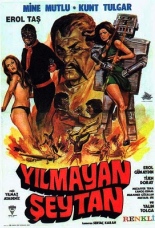
The Deathless Devil (1973)

Mere minutes after learning his long-dead father was the celebrated superhero Copperhead — a secret, despite the costume being left in the top of his adopted dad’s desk drawer — Tekin carries on the family tradition of fistfighting, leaping onto moving trains, and dressing in a sparkly silver mask and flowing red neckerchief. He leaves a novelty snake figurine at the scene of each skirmish, like a parting gift for kicking your ass.

Under the guise of Coppherhead, Tekin seeks to avenge the murder of his two dads by Dr. Satan, because that’s just the kind of thing people with monikers like Dr. Satan are born to do. The Borgnine-ian buffoon Bitik gets assigned to assist Tekin in his mission — a move akin to appointing Jerry Lewis to the G8 summit — so he dons a Sherlock Holmes outfit.

Sporting a mustache that suggests a raccoon tail protruding from within each nostril, Dr. Satan gets others to do his bidding of theft and murder via remote-control devices that he can detonate. (He calls them “explosions,” but if farts were visual, they’d look like this.) Unbeknownst to authorities, the doc has assembled a bowlegged killer robot. It’s so primitive-looking, I wouldn’t be surprised if director Yilmaz Atadeniz ordered it filched from a local first-grade class art room.

Logic figures nowhere in The Deathless Devil, but makes up for it with open-to-close action (intended) and lunacy (some intended). Comic-book colorful and charming in its pure ineptness, the Turkish picture has lots to offer, from Dr. Satan’s booby-trapped lair to an out-of-nowhere love scene. And I want it for all time. —Rod Lott

Buy it at Amazon.

Extreme Prejudice (1987)

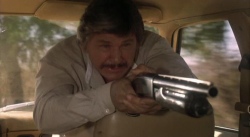
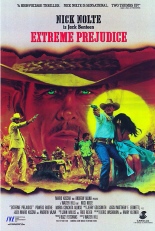
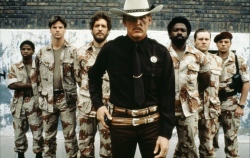
If you’re like me, Chuck Norris has forever debased the image of the Texas Ranger into a caricature of bearded empty-headed goofiness. How strange is it, then, to watch Extreme Prejudice and see Nick Nolte portray a Ranger with even less emotional range, and hit it out of the park.

Walter Hill, director of such manly classics as 48 HRS., The Long Riders and Southern Comfort, is not known for subtlety of characterization. He deals in black-and-white archetypes of mandom, shades of gray rarely necessary. So it’s no surprise that Nolte’s Ranger is good, Powers Boothe is evil (he crushes scorpions between his fingers, for Christ’s sake), and we’re never in doubt that Nolte will get the girl (The Running Man‘s Maria Conchita Alonso, doing her best to convey some sort of character in a translucently thin role).

Luckily, there’s a subplot involving rogue mercenaries led by Michael Ironside to complicate things. Throw in the invaluable Clancy Brown, William Forsythe and Rip Torn; coat everyone in record amounts of perspiration; and climax with a straight-up bullet-ridden homage to The Wild Bunch (if you must steal, steal from the best), and you’ve got a testosterone-fueled, underrated ’80s actioner that The Expendables could only dream of replicating.

Leading it all, the oak tree that is Nolte in his glorious physical prime, running on one emotion and one facial expression and overpowering everything in his path. There may be another fist beneath Norris’ beard, but beneath Nolte’s mustache? Chuck Norris, weeping like the little girl he really is. —Corey Redekop

Buy it at Amazon.

Viva Knievel! (1977)

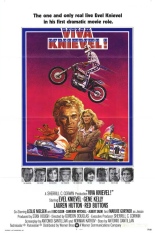
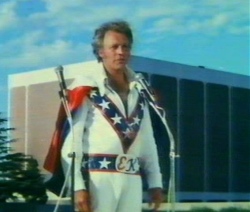
At the beginning of Viva Knievel!, the world’s most famous daredevil (Evel Knievel, playing himself) breaks into an orphanage in order to deliver a boxful of toys. While he’s there, an adorable crippled moppet abandons his crutches and explains that Evel’s heroism served as the inspiration to get him to walk again. It’s a moment so shameless, it feels like director Gordon Douglas (Them!) is begging us to imagine Santa Claus and Jesus Christ combined in the body of a red-faced, sideburned hillbilly with a twisted motorcycle fetish.

And as over-the-top as this may seem, what makes Viva Knievel! so special and an absolute must see for anyone interested in classic WTF cinema is the astonishing fact that this is the most subtle and ambiguous scene in the entire movie!

With his life story already having been told in 1971’s Evel Knievel (but starring George Hamilton), Viva eschews typical biopic melodrama in favor of cheesy, ’70s-era action exploitation. That is, unless at one point in Knievel’s life, there really was a conspiracy to sabotage his bike during a jump in Mexico, so a group of drug smugglers could load the semi carrying his corpse back into the States with millions of dollars worth of cocaine. In that case, the film could be considered unusually accurate.

To its credit, Viva is surprisingly well-made and looks like a real movie, unlike similar projects, which tend to resemble glorified TV pilots. To its discredit, it manages to outdo Xanadu for featuring the most embarrassing performance of Gene Kelly’s career and also forces us to confront the terrifying image of Knievel (who is admittedly better in the role than Hamilton was) making out with Lauren Hutton, which ranks right up there with Jessica Alba kissing Danny Trejo in Machete for pure unintended horror. —Allan Mott

Buy it at Amazon.

Foxy Brown (1974)

In a lily-white era where female matinee idols were Barbra Streisand and Goldie Hawn, Pam Grier became a groundbreaking alternative, in part due to her landmark role of Foxy Brown. While the film is also a blaxploitation classic, make no mistake: Grier’s too confident onscreen to be exploited herself, bare breasts and all. Regardless of the race element, it’s just a damn enjoyable AIP actioner.

In the not-a-Coffy-sequel to Coffy, Grier is the no-nonsense, clean-living voice of reason in a world of danger. She pleads for her brother, Link (Antonio Fargas, Huggy Bear of TV’s Starsky & Hutch), to get straight by leaving the blow-dealing biz behind. When he gets into trouble with a loan shark, Link rats out sis’ undercover-cop beau (Terry Carter, Abby) for the payoff.

When Foxy’s boyfriend is gunned down, she skips the grieving process and goes undercover herself, as a high-class hooker for the organization responsible. That way, she can exact revenge from the inside out.

Writer/director Jack Hill fought to get Grier in the title role, and it’s easy to see why: She commands the screen. She is the movie. She can play sexy and sweet, tender and threatening, and exude credibility no matter what mode she’s in — and that includes the finale, where she bestows the gift in the pickle jar. Only the embarrassing opening-credits sequence gives Grier anything to be ashamed of. —Rod Lott

Buy it at Amazon.

Around the World in 80 Days (2004)

Too bad it bombed, because Around the World in 80 Days, an adaptation of Jules Verne’s classic novel, is one of the most purely enjoyable American vehicles for Jackie Chan. On the run after stealing his village’s one-of-a-kind jade Buddha from the Bank of London, Chan’s Passepartout finds a convenient hiding place as a valet to eccentric inventor Phileas Fogg (Steve Coogan, Tropic Thunder). When Fogg accepts a career-on-the-line bet to traverse the globe in 80 days, Passepartout sees the trip as a great way to evade authorities.

No matter where they go, they’re pursued by policemen, not to mention the occasional ninja. Picking up a French painter for whom Fogg has an eye (the cute but annoying Cécile De France, Hereafter), the pair finds adventure going country to country, continent to continent, whether by air, land or sea. Said adventures include meeting an egotistical Turkish prince (Arnold Schwarzenegger) who’s on the prowl for a seventh wife, running into the Wright Brothers (an ad-libbing Owen and Luke Wilson) in the middle of the desert and rightfully returning the Buddha to his Chinese village, only to find themselves in the middle of a martial-arts battle, with Sammo Hung as the legendary fighter Wong Fei Hung.

The way the movie plays with various genres, locales and historical characters is undeniably fun, but it’s elevated to another level entirely by Chan’s set pieces. The aforementioned fight that has him squaring off alongside pal Hung is a highlight, as is when he attempts to board a hot air balloon by hanging on to a rope, encountering numerous obstacles in the process, just ripe for his brand of physical comedy.

Usually family films are seemingly made for only one half of the family: the young one. But 80 Days can be enjoyed by all ages without insulting the older half. Oh, sure, there are obvious slapstick bits to guarantee laughs from the kids, but many of them are carried off with enough skill and comic timing that it was hard to resist them myself. It is an old-fashioned epic adventure that remains true to Verne’s light style while also making for a great and appropriate showcase for the inimitable Chan. My only problem: Where are his trademark end-credit outtakes? —Rod Lott

Buy it at Amazon.