
Category Archives: Action

Riot on 42nd St. (1987)

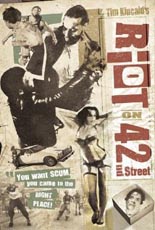
riot42Tim Kincaid’s Riot on 42nd St. is so bad that it’s an argument for New York City officials’ Disneyfication of the area depicted — one of sex shops and flame steaks, of grindhouse theaters whose oft-flashed marquees were playing everything from Steele Justice and Penitentiary III to Masters of the Universe and Wet Hookers. Real wet hookers strut the streets outside to the tune of the Casio-clap soundtrack.

Having served time behind bars for killing a drug pusher, Glenn Barnes (John Patrick Hayden, Hot Tamale) brings his porn ‘stache and Haggar slacks back to the Deuce and more specifically, back to The Garage, the spacious theater owned by his family. Barnes aims to help them reopen it as a nightclub, thereby acquiring the wrath of Farrell (Michael Speero, She’s Back), the owner of the rival club across the street, Love Connection, where skanky women dance undulate in the altogether.

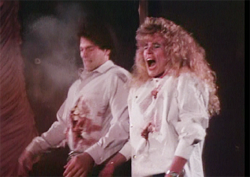
riot421Farrell’s competitive business strategy is twofold: First, get his ladies to prostitute themselves to customers, and two, crash The Garage’s debut gala with automatic weapons. The latter proves more effective as his goons shoot up everyone in the place, whether they’re being entertained by high-stakes gambling, hoochie lingerie dancing, stand-up comedy (courtesy of actual “comedian” Zerocks, playing himself) or a woman crooning something about a “Uranus Child.” The shootout — with each group shown killed twice, the second time in gut-busting slow-motion — results in the titular riot. Then a cop played by future Lawnmower Man Jeff Fahey (in just his third movie ever) says something meant to be profound. Go home, people.

As cheap as dirt and probably as tasty, Riot on 42nd St. is punishing viewing that finds inspiration in repetition. Writer/director Kincaid (Breeders) flourishes with such incompetence, it all makes sense when you learn of his prolificness in the world of gay porn. This comparatively mainstream release is woefully flaccid, good only as a time capsule of the Big Apple’s sleazier, greasier times. —Rod Lott

Buy it at Amazon.

Lady Cocoa (1975)

ladycocoaSinger-turned-actress Lola Falana (The Liberation of L.B. Jones) stars as Lady Cocoa, a spoiled, sassy “hot piece of cheese” who gets out of prison for 24 hours in order to testify against a mob boss. Under the watchful eye of two cops in a Nevada hotel, she bats her eyelashes, throws temper tantrums and scoffs, “You poo-poos!”

After she tires of tossing off the insult “Buster Brown,” she ventures into the casino and soon finds herself in a heap o’ trouble, being pursued by no fewer than two teams of hitmen, one of which contains football player-turned-soda pitchman “Mean” Joe Greene (The Black Six); the other, a dude in drag. The best scene has a car being chased through the casino by a cop on foot. Do the math.

ladycocoa1I’ve long believed that there was no such thing as a bad theme song for a blaxploitation movie, but then I heard this film’s, appropriated from “Pop Goes the Weasel” (an alternate title for this cup of Cocoa). Director Matt Cimber (Butterfly) has it played over and over and over. —Rod Lott

Buy it at Amazon.

Death Force (1978)

deathforceFresh from warring in Vietnam, Doug Russell (James Igleheart, Beyond the Valley of the Dolls) dreams of pursuing real estate, pawing his wife again and finally meeting their toddler son, born as a result of previous pawing sessions. But first, the fresh vet is recruited to help steal a file cabinet full of gold bars for a Chinese crime lord. Talking him into it are his military buddies, Morelli and McGee (whose paired names sound like a fly-by-night law firm found advertising on bus stops), played by Carmen Argenziano (the original When a Stranger Calls) and Leon Isaac Kennedy (the Penitentiary series), respectively.

After the fortune-making transaction in the ocean is through, Morelli and McGee (or a failed TV cop pilot, perhaps?) increase their take by greedily turning on Russell. They stab him from the front and behind, and toss his bleeding body overboard to sleep with the fishies. Miraculously, Russell cheats death as he’s washed ashore on an island inhabited by two Japanese soldiers. Although one of them wishes a barrel of rice would’ve appeared on the beach instead of this new Afro-ed stranger, they teach Russell the way of the samurai with bamboo swords so that he can become a one-man Death Force. (To put it in terms of the film’s alternate titles, he’s so Fighting Mad that he’s sure to exclaim Vengeance Is Mine.)

deathforce1Back home, McGee is putting the moves on Russell’s wife (Cover Girls‘ Jayne Kennedy, then Kennedy’s real-life spouse), a singer in seedy bars. Many scenes exist in which Russell’s son (played by Iglehart’s actual child, James Monroe Iglehart) cries and/or looks terrified when McGee comes around, because the tot was too young to understand the scenes of domestic violence going on around him were just pretend.

When Russell is able to avenge his near-murder, Death Force hits the revenge-picture sweet spot. No fewer than three torsos spurt streams of blood when our hero’s sword — now made of steel — separates them from their heads. Written by Saturday the 14th mastermind Howard R. Cohen and directed by the Philippines’ ever-prolific Cirio H. Santiago, who dabbled in blaxploitation before (most notably 1974’s TNT Jackson), the movie delivers, but freeze-frames on an abrupt final shot so cruel and bleak, it’s like a well-planted kick to moviegoers’ nuts. You’ll get over it. —Rod Lott

Buy it at Amazon.

Mission: Killfast (1991)

missionkillfastMission: Killfast seems like Ted V. Mikels’ answer to the Andy Sidaris series of spies, lies and exposed thighs (and then some), yet the result is so bad, Sidaris looks like a Cahiers du Cinéma-lauded auteur in comparison. That’s bound to happen when your sections of principal photography are separated by nine years.

The plot, as it is, revolves around missing detonators, which pass through the hands of the characters as if water. Should said detonators fall into the mitts of someone who also possesses “the components,” kablooey: nuclear bomb. Called in to prevent this global catastrophe from occurring is martial-arts master Tiger Yang (Game of Death II), playing himself and fresh off “a world tour.” His first order of business once in town? Appearing in the local parade as its “grand marshall” [sic]; certainly there are better ways to keep a low profile when on a life-or-death mission, but how could Mikels justify so many minutes of parade footage otherwise?

missionkillfast1The director/writer/producer uses it in the same way Mission: Killfast‘s villains do their “skin mag” empire: as a front to keep people distracted. The would-be Playboy Mansion, largely a pool adjacent to a neighborhood golf course, allows for some skanky ladies with rockin’ bods to cavort about in swimwear apparently swiped from Star Search‘s spokesmodel wardrobe. For whatever reason, the woman Mikels’ camera chooses to focus on has a shaved head, as if she stopped by after chemo.

Elsewhere, there’s ’80s B-movie starlet Jewel Shepard (Hollywood Hot Tubs), eschewing thread. Appearing in a see-through mesh shirt to accentuate the bare nipples, Mikels himself. Later, he appears with novelty eyebrows, which is something to see, even if the movie is not. Coming out between his War Cat and the drama (allegedly) Female Slaves’ Revenge, it’s an incomprehensible mess of polka dots and mullets, of Canon fax machines and Casio scores. —Rod Lott

Buy it at Amazon.

Spies Against the World (1966)

spyaroundtheworldAnthology films largely reside in the realm of horror, only occasionally landing in comedy and science fiction. But spy movies? It happened — in Italy, of course — in Spies Against the World, aka Killer’s Carnival and, seriously, Where Are You Taking That Woman. In the wraparound tale, a wanted and armed murderer (Peter Vogel, The Black Cobra) of “four young and beautiful girls” breaks into the study of a professor (Patton’s Richard Münch), who warns his captor what a life of crime will get him by telling him three tales. Each conveniently takes place in a renowned locale across the globe — lavish spots to which I cannot afford to travel.

In the first segment, in Vienna, a woman insists on seeing David Porter (Stewart Granger, 1950’s King Solomon’s Mines), because the crab apple is the only one who can find the men responsible for killing her knew-too-much journalist brother.

spyaroundtheworld1Rome if you want to for Spies’ inventive middle section, which sees a secret agent (Pierre Brice, Apache Gold) receive his orders Mission: Impossible-style, on vinyl made of spaghetti. He’s to track down some material from a gang, but story is secondary; goofy comedy is the main course as crosses and double-crosses are held together with thick layers of slapstick.

Finally, detective Glenn Cassidy (Lex Barker, The Torture Chamber of Dr. Sadism) finds his investigation of beached corpses in San Francisco takes him to Rio de Janeiro during its Carnival celebration, where the president is the target of an assassination plot. Yes, the two are connected, and it all leads to an electrifying finale on a merry-go-round. Eagle eyes should watch for the future Nosferatu himself, Klaus Kinski, wiping his sweaty face in the background of this one.

Spies Against the World deserves exploring for being such an obscurity, but the puffery is also tremendous fun for those with an affection for ’60s swinging spies that proliferated in James Bond’s wake. Naturally, the scenery is terrific — both the destinations and the delightful beauties who grace them, including Karin Dor (You Only Live Twice) and Margaret Lee (Venus in Furs), whose passports beg for stamping. —Rod Lott

Buy it at Amazon.