
Category Archives: Action

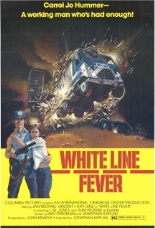
White Line Fever (1975)

Apologies to Jonathan Kaplan’s White Line Fever and its star, Jan-Michael Vincent, for wrongly assuming all these years that it was a film about cocaine. Sometimes the private demons of public figures can cause one’s mind to mix fact with fiction. (Submitted for my defense: that title, c’mon!)

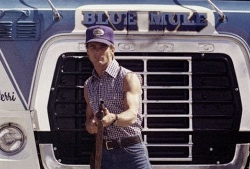
Instead, the actioner — one of many hick flicks at the time to cast the CB-clutching working man as an American hero — concerns itself with corruption in the trucking industry. The character played by Vincent (1972’s The Mechanic) may sport a feminine-sounding name, but Carrol Jo Hummer is masculinity embodied: a war veteran, a Southerner, a family man, a blue-collar clock puncher. Returning from Vietnam to his Arizona home and his soon-to-be bride (Kay Lenz, 1985’s House), Hummer happily puts himself in debt “up the wazoo” to buy a rig and pursue his late father’s independent-trucking dreams. Dubbing his bucket the “Blue Mule,” Hummer brims with Brut-splashed zeal at the prospect of hitting the highway for an honest day’s pay.

His first stop is to see his pappy’s former partner (Slim Pickens, Sam Peckinpah’s The Getaway), who works for a shipping biz run by the greasy, sleazy, sexist and racist Buck (L.Q. Jones, The Brotherhood of Satan). Hummer immediately gets work, but when he sees illegal slot machines and smokes being loaded into his rig, he refuses. While it’s the right thing to do, it’s the wrong decision in the beady eyes of Buck, who gets Hummer blackballed all over town. With a two-grand monthly payment to the bank weighing down his shoulders, but unable to make a haul, Hummer has no choice but to get even, and that requires getting his mitts dirty.

White Line Fever skillfully follows the Walking Tall template of rural revenge to appease audience expectations and to elevate Hummer to that rarified status of folk hero for the common man. (But to speak of the common woman for a moment, Lenz shines with good-natured grace and power in the first half, before a lazy soap-opera subplot tosses her character into the backseat.) The movie’s iconic, climactic shot of the Blue Mule crashing through the logo signage of the conveniently named Glass House represents an extended middle finger to corporate America and all its malfeasance.

I’m guessing Kaplan drew upon his education through the Roger Corman school of directing (Night Call Nurses) when he chose to shoot that stunt in slow motion, because that’s just the kind of thing the legendary producer would advise his students to do with their films’ visual orgasm: Put it all up on the screen. Technically, Fever is not a Corman picture, yet it operates in the same efficient manner as much of the man’s low-budget fare of that time: with more going on underneath its boom-boom-pow surface. —Rod Lott

Get it at Amazon.

Sweet Sugar (1972)

Elation turns to frustration when a prostitute named Sugar is sentenced to the plantation, in the Cain-raising Sweet Sugar. In a role similar to her star(let) turn in the following year’s Terminal Island, the lovely Phyllis Davis pours every bit of her seductive curves and salacious charm into the role, making the women-in-prison picture a superior example of the exploitation-staple subgenre.

Set up for a marijuana bust in Costa Rica, Sugar is thrown into jail. Rather than face a year or more behind bars while waiting for her sure-to-be-unfair trial, she opts for the alternative punishment of a two-year stint cutting sugar cane under the unforgiving sun. She and her fellow conscripted cuties (including Detroit 9000’s Ella Edwards as the film’s good-enough simulation of Pam Grier) use their rented machetes and feminine wiles in numerous attempts to overpower the men and make a run for the border.

Virtually every character with testicles — the literal kind, mind you — is a villain, none more so than the wackadoodle scientist Dr. John (Angus Duncan, How to Seduce a Woman), whose twisted experiments include some sort of orgasm machine that Sugar short-circuits and a drug he injects into cats to turn them ferociously feral, upon which they are hurled by the guards toward the caged women.

From Werewolves on Wheels steerer Michel Levesque and The Big Doll House scripter Don Spencer, Sweet Sugar has far more going for it than the average WIP entry, most notably a subplot involving voodoo rituals conducted by the Afro-sporting male prisoner Mojo (Timothy Brown, The Dynamite Brothers). But make no mistake: All it really needed to work was the underappreciated Davis, who balances playing delectable and devious by practically erasing the line that separates the two. The camera loves her even more than the hormone-raging guards trying to win her favor. —Rod Lott

Get it at Amazon.

SnakeEater II: The Drug Buster (1989)

Forever on suspension from the force, renegade cop Jack “Soldier” Kelly (Lorenzo Lamas, Mega Shark vs. Giant Octopus) drops in on an urban-area gymnasium to see his pal, Speedboat (Larry B. Scott, Lamar in the Revenge of the Nerds quadrilogy), whose name is never explained and who gets nowhere near a body of water. Speedboat is coaching a group of youths preparing for some kind of step-dance competition, when all of a sudden, his sister and another kid collapse. Soldier plants the girl’s head in his crotch and calls for an ambulance. The pair ingested some drugs for a performance boost, not knowing the narcotics had been cut with rat poison.

While Speedboat’s sister lay comatose in the hospital, Soldier offers a sensitive recommendation: “I’ve got an idea! Why don’t you have your friends stop doing it like it’s popcorn?” Soldier quickly comes around and vows to take down the supplier; ergo, he becomes SnakeEater II: The Drug Buster. This time, it’s personal … and Lamas approaches being in on the joke.

Killing four drug dealers, the ever-cavalier Soldier faces going to prison, until his court-appointed attorney invokes the insanity defense and gets his client committed to a mental-health facility. There, Soldier flirts relentlessly with his psychiatrist (Michele Scarbarelli, TV’s Alien Nation) and is introduced to the residents’ favorite game: rooftop wheelchair battles. He forges a bond with a handful of fellow patients, including a human version of novelty Groucho glasses (Harvey Atkin, Meatballs), a tit-obsessed evangelist (Jack Blum, Happy Birthday to Me) and Torchy (Ron Palillo, TV’s Welcome Back, Kotter), the firebug whom Solider busted at the end of the first SnakeEater film. However, the two never acknowledge their shared history, so despite the characters being the same (and director George Erschbamer and his screenwriting team returning), SnakeEater II pretends their previous encounter never occurred.

Compared to the first movie, also released in 1989, Erschbamer (Fire Twister) considerably lightens the mood of The Drug Buster; remove the business with the girl in a coma and drug lord Franco (Al Vandecruys, Snowboard Academy) backhanding his hookers, and the action film is practically an action-comedy. Unfortunately, Erschbamer and company’s collective comic chops are even worse-honed than their combat ones. For example, as Soldier sneaks out of the “loony bin” via the overhead vents, he runs (crawls?) into a prostitute sneaking inside. And then a Domino’s Pizza deliveryman.

SnakeEater II kicks into third gear when Soldier and Speedboat don Inspector Clouseau disguises to infiltrate a French bistro prior to Franco’s arrival; while Speedboat dumps an entire flask of laxative into the marinara, Solider rigs the restaurant’s lone toilet with a MacGyver-style bomb to explode when flushed. Later, our less-than-dynamic duo take off their shirts to fill Franco’s panic room with bags of his poisoned coke, dumped through the ventilation system. (The film does not tell us if any pizza deliverers were killed as collateral damage.)

Instead of giving cups of piss to the homeless, the running gag this time is Speedboat answering yes/no questions with the rhetorical, grammar-butchering refrain of “Do shit stink?” It sure does! Would you have SnakeEater II: The Drug Buster any other way? Three years later, the series concluded with the aggressively punctuated SnakeEater III: … His Law. —Rod Lott

Get it at Amazon.

SnakeEater (1989)

When we first meet renegade cop Jack “Soldier” Kelly (Lorenzo Lamas, Body Rock), he’s lounging with his sunglasses on inside an abandoned building, tossing playing cards, singing “Kumbaya” and improvising a bit about death by masturbation. He’s on a drug stakeout. He’s an ex-Marine. He’s “some kind of nutcase.” He’s the SnakeEater, and he’s got the T-shirt and belt buckle to prove it.

To pick a nit, he’s never called SnakeEater; everyone refers to him as “Soldier,” but a title like that is hardly the stuff of direct-to-video gold. As Lamas’ long-running gig as Lance Cumson (!) on TV’s Falcon Crest was coming to an end, the Canadian-financed SnakeEater was his attempt at breaking out on the big screen. You remember the lines snaking around the block, right? No?

The rather straightforward story puts Soldier on the hunt for his missing teen sister, Jennifer (Cheryl Jeans, an IMDb one-timer). She’s been kidnapped from a rented houseboat by an inbred country clan led by Junior (Robert Scott, Just the Way You Are), who kills her parents and sets the watercraft on fire before taking Jennifer to their rickety rape shack. Using a motorboat that’s been pimped out with parts of his beloved Harley, Soldier pulls into their neck of the swamp, sets some traps, shaves his face with a Bowie knife and Rambos up for revenge. Lamas is credited as having done his own stunts; his hair is not.

Helmed by George Erschbamer (The Incredible Adventures of Marco Polo on His Journeys to the Ends of the Earth), the film is bookended with a gag of a hobo asking a cop named Lou (former NFL Miami Dolphin and American Gladiators host Larry Csonka) for a cup of coffee, and Lou gives him a fresh cup of piping-hot urine. It’s also worth noting that SnakeEater contains an epilogue in which Soldier outsmarts an arsonist named Torchy (Ron Palillo, aka Horshack of TV’s Welcome Back, Kotter) with little more than a condom and a candle. Those objects are not important; that they’re setting up Torchy’s return for the immediate sequel, SnakeEater II: The Drug Buster, is. Therefore, the end-credits tradition of Marvel Cinematic Universe has the genius of Lorenzo Lamas to thank for the idea.

While we’re on the subject of genius, be sure to stick around for the thoroughly ’80s power ballad of a theme song, with plot-recapping and soul-searching lyrics like “Soldier, where’s your sister / Can you hear her helpless cries / The only light to guide you now / Is the fire in your eyes.” —Rod Lott

Get it at Amazon.

South Bronx Heroes (1985)

With all the low-budget panache of an unauthorized ABC Afterschool Special made on spec by the assistant to the second assistant director of Exterminator 2, the perennial dollar-bin favorite South Bronx Heroes both looks and feels like the cinematic equivalent of a missing child’s last known photo, one that happened to be photobombed by a breakdancing Mario Van Peebles (Rappin’).

Somewhere in the suburbs — we reckon it’s the suburbs, as the set is comprised of a wood-paneled rumpus room, and that’s a pretty suburban thing, right? — a child pornographer (complete with a script supervisor, boom mic operator and an intern to slate the scene) is berating some kids, so much so that they get the gumption to finally run away, an act which seems to encompass crossing over a mountain range that leads directly to the hellish landscape that is the Bronx. South Bronx, to be exact.

At this is all happening, a Naval-hatted Mario Van Peebles, complete with a rambunctious pet ferret, arrives in the South Bronx, fresh out of the Navy Mexican prison. He’s immediately accosted by a trio of multiethnic toughs armed with nunchucks, but Mario is quick to pull out a pistol, dub them the “faggot Mod Squad” and take all of their clothes.

As our pair of runaways find an abandoned building to squat in, they make the most of their days, eating garbage, avoiding area ruffians and sitting on rocks, staring off into the sun, dreaming of a better life as a brutally maudlin song about believing in yourself and fighting for what’s right Casiotones in the background.

Meanwhile, over at the Peebles place, Mario’s no-nonsense sister wants him to get a job and go straight, but he’d rather hang out at underpasses with his ferret, occasionally chilling with a breakdancing crew as (courtesy of Mario himself) a brutally maudlin rap about believing in yourself and fighting for what’s right Casiotones in the background.

When said orphans are busted taking a shower in his crib, after asking many inappropriate questions about the kiddie-porn biz in what I’m sure was director William Szarka’s idea of comic relief, Mario slaps on a 1940s suit and fedora, and goes undercover to help bring those suburban scumbags to justice. Wonder Years block of clay Dan Lauria shows up as an FBI agent for 30 seconds to offer his reluctant thanks in cracking the case.

About 10 minutes after, they called a wrap on filming, the always prolific Mario walked right up the block and started shooting the similarly themed DVD dollar-bin favorite Children of the Night, co-starring Kathleen Quinlan (Breakdown) as a sociology student undercover in the world of teenage prostitution. —Louis Fowler

Get it at Amazon.