
Category Archives: Action

Vigilante Force (1976)

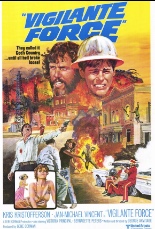
Baby-faced and butt-cut, White Line Fever’s Jan-Michael Vincent again plays a Working-Class Hero, this one named Ben, in the utterly oddball and oddly rewarding Vigilante Force, from George Armitage (Miami Blues). A farm machinist and single dad, Ben notices something just ain’t right in his small town of Elk Hills, California: namely, that influx of redneck oil workers. They’ve turned the place into a comically lawless swath of blue-collar chaos.

Low on officers because they keep getting killed in broad-daylight shootouts, the police chief (Judson Pratt, Futureworld) suggests Ben recruit some tough guys, starting with that no-good brother of his, Aaron (Kris Kristofferson, Convoy). A Vietnam vet who apparently never met a shirt he liked to wear for more than a few minutes, Aaron agrees and brings along some buds, all of whom are sworn in as lawmen. Initially, Aaron looks like the ideal hire, because he produces near-instant results in cleaning up the riffraff.
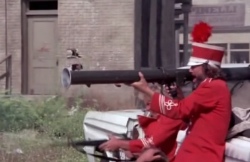
Too bad the power goes straight to Aaron’s bearded head. Acquiring a tone-deaf bar floozy (Bernadette Peters, The Jerk) as property, he has the bright idea to start charging local businesses for “protection,” and to shoot shit (and shit-kickers) up as he damn well feels like it, cockfight included! Suddenly, it’s sibling against sibling, Cain vs. Abel, concluding in an all-out war during a bicentennial parade. It looks and feels like a showdown from an alternate reality: On one side, a topless Ben in overalls; on the other, Aaron, wielding a bazooka while dressed like The Music Man. Many, many explosions follow, because producer Gene Corman learned well from brother Roger.

And so did writer/director Armitage, who cut his teeth on Private Duty Nurses (part of Corman’s five-film cycle of RN-fronted sex comedies), because he fills the screen with eye candy and other dirt-cheap visual effects. A drop-dead gorgeous Victoria Principal (Earthquake) plays the girlfriend of Ben, whose idea of romance is greeting her with a six-pack of Pabst Blue Ribbon — a gesture that may make viewers cringe, knowing how Vincent torpedoed his career. There’s also a pre-WKRP Loni Anderson, uncredited as a buxom, brunette casino hussy named, naturally, Peaches.

One of the great unheralded pics in hicksploitation history, Vigilante Force comes packed with an uncredited Dick Miller (A Bucket of Blood) as a piano player, a lot of whores, a guy named Shakey, a girl named Boots, several grown men in coonskin caps, a fake Cloris Leachman and the real Andrew Stevens. Plus, David Doyle (aka Bosley from TV’s Charlie’s Angels) gets run over by a car, so there’s that, too! Now how much would you pay? —Rod Lott
Get it at Amazon.

The Day of the Wolves (1971)

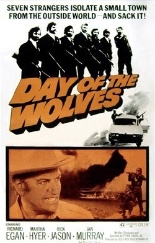
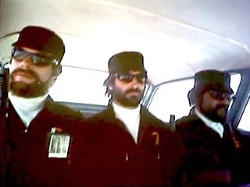
Seven criminals are recruited to pull a job. They are known to one another only by an elementary code and sport the same cool-guy disguise. Sound familiar? There’s no way that a TV broadcast of The Day of the Wolves managed to escape the eyes and psyche of a young Quentin Tarantino.

As ringleader, No. 1 (Jan Murray, 1967’s Thunder Alley) assigns his assembled men numbers instead of names, instructs them to don fake beards and black gloves, and runs them ragged through two days of training for a three-hour job he promises will net each of them no less than a $50K payday: robbing the entire desert town of Wellerton, population 7,420. When questioned how such a small group can pull off such a big heist, No. 1 explains with a shit-eating grin, “One wolf can maul a whole flock of sheep. Imagine what seven can do.”

Unbeknownst to the crew, their otherwise perfectly planned crime coincides with the forced resignation of the town’s longtime chief of police (Richard Egan, The Big Cube) for purely political reasons; just because he’s lost his badge doesn’t mean he’s lost his will to protect and fight. Imagine what one can do.

If only it weren’t so obscure, the Arizona-lensed Wolves would be taught as a textbook case of what a resourceful filmmaker can do with the barest of resources. Although I’m sure writer/director Ferde Grofé Jr. (The Proud and Damned) would have stacked the deck with marquee names if he could have afforded it, the homogeny among the criminals doesn’t require it. Indeed, it seems almost deliberate that only one of the hired guns, No. 4 (Rick Jason, The Witch Who Came from the Sea), bears a discernible personality. What the film lacks in finesse, Grofé mitigates with an inventive setup, a crackling pace, a corker of an ending and action action action. Imagine what one can do. —Rod Lott

Get it at Amazon.

The Arena (2001)

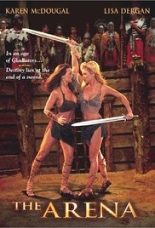
Cross Gladiator with any episode of Xena: Warrior Princess. Then cross that with Playboy’s Erotic Fantasies II and you have yourself The Arena, a grim and inept Roger Corman production. A remake of the 1973 Corman production starring Pam Grier, this newfangled Arena stars not one, but two Playmates of the late 1990s, Karen McDougal and Lisa Dergan.

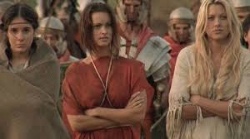
Respectively playing Jessemina and Bodicia, the girls are sold as slaves to the evil governor. Their duties are to clean the gladiator arena and serve as unpaid whores. But when the gov catches all the women having a heated catfight in their hut, he drafts them for a public cage match, because who doesn’t want to see girls, well, fight like girls? After the first girl-on-girl event, the soldiers celebrate by doing some strange Hokey Pokey dance. All the gladiator scenes are shot in that annoying shaky-cam “style,” but at least there is blood: a beheading, a man cut in half, another shot through the mouth with an arrow — and that’s just the first 10 minutes!

I think it says a lot about the film — the first in English for Russian director Timur Bekmambetov (Abraham Lincoln: Vampire Hunter) — when even its sex scenes bore. But thanks to the bubble-butted McDougal’s exposure, I learned that boob jobs and bikini waxes were far more prevalent in ancient Rome than we were taught in schools. Predictably, she and Dergan are awful actresses; the stilted conversations between them are so pained and forced, it’s like watching two Valley girls struggle to talk about anything other than shoes or boys. And when it comes down to it, that’s exactly what they’re doing.

The supporting cast includes the now-stereotypical feminine, John Lithgow-type of a governor; a tough bald guy who always sniffles; and a hunky dude who looks and acts like Kevin Sorbo with a head injury. Everything is tinted blue or yellow — just like Steven Soderbergh’s Traffic, but without purpose or reason to exist. —Rod Lott

Get it at Amazon.

White Line Fever (1975)

Apologies to Jonathan Kaplan’s White Line Fever and its star, Jan-Michael Vincent, for wrongly assuming all these years that it was a film about cocaine. Sometimes the private demons of public figures can cause one’s mind to mix fact with fiction. (Submitted for my defense: that title, c’mon!)

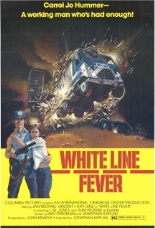
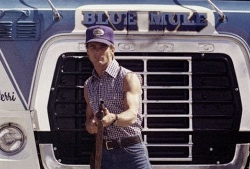
Instead, the actioner — one of many hick flicks at the time to cast the CB-clutching working man as an American hero — concerns itself with corruption in the trucking industry. The character played by Vincent (1972’s The Mechanic) may sport a feminine-sounding name, but Carrol Jo Hummer is masculinity embodied: a war veteran, a Southerner, a family man, a blue-collar clock puncher. Returning from Vietnam to his Arizona home and his soon-to-be bride (Kay Lenz, 1985’s House), Hummer happily puts himself in debt “up the wazoo” to buy a rig and pursue his late father’s independent-trucking dreams. Dubbing his bucket the “Blue Mule,” Hummer brims with Brut-splashed zeal at the prospect of hitting the highway for an honest day’s pay.

His first stop is to see his pappy’s former partner (Slim Pickens, Sam Peckinpah’s The Getaway), who works for a shipping biz run by the greasy, sleazy, sexist and racist Buck (L.Q. Jones, The Brotherhood of Satan). Hummer immediately gets work, but when he sees illegal slot machines and smokes being loaded into his rig, he refuses. While it’s the right thing to do, it’s the wrong decision in the beady eyes of Buck, who gets Hummer blackballed all over town. With a two-grand monthly payment to the bank weighing down his shoulders, but unable to make a haul, Hummer has no choice but to get even, and that requires getting his mitts dirty.

White Line Fever skillfully follows the Walking Tall template of rural revenge to appease audience expectations and to elevate Hummer to that rarified status of folk hero for the common man. (But to speak of the common woman for a moment, Lenz shines with good-natured grace and power in the first half, before a lazy soap-opera subplot tosses her character into the backseat.) The movie’s iconic, climactic shot of the Blue Mule crashing through the logo signage of the conveniently named Glass House represents an extended middle finger to corporate America and all its malfeasance.

I’m guessing Kaplan drew upon his education through the Roger Corman school of directing (Night Call Nurses) when he chose to shoot that stunt in slow motion, because that’s just the kind of thing the legendary producer would advise his students to do with their films’ visual orgasm: Put it all up on the screen. Technically, Fever is not a Corman picture, yet it operates in the same efficient manner as much of the man’s low-budget fare of that time: with more going on underneath its boom-boom-pow surface. —Rod Lott

Get it at Amazon.

Sweet Sugar (1972)

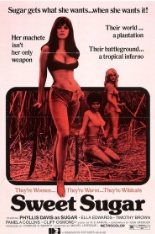
Elation turns to frustration when a prostitute named Sugar is sentenced to the plantation, in the Cain-raising Sweet Sugar. In a role similar to her star(let) turn in the following year’s Terminal Island, the lovely Phyllis Davis pours every bit of her seductive curves and salacious charm into the role, making the women-in-prison picture a superior example of the exploitation-staple subgenre.

Set up for a marijuana bust in Costa Rica, Sugar is thrown into jail. Rather than face a year or more behind bars while waiting for her sure-to-be-unfair trial, she opts for the alternative punishment of a two-year stint cutting sugar cane under the unforgiving sun. She and her fellow conscripted cuties (including Detroit 9000’s Ella Edwards as the film’s good-enough simulation of Pam Grier) use their rented machetes and feminine wiles in numerous attempts to overpower the men and make a run for the border.

Virtually every character with testicles — the literal kind, mind you — is a villain, none more so than the wackadoodle scientist Dr. John (Angus Duncan, How to Seduce a Woman), whose twisted experiments include some sort of orgasm machine that Sugar short-circuits and a drug he injects into cats to turn them ferociously feral, upon which they are hurled by the guards toward the caged women.

From Werewolves on Wheels steerer Michel Levesque and The Big Doll House scripter Don Spencer, Sweet Sugar has far more going for it than the average WIP entry, most notably a subplot involving voodoo rituals conducted by the Afro-sporting male prisoner Mojo (Timothy Brown, The Dynamite Brothers). But make no mistake: All it really needed to work was the underappreciated Davis, who balances playing delectable and devious by practically erasing the line that separates the two. The camera loves her even more than the hormone-raging guards trying to win her favor. —Rod Lott

Get it at Amazon.