Category Archives: Action

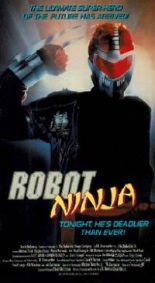
Robot Ninja (1989)

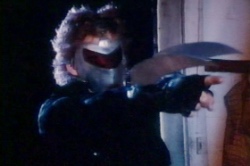
A stealth killing machine trained in the ancient art of invisible assassination known as ninjutsu — who also happens to walk with the clankity-clank of a clunky robot, mind you — is becoming the biggest hit on Burt Ward’s television station.

Pushing aside the fact that Burt Ward has a successful television station, the campy humor of the Robot Ninja program doesn’t sit well with the creator, Leonard Miller (Michael Todd, Lurking Fear). Instead of filing an injunction or, even easier, moving on and creating an anti-Robot Ninja answer in comic-book form, Miller hooks up with his German friend and creates a real-life Robot Ninja suit.

When he runs afoul of the city’s top criminals — apparently a couple of rednecks in your uncle’s windowless van — Miller pops a handful of pain pills and slams some pieces of metal in his forearm and takes the Robot Ninja-ing to the streets, wreaking low-budget havoc in many open fields and parking lots, with plenty of old-school gore effects that made Tempe Entertainment releases Friday night must-rents.

Directed with empty-pocketed flair by legendary backyard filmmaker J.R. Bookwalter (The Dead Next Door), this last-ditch effort to get the video label’s efforts out to this new generation of film geeks is a grand one, complete with an autographed Blu-ray sleeve and a moderately entertaining comic-book tie-in. But for me, Robot Ninja mostly karate-chops my own sense of teenage nostalgia, so much so that I’d like to preorder Bookwalter’s Ozone and The Sandman, if possible. —Louis Fowler

Get it at Amazon.

Fantomas Unleashed (1965)

Picking up one year after the events of Fantomas, the sequel Fantomas Unleashed opens with the bumbling Commissioner Juve (Louis de Funès) being named a Knight in the Legion of Honor for ridding France of that masked master criminal Fantomas (Jean Marais) … uh, even though he didn’t. Fantomas just went on hiatus, but he’s back to embarrass the blood-boiling Juve and announce his intent to “perfect a ghastly weapon. … Soon, I will be the master of the world.”

Said game changer is a mind-control ray, and all Fantomas lacks is the participation of both the scientists who have been developing it. Having abducted one already, he sets his sights on kidnapping the elderly Professor Lefèvre (also Marais) at the International Scientific Conference; hero journalist Fandor (Marais once more) offers to take the learned man’s place by disguising himself as the bald, bulb-nosed prof. It’d be a mistake for Unleashed to ignore a ripe opportunity for mistaken identity — and then some! — so it doesn’t.

“These days, it’s all secret agents and gadgets,” says Juve — a bit of self-reflexiveness, as returning director André Hunebelle doubles down on the 007 influence, packing the picture with more gadgetry and accoutrements than before. While Fantomas has acquired a remote-controlled mini-car and submerged-volcano lair, Juve makes use of a third-arm contraption and bullet-firing cigars. These items of spy-fi work in support of the cartoon opening credits to cue viewers in on how seriously not to take the next hour and a half.

Front and center in the first Fantomas, Fandor yields the spotlight to Juve this time, likely because the commissioner’s brand of comic relief — so hot-tempered, he’s a walking ad for beta blockers — works in harmony with the light tone. Back as Fandor’s fiancée, Mylène Demongeot enjoys an elevated role as her character more actively participates in the caper and gains a precocious little brother (Olivier de Funès, son of Louis, in his film debut). Whatever the ratio, the group not only continues to charm, but charms more, and Unleashed is the better movie for it. —Rod Lott

Get it at Amazon.

Fantomas (1964)

While based upon the French anti-hero created in 1911, the 1964 incarnation of Fantomas seems more influenced by 007. As portrayed by Jean Marais (Jean Cocteau’s Beauty and the Beast), the master criminal trades the top hat for a proto-Blue Man Group visage as a man-of-a-thousand-faces supervillain set to rival Dr. No and Auric Goldfinger in all things deadly and dastardly.

Arriving with a pair of OSS 117 secret-agent flicks already under his belt, director André Hunebelle gets the hardly gauche Gaumont picture going with a prologue ripped straight from the pulps, as a disguised Fantomas makes off several million francs of jewelry by “paying” with a check written in disappearing ink.

Two people in particular are intrigued by this brazen crime. One is the hotheaded, bald-headed Commissioner Juve (the delightful Louis de Funès, The Mad Adventures of Rabbi Jacob), eager to bring the madman to justice. The other is Fandor (also played by Marais), a newspaper reporter eager for a good story — eager enough to make it up, complete with fake photoshoot, with the help of his decorative girlfriend (Mylène Demongeot, The Giant of Marathon).

Unamused at the front page that follows, Fantomas has the journalist kidnapped and brought to his underground lair, laden with high-tech spy-fi gadgetry (where do these evil masterminds find their contractors?), and explains a few things to his captive:
• He wants to control what the press writes about him. (How prescient!)
• He can re-create human skin, from face to fingerprints, which he dons to perpetrate felonies under the guise of upstanding citizens — like, say, Fandor.
• He “may kill people, but always with a smile.”

For fans of crime thrillers coated in camp, that smile may prove contagious throughout, as Fantomas-as-Fandor pulls a daring diamond heist during a rooftop beauty contest in broad daylight. As Fantomas-as-Juve terrorizes Paris with acts of random violence. As Fantomas gives Tom Cruise a run for his face-switching, Mission: Impossible money. As James Bond-ian submarines and helicopters come into play. As a silly slapstick car chase grows increasingly inventive until it’s nearly worthy of Buster Keaton.

Full of action, light of heart and swift of feet, Fantomas begins and ends as a good caper should: fun. One could argue it doesn’t end at all; rather, it presses pause on its own cat-and-mouse tale, as if awaiting the projectionist to switch reels and start the sequel (Fantomas Unleashed, unleashed the next year by the same team), but assuming you’re already “in,” you’ll hardly mind the inconvenience. —Rod Lott

Get it at Amazon.

Dixie Dynamite (1976)

In the Deep South, because where else, Tom Eldridge (Mark Miller, Blonde in Bondage) runs a moonshine business on his 7.5-acre property … until the town sheriff (Christopher George, Mortuary) shows up to throw a wrench in the works. As Tom panics and tries to flee Johnny Law, he’s shot dead by a lummox of a deputy (Wes Bishop, who wrote and produced the film).

Daddy’s death is the first domino in a string of troubles in motion for Tom’s two daughters, Dixie (Jane Anne Johnstone) and Patsy (Kathy McHaley). They face eviction from their home, thanks to the local greedy banker (R.G. Armstrong, Evilspeak), and can’t find a job — cue the montage of the ladies walking past multiple “NO HELP WANTED” signs. When close family pal Mack (Warren Oates, Stripes) fails to win the $1,000 grand prize at The Moto-Cross Big Race — seriously, that’s what it’s called — the Eldridge girls decide to resort to the ol’ standby. No, not prostitution: revenge.

A knee-jerk reaction would be amazement that Dixie Dynamite works as well as it does. But Bishop and frequent director Lee Frost made B-movie magic almost every time at bat in their long and fruitful partnership, which included horrors that shocked (Race with the Devil), schlocked (The Thing with Two Heads) and stripped (House on Bare Mountain). This proto-Dukes of Hazzard entry into the hicksploitation contender is no different. In fact, it’s one of the better ones, comfortably forming a wheel-centric companion to Chrome and Hot Leather, Frost/Bishop’s 1971 biker pic.

Plus, with Oates as something of a third-lead ringer, Frost/Bishop were able to anchor the film with more talent than the duo’s lesser efforts. If Dixie Dynamite holds any sort of surprise, well, it actually has two. The first is that one of the racing cyclists is Hollywood legend Steve McQueen; don’t bother looking for him, because he’s hiding uncredited underneath a helmet. The other, larger surprise is not that Johnstone and McHaley had zero movie credits before this, but that they had zero afterward, as both women are radiant. The screen clearly adores them, making their vanishing act from it all the more criminal. And speaking of, the final reel’s heist sequence cleverly pulls a Quick Change/Inside Man trick years before either had the chance. —Rod Lott

Get it at Amazon.

The Real McCoy (1993)

One of the great good films to come out of the 1990s action boom, this Russell Mulcahy caper stars Kim Basinger as Karen McCoy, quite possibly the hottest felon ever to walk out of a woman’s prison, complete with makeup and hair did. After a multiyear rap for a botched burglary of an Atlanta bank — complete with high-tech gear that must’ve cost more than she would’ve made from the heist – she’s now looking to reconnect with her son and walk the straight and narrow.

But, of course, because Kim Basinger is so hot, every man she comes across wants to wrap their slimy tentacles around her, especially her grimy parole officer, who I’m pretty sure was in plenty of Ernest P. Worrell flicks. Add in the equally slimy Terence Stamp, as a crime lord clad mostly in a terrible Southern accent, who kidnaps her kid, leaving her with no other option but to return to the robbing life. Along the way, she meets affable J.T. (an affable Val Kilmer), a bumbling driver who seems out of place in this movie, but oh, well, it was the ’90s and we threw caution to the wind and hired Val Kilmer whenever we could.

Watching The Real McCoy for the first time in 20 or so years, it’s a bit strange now to watch these Joel Silver, Andrew Vajna, Don Simpson or, in this case, Martin Bregman-produced flicks in the era of #MeToo, because throughout most of the movie, Basinger takes beating after beating from various men and never once fights back — until the very end, of course, when she all of a sudden unleashes kung-fu kicks left and right.

A lot of this probably wouldn’t fly today and you’d have to wonder if Basinger, whose star has waned a bit, would do it all differently today. And while it would be easy to call for a remake, this was quite the bomb at the box office, earning about $6 million in receipts. Maybe it didn’t fly so well back then, either? —Louis Fowler

Get it at Amazon.