
Category Archives: Action

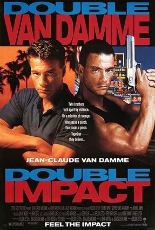
Double Impact (1991)

If you’re anything like me — and I’m guessing you probably aren’t — you probably thought that The Parent Trap would have been a might better with Bolo Yeung as a Triad hitman who mercilessly shotgunned Hayley Mills’ parents to death in the film’s opening.

Double Impact gets you halfway there, albeit with double the Jean-Claude Van Dammes. Let’s get together, yeah yeah yeah!

Here, JCVD takes on the dual roles of Chad and Alex, somewhat different twins separated at birth and driven together by their love of smoking-hot blondes and, I guess, solving the murder of their parents while collecting the apparent royalties from the Hong Kong-mainland tunnel their dad completed before his death. But mostly smoking-hot blondes.

Between selling smuggled Mercedes on the high seas to busting up a clandestine Hong Kong drug operation, the brothers seem to be getting along until one of them gets way too drunk and imagines in his mind — and dramatized onscreen, thankfully — the other brother sexually satisfying a smoking-hot blonde, leading to some classic Van Damme-on-Van Damme action.
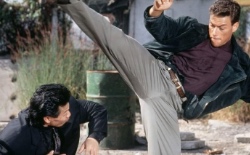
Still, after seeing a few Triads storm the beach the next morning, they decide to put their mutual dislike of each other aside and take on the nameless Chinese sentries, all to get to the snooty British businessman that, as snooty British businessmen are wont to do, put the hit on his parents for reason I still haven’t grasped.

With many instances of Bolo Yeung’s burly stockiness lurking about — and even a little bit of Cory Everson’s muscular thigh-crunching for equal opportunity — the screenplay, written by Van Damme and director Sheldon Lettich (Lionheart), is a highly nonsensical but ultimately fun kick to both of the gonads, preferably while in the patented Van Damme splits position.

For years, Van Damme has teased a sequel pitting Chad and Alex against the “South Central mob,” if such a thing exists, but those plans have yet to see the light of day. I guess those Tostitos commercials are the closest we’re ever going to come, which I’m okay with. —Louis Fowler
Get it at Amazon.

Heroes Shed No Tears (1986)

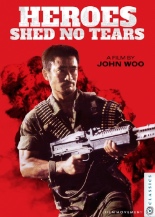
In this life, there are many things that heroes shed but, apparently, tears are not one of them. At least that is the thesis statement behind John Woo’s 1986 testes-dropper, Heroes Shed No Tears, starring Eddy Ko (PTU) as the non-crying hero.

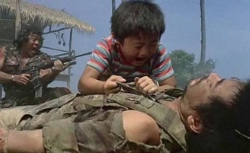
Actually, I feel like I should walk that back a few steps: Ko, as Chinese mercenary Chan, does cry a time or two but, to be fair, it is because for a few moments he believes the evil Thai colonel has set his small child on fire. I think that, if you were not to cry at something like that, you’re probably more of a sociopath than an actual hero, but I guess that’s just me.

Anyway, Chan is the leader of a group of Chinese commandos out to capture Gen. Samton, who’s running the drug trade in the Golden Triangle. Even though the capture is primarily a success, crossing the mountain range and getting to their contact into Vietnam is quite the bitch, especially with Chan’s kid and his aunt, a French reporter and a couple of soldiers with a hilarious gambling problem in tow.

With one violently cool set piece after another — how the evil Thai colonel loses his eye is worth the price of admission unless, you know, you’re an evil Thai colonel — this flick isn’t a predictor of future Woo flicks like The Killer or Hard Boiled, but instead absolute bloody proof that his ballistic ballets had been a staple of Hong Kong cinema for a while; it just took the rest of us world-cinema jerks to catch up to him.

Arguably one of the best action films in a decade that had nothing but, Heroes Shed No Tears is the overseas grindhouse version of the Rambo movies, with plenty of fighting for the guys, romance for the gals, and hardcore scenes of gambling addiction for the drunk uncles in the audience. —Louis Fowler

Get it at Amazon.

The Tough Ones (1976)

Clint Eastwood’s iconic character of Dirty Harry inspired many a trigger-happy cop who plays by his own rules, but in Italy, he invented practically a whole new genre, with a prime shaker in their police film movement being Filthy Leo Tanzi (Maurizio Merli, Magnum Cop); in The Tough Ones, he delivers homily after homily about how the criminals rule the streets, all the while chasing down a sadistic hunchback (Tomas Milian, Don’t Torture a Duckling) who craps bullets. Literally.

Punching, kicking and most definitely shooting every punk and purse snatcher from here to the Coliseum, Roman detective Tanzi is an unlikable brute in a surprisingly stylish sports coat, the type of guy who’s got no problem browbeating his psychiatrist girlfriend, loudly, in a restaurant. As he works his way through the pristine Italian underworld, it keeps leading him back to the utterly disturbing villain who totes a smile and a machine gun like a Punisher baddie, probably from the Garth Ennis era.

Even when Tanzi’s boss demotes him to the permits department, he still finds the time to help track down a gang of rapists, preferably by slamming their heads right through a pinball machine. Much like the aforementioned Harry, to see an antihero cop take matters into his own fist, especially in the sleaze and grime of the sports car-driving, marinara-covered underbelly, it remains a cool enough ride of coveted two-fisted violence some 40 or so years later.

Also known as Rome Armed to the Teeth, Brutal Justice and Assault with a Deadly Weapon (from Sybil Danning’s Adventure Video line, which I remember fondly), famed director Umberto Lenzi directs with all the subtly of a hunchback spraying the crowd with gunfire, laughing manically as the spaghetti-sauce splashes across the screen, all to a funky Franco Micalizzi score, which, remarkably, is included here on compact disc in the gorgeous Grindhouse Releasing package.

An entertainingly blood-spewing example of the legendary poliziotteschi film series of the 70s, The Tough Ones may not be as trashily seminal as Lenzi’s Eaten Alive!, Cannibal Ferox or even Nightmare City, it is still nominally far dirtier than any American cop flick from the same era. So go ahead, make his … well, I’m sure you know the rest. —Louis Fowler

Get it at Amazon.

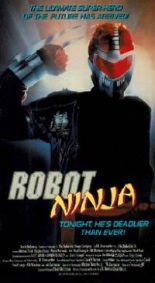
Robot Ninja (1989)

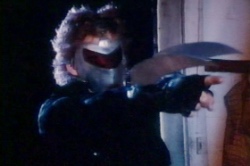
A stealth killing machine trained in the ancient art of invisible assassination known as ninjutsu — who also happens to walk with the clankity-clank of a clunky robot, mind you — is becoming the biggest hit on Burt Ward’s television station.

Pushing aside the fact that Burt Ward has a successful television station, the campy humor of the Robot Ninja program doesn’t sit well with the creator, Leonard Miller (Michael Todd, Lurking Fear). Instead of filing an injunction or, even easier, moving on and creating an anti-Robot Ninja answer in comic-book form, Miller hooks up with his German friend and creates a real-life Robot Ninja suit.

When he runs afoul of the city’s top criminals — apparently a couple of rednecks in your uncle’s windowless van — Miller pops a handful of pain pills and slams some pieces of metal in his forearm and takes the Robot Ninja-ing to the streets, wreaking low-budget havoc in many open fields and parking lots, with plenty of old-school gore effects that made Tempe Entertainment releases Friday night must-rents.

Directed with empty-pocketed flair by legendary backyard filmmaker J.R. Bookwalter (The Dead Next Door), this last-ditch effort to get the video label’s efforts out to this new generation of film geeks is a grand one, complete with an autographed Blu-ray sleeve and a moderately entertaining comic-book tie-in. But for me, Robot Ninja mostly karate-chops my own sense of teenage nostalgia, so much so that I’d like to preorder Bookwalter’s Ozone and The Sandman, if possible. —Louis Fowler

Get it at Amazon.

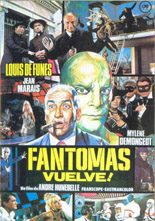
Fantomas Unleashed (1965)

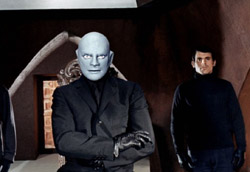
Picking up one year after the events of Fantomas, the sequel Fantomas Unleashed opens with the bumbling Commissioner Juve (Louis de Funès) being named a Knight in the Legion of Honor for ridding France of that masked master criminal Fantomas (Jean Marais) … uh, even though he didn’t. Fantomas just went on hiatus, but he’s back to embarrass the blood-boiling Juve and announce his intent to “perfect a ghastly weapon. … Soon, I will be the master of the world.”

Said game changer is a mind-control ray, and all Fantomas lacks is the participation of both the scientists who have been developing it. Having abducted one already, he sets his sights on kidnapping the elderly Professor Lefèvre (also Marais) at the International Scientific Conference; hero journalist Fandor (Marais once more) offers to take the learned man’s place by disguising himself as the bald, bulb-nosed prof. It’d be a mistake for Unleashed to ignore a ripe opportunity for mistaken identity — and then some! — so it doesn’t.

“These days, it’s all secret agents and gadgets,” says Juve — a bit of self-reflexiveness, as returning director André Hunebelle doubles down on the 007 influence, packing the picture with more gadgetry and accoutrements than before. While Fantomas has acquired a remote-controlled mini-car and submerged-volcano lair, Juve makes use of a third-arm contraption and bullet-firing cigars. These items of spy-fi work in support of the cartoon opening credits to cue viewers in on how seriously not to take the next hour and a half.

Front and center in the first Fantomas, Fandor yields the spotlight to Juve this time, likely because the commissioner’s brand of comic relief — so hot-tempered, he’s a walking ad for beta blockers — works in harmony with the light tone. Back as Fandor’s fiancée, Mylène Demongeot enjoys an elevated role as her character more actively participates in the caper and gains a precocious little brother (Olivier de Funès, son of Louis, in his film debut). Whatever the ratio, the group not only continues to charm, but charms more, and Unleashed is the better movie for it. —Rod Lott

Get it at Amazon.