
Category Archives: Action

Man of Violence (1970)

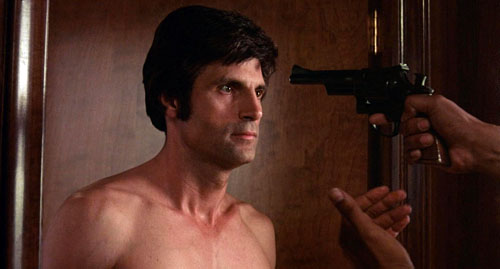
With a title like Man of Violence, Pete Walker’s third feature gives no indication of its driving conflict: dueling British property developers. Smart move, Pete! Same goes for slapping your opening credits atop footage of a woman’s navel shot in such extreme close-up, it verges on the gynecological.

A real estate war may sound like a snore, but fear not, readers: These property bros aren’t above resorting to murder to get shit done. One side hires a freelance fixer named Moon (Michael Latimer, Hammer’s Prehistoric Women) to do their dirty work. The other side also hires Moon to do their dirty work. Moon being Moon, an opportunist crook, he plays both sides. After all, despite his tousled hair and a water pistol loaded with Heinz Tomato Ketchup, he’s got a taste for life’s finer things, and London’s clothiers don’t just give away collared tangerine shirts, luv.

The plot involves ax-clutching gangsters, a protection racket, a smuggling scheme — all a MacGuffin, as far as I’m concerned. Perhaps Walker felt the same, tasking the yowza Luan Peters (Hammer’s Twins of Evil) to deliver a chunk of exposition while undressing. (Like, are we supposed to pay attention? If so, that’s not playing fair.) Functionally, the story is more about biding time to get to the next set piece. My favorite among them might be Moon subduing a threatening passenger by braking so hard, the poor guy’s forehead smashes against the dash. Perhaps Schizo Walker felt the same, having Moon quickly drive forward and backward to brake again, over and over, making good on the film’s title. (Speaking of, its alternate one is, stupidly, Moon.)

A sign outside a club owned by one of Moon’s clients reads, “IF YOU DON’T SWING, DON’T RING.” The rhyme could double as a gatekeeper for viewers, too, as Man of Violence explores sexual kinks (hetero- and homo-) and spontaneously jet-sets to Marrakesh for the third act. This trip temporarily turns the movie into something of a freewheeling travelogue à la Harry Alan Towers’ 1960s espionage adventures (see Code 7, Victim 5!; Mozambique; Five Golden Dragons; et al.) — by no means a complaint. Walker’s conclusion bears so many twists, you’d think he’d installed a turnstile. It may be more complicated than necessary, yet also more clever. —Rod Lott

Get it at Amazon.

Censor Addiction (2026)

In 2030, the hubbub in America isn’t around the morning-after pill, but the good-morning pill. The drug was developed to cure violent tendencies until its CEO, Addis (Chris Moss), realized the greater windfall stood in having it secretly cause such urges, thus increasing demand. Bwah-hah-hah!

Meanwhile, a former employee named Soul (Daniel O’Reilly) leads a small movement of highly armed revolutionaries against Addis’ greedy, grubby ways. Soul, who looks like John Travolta playing a Ken doll (or vice versa), is so committed to the movement, he initially refuses sex with his hot-to-trot wife (Marnette Patterson) so he can focus.

Like me, Censor Addiction sags in the middle, as each stage of the factions’ ongoing tête-à-tête grows protracted with heavy dialogue. Human action figure Mike O’Hearn (National Lampoon’s TV: The Movie) livens things up for a minute as an Addis fixer who feels no pain, has advanced healing properties and could be the result of entering “bicep but a person” into ChatGPT. Former pin-up model September D’Angelo also livens things up by falling to the ground rather delicately for someone violently plugged with machine-gun fire.

Censor Addiction is basically a reunion of Michael Matteo Rossi’s The Charisma Killers from 2024, right down to the appearances of Vanessa Angel, Vernon Wells, Ana Ciubara, what looks like the same living room, a familiar driveway, and wacko character names — here including Wizard, Pillar and Canvas Jones. The latter is an Addis henchman played by Bart Voitila (David DeCoteau’s The Pit and the Pendulum); he and Moss stand out by acting with the proper sodium level for the ham they’re given. That’s in step with the Addis commercials that open the movie, targeting Big Pharma with satire reaching for RoboCop-style heights. Rossi doesn’t get there, but he should try more of that. —Rod Lott

Get it at Amazon.

Thrashin’ (1986)

The 1980s had their “big” movies dedicated to the dawn of the most extreme of sports, little-seen mainstream product like Rad, North Shore, Body Slam or even The Dirt Bike Kid with Peter Billingsley and half the cast of HBO’s Not Necessarily the News.

But only one movie made me want to skateboard down a “freewheeling boogieman” on the 405, bounce off a “parallel shortbus” at the youth center and bust out with a “360 knapsack” on a “total doogie” — that’s the lingo, right? — and that movie was Thrashin’.

The whole skating craze was more my younger brother’s bag. I’d watch him and his friends doing “ollie-hopnoodles” and “jitterbuggin’ the manatee” in the neighborhood park while I sat in the shade of a tree and read my dystopian fiction novels above my reading level — a sad childhood, to be sure.

In that summer of 1986, though, Thrashin’ was advertised on the back of every Marvel comic book and, man, I was as pumped as a fat kid with no athletic ability could be pumped: I needed to see that movie!

Too bad there were no theaters in my small town. The next year, I rented it on VHS and thought it was okay, but my skating fandom already had died; by then I was obsessed with extreme bike-messengering, mostly because of Kevin Bacon’s Quicksilver.

Since that long-lost rental, I hadn’t revisited Thrashin’ until yesterday. A dated piece of analog flotsam, it’s from a more innocent time when all you needed to be a hero was your absolute will to be the best skater in the Valley.  

Corey (a baby-faced Josh Brolin) is the new kid in town and he’s got that will. Decked out in his loose Vision tee, stylin’ Jams shorts and parent-approved elbow and knee pads, he cruises in the wind toward PG-13 oblivion while a generic “punk” song by Meat Loaf, with lyrics about “achieving your dreams” and “flying high,” plays on the epic soundtrack,

With plenty of sick “flip-kicks,” “Mr. Coffees” and “Gorgonzola dunks,” Corey and his friends call themselves the “Ramp Locals” because, well, they made a ramp. Eventually, they run into the skater punks from the other part of town, led by swarthy Tommy (’80s mainstay Robert Rusler).

While the Red Hot Chili Peppers play a skate party — the band’s second movie of the year, alongside Tough Guys with Kirk Douglas and Burt Lancaster — the Romeo and Juliet vibes take precedence as Corey and Tommy’s sister, Chrissy (Pamela Gidley), spend time playing games at an outdoor carnival, as you do.

Even though the stakes are low, the punks are pretty mad and make a wager to control the whole skateboarding scene, as well as, um, a corporate sponsorship. As you can guess, after a rehabilitation montage, Corey soundly defeats them and you think the punks will be mad … but, instead, Tuff Tommy shakes Corey’s hand and says, “Good game, brah!” or something to that effect.

Aided by a bunch of ’80s skaters like Tony Hawk and Tony Alva, both Brolin and, to smaller effect, Rusler are pretty good in their melodramatic roles. But the real star is director David Winters, a longtime choreographer whose work on Linda Lovelace for President, Roller Boogie and the Star Wars Holiday Special make me think his life story would be a great movie.

In the end, Thrashin’ was a near-wipeout of the whole skateboard craze, schooling me on the fads and foibles that, as a young person in the ’80s, I could often find myself in. At least not until Gleaming the Cube … right, brah? —Louis Fowler

Get it at Amazon.

Seeds (2024)

In films, Indigenous characters (both fictional and non-), are usually created, written and filmed to be stereotypical “redskin” primitives as generic, nonsupporting players in whitewashed plots. If you even get the part, you’re killed off in the first 15 minutes for union scale, an IMDb credit and another notch in white supremacy’s belt.

It seems Indigenous filmmakers aren’t going to take it anymore. In the past few years, when an wholly Indigenous creative team goes all-in, their projects personify simmering rage against polite society’s established systems. A Canadian film by Kaniehtiio Horn (Possessor) puts all those sharp feelings in a blender and goes hits “cultural purée.” Of course, I loved it.

That genre-bending film is Seeds, recently named Best North American Indigenous Film by the Oklahoma Film Critics Circle, of which I’m part. I felt like I triumphed; as half-Choctaw, I identified with Horn’s character, Ziggy, as she tries to reconcile the old world with the new, the traditional ways with the savage, and, naturally, the comedic side with the horrific. Seeds plays very well at balancing these sides.

Living in the city, Mohawk tribe member Ziggy is an influencer/food delivery driver with some outstanding bills she’s trying to pay off. Looking to recharge her account, her cousin (the very funny Dallas Goldtooth, TV’s Reservation Dogs) asks her to come to the Pine River rez to house-sit. Many out-of-water comic scenarios — including strapping ex-boyfriends, homemade energy drinks and clandestine internet issues — make you think Seeds is a comedy.

But soon enough, a storm builds when the town’s white-trash thief and his two accomplices try to steal Ziggy’s aunt’s most prized possession: legacy corn, bean and squash seeds. They break in and kill her cat to scare her to give up the seeds. If you know Natives, that’s easier said than done, because 500 years of Indigenous rage pours out. With total prejudice and no mercy, she strings the guys up, whips them, covers them in hot oil and “de-barks” them in an act of Indigenous revenge that’s very raw and justified.

With a true supporting cast that includes the late Graham Greene and an impossibly Goblin-esque soundtrack by Alaska B, writer and director Horn has ripped up the playbook that white people have used for a hundred years and deftly mixes humor and horror to the hilt.

I am proud to champion this film and hopefully more people will see it, from Indigenous cinephiles to all-around horror fans. However, a different movie called Seeds, a documentary about Black farmers, was released around the same time, causing confusion. As a result, both may go unrecognized. I guess when it comes to non-white films, they all look the same, right? —Louis Fowler

Get it at Amazon.

The Farmer (1977)

Cult films number many, yet few earn that status from going unseen. The Farmer is one from that small crop, unavailable for roughly 45 years after a theatrical run so unsuccessful, “theatrical limp” would be more accurate.

Gary Conway (I Was a Teenage Frankenstein), who also produced, takes the lead role of Kyle Martin, a Silver Star soldier returning home from World War II to find his late father’s farm headed toward foreclosure. Prospects are grim until Kyle rescues gamblin’ man Johnny (Michael Dante, The Naked Kiss) from a drunk-driving accident. In thanks, Johnny sends his floozie girlfriend, Betty (Angel Tompkins, Relentless), to gift $1,500 in cash to Kyle, who takes the dough and the dame.

After getting acid-blinded by gangster Frank Passini (George Memmoli, Mean Streets) for cheating on the ponies, Johnny offers Kyle $50,000 to get “the bastard scum.” It’s an offer he can’t refuse. Well, actually, he can and does … until one of Passini’s men, the aptly named Weasel (Timothy Scott, Vanishing Point), rapes Betty and burns down Kyle’s barn, essentially turning it into a hot glue factory. Only then is our do-gooder ready to put the Passini gang to pasture.

This is where The Farmer shifts into revenge mode, earning itself a spot in the 1970s cycle of veteran-vengeance pics like Taxi Driver and Rolling Thunder. It’s nowhere near the greatness of either, but a rep is a rep. The highlight isn’t Kyle shooting bad guys with a sawed-off shotgun packed with homemade potassium cyanide pellets; the highlight is how those pellets send its targets violently sliding across concrete as if they were first-timers in the ice follies.

That brutal blast and a surprise ending are enough to let you leave The Farmer on enough of a high note to distract you from how the first hour is fairly hokey, time-biding and more complicated than necessary — perhaps the result of four credited screenwriters. Had the movie been made 10 years later, director David Berlatsky might have tasked one of those scribes to juice up the script with action-hero quips like, “The farm report: You’re dead” and “They call me The Farmer, and I’m here to till your soil,” and “Wheat futures? Rising. Your future? Nonexistent.” —Rod Lott

Get it at Amazon.