
Category Archives: Action

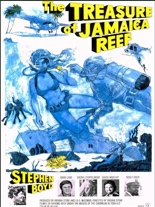
The Treasure of Jamaica Reef (1974)

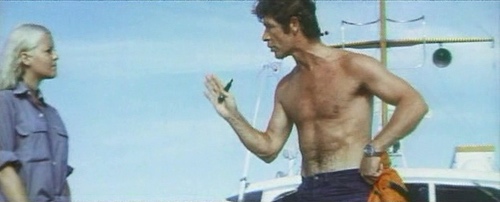
Underwater photography is the true star of The Treasure of Jamaica Reef, a pleasingly tame action-adventure about San Diego professionals who quit their day jobs to go hunting for rumored sunken gold in the Caribbean. The guys are played by The Oscar’s Stephen Boyd, future MGM exec David Ladd and a Wolfman Jack-bearded Chuck Woolery, right before achieving fame on the tube as the host of a new game show called Wheel of Fortune. Rounding out the quartet is a feisty blonde named Zappy (Cheryl Ladd, then Stoppelmoor and three years from joining Charlie’s Angels).

First-time director Virginia L. Stone (Run If You Can) takes an A-to-Z, near-documentary approach on getting our heroes to the ocean — for example, showing them negotiating to buy an old truck shaped like a wine barrel. Along the way they meet surfer-dude teen Darby (Darby Hinton, Malibu Express), who aids them in a chase in which Zappy hangs onto the luggage rack of a thief’s speeding car, and teddy-bear boat captain Rosey Grier (Skyjacked), who does not.

By the time the team is piloting small-prop planes and surveying the ocean floor from the comfort of a glass-bottomed raft, it hit me: The Treasure of Jamaica Reef plays as if based on the Fisher-Price Adventure People toy line, perhaps from a 9-year-old’s thunked-up outline. It’s certainly that sexless, with Mrs. Ladd in not only an overly modest bikini, but the same bikini day to day to day. As her character’s name hints, Zappy is presented as more kid sister than sex object, with Stone’s camera more interested in what lies beneath sea level. Unlike most B movies, Reef’s underwater footage is neither muddy, stock nor faked, so at the very least, viewers can appreciate local flavor galore.

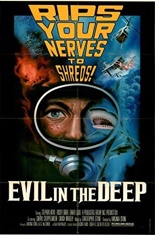
When Jaws busted blocks the next year, the producers presumably kicked themselves for not having sharks in their film. Wrangling Boyd back, they shot bookends that graft a new plot of a cursed treasure map, and added some gore, some sex and, most importantly, some sharks. The resulting waterlogged mess was rechristened Evil in the Deep. No word if, per the poster, anyone’s nerves were ripped to shreds, but the 2.0 ending is an absolute hoot. —Rod Lott

Get it at Amazon.

Ghost Dog: The Way of the Samurai (1999)

I’ll gladly admit that I was a pretentious sixth-grader who regularly rented and fully enjoyed the films of Jim Jarmusch.

While much of his work over the past decade hasn’t held my attention for very long, flicks like Down by Law, Mystery Train and Night on Earth — which I actually had a poster of in my childhood room — kept me suitably enthralled, but it was his double shot of Dead Man and especially Ghost Dog: The Way of the Samurai where I felt he reached his apex as a filmmaker and, consequently, my zenith as a teenaged film snob.

Taking the cinematic concept of the samurai warrior’s code and placing it in the crime-filled streets of a nameless industrial city, Jarmusch directs a superbly cast Forest Whitaker as the titular Ghost Dog, a modern-day Mifune who is a silent hit man for Louie (John Tormey), the comically stereotyped gangster. (As a matter of fact, all the gangsters here are comically stereotyped.)

When Dog takes out a philandering goomba, a hit is placed on our hero. Using his samurai skills — with a gun instead of a sword, natch — he takes out these made men one by one and still has enough time to visit his best friend, a French ice cream man (Isaach De Bankolé) who doesn’t share the same language, but always seems to get what Dog is saying.

Like Dead Man, Ghost Dog is a bizarre blend of action and comedy. Back then, it was a strange genre for Jarmusch to take on, but in his broken way, he deftly pulls it off, mostly due to a calm Whitaker as the cold-as-steel modern samurai, one of the coolest characters to ever slash the screen, against mucked-up mafiosos led by Henry Silva, both men showcasing an ancient world on the verge of disappearing forever.

I should probably give special mention to the soundtrack, orchestrated by the RZA. I highly recommend the Japanese import, featuring the beautiful, beat-heavy instrumentals, plus a few unreleased Wu-Tang cuts. At least the pretentious 2000 version of me thought so. —Louis Fowler

Get it at Amazon.

Train to Busan Presents: Peninsula (2020)

It took South Korea to rejuvenate the American zombie film with 2016’s Train to Busan. With writer/director Yeon Sang-ho returning for the sequel, Train to Busan Presents: Peninsula, lightning strikes twice — albeit at a notably lower voltage.

Necessity gives us a new protagonist in Jung-seok (Gang Dong-won, 2010’s Haunters), a former soldier. After suffering a whopping double tragedy in the prologue, the more reckless Jung-seok joins what certainly seems like a suicide mission to the titular site. There, among hordes of the hungry undead, he and his team are to retrieve an armored truck containing $20 million in the back — and a desecrated corpse in the driver’s seat.

That setup marks a unique and exciting spin on the heist film, but Peninsula is not really about a heist. The crime merely serves as the backing for the first act’s big set piece. The second act delves into a tri-generation family Jung-seok meets and has a guilt-ridden connection to; here, the story bounces between the unconventional family’s unity under immense pressure — some real Omega Man stuff — and Jung-seok’s own brother-in-law unwittingly ushered into a sort of zombie fight club (which is more engaging than the actual, terrible Zombie Fight Club).

Finally, as everything comes to a head, the film palpably sweats an Escape from New York musk — by no means a negative. More action-oriented than its predecessor, the hard-charging Peninsula is what a sequel should be: an extension of the original, rather than a repeat. (World War Z, take note!) In doing so, that means this second round of the Train to Busan franchise doesn’t yank on the heartstrings to deliver a devastating, memorable end, so if you have tissues at the ready, save them for your brow. —Rod Lott

Get it at Amazon.

Danger USA (1989)

Danger USA begins like no other action film, except Mind Trap, its alternate title: with a woman fighting off a burglar in her home, which is revealed to be built inside an 18-wheeler barreling down the freeway. I’m still trying to parse this problematic prologue, like how a house can be in broad daylight when it’s literally enclosed in a windowless semi.

I’ve already given this more thought than director Eames Demetrios, grandson of mid-century modern legends Charles and Ray Eames. Let’s just say the family’s creativity genes for designing furniture and architecture did not extend to fictional filmmaking — not even for insane and nonsensical VHS premieres with the budget of whatever Demetrios’ vowels could garner on Wheel of Fortune.

Attractive one-and-doner Martha Kincare plays Shana, an action-movie actress forced to become an action hero IRL when the KGB targets her for the whereabouts of her father’s invention, “the Dream Room,” which is just what it sounds like, plus operated by the Clapper. The Russkies on Shana’s tail include femme fatale Sonja (Maureen LaVette, Virgin High), she of the “moose and squirrel” accent, and Mojo (Frogtown II‘s Kelsey — just Kelsey, thanks), which he claims is short for “more johnson.”

Mojo delivers this nomenclature lesson while unzipping his pants to rape Shana’s sister, Ginger (Jacquie Banan, Desperation Rising). However, thanks to erectile dysfunction — thanks, erectile dysfunction! — he can’t carry out the dirty deed, leading to taunts from not only Ginger and Shana, but his teammates. Nonetheless, Sonja and the gang succeed at killing Shana and Ginger’s mother (Mary MacGyver, another one-and-doner); Shana tearlessly responds with a line of dialogue equally as lifeless: “Mom, you were great. Crazy, but great.”

Viewers are urged to keep their ears peeled for similar winning lines — e.g., “You know your father was an accomplished ventriloquist,” “You’re engaged to a tapeworm” and “You and your pussy are gonna pay for that one!”

In one of his post-coke-arrest roles, former Grizzly Adams star Dan Haggerty gets top billing as movie producer Sergei — repeat: Dan Haggerty is Sergei — and he’s as mumble-mouthed as he is corpulent. He and his exhausted suspenders have little to do in Danger USA, other than to use two breaths to inflate a single party balloon to a quarter than expected, and to get Shana an audition. I think the latter to-do item helps advance the plot, but when a third of the flick passes before Demetrios establishes Danger USA‘s who, what, where, when, why and how as properly as he’s able, it’s tough to know for sure.

Also caught up in the shapeless mass — the movie, that is, not Haggerty — are Shana’s air-horn-obsessed fiancé (Thomas Elliot, Year of the Gun), who goes clinically catatonic after losing a finger; a breast-milk-obsessed director (Sam Hill, what in the) who employs a topless secretary; and Lyle Waggoner (TV’s Wonder Woman) as the guy Shana throws onto the highway at high speed, right after throwing a cat at his face, followed by the Yellow Pages.

These narrative live wires converge as a captive Shana tricks one of the villains into having sex with her as the precious seconds of their time bomb tick by. All too trusting, the guy asks her how much longer they have left, rather than pause his humping to look at the timer his own damn self.

Movie, you were great. Crazy, but great. —Rod Lott

Get it at Amazon.

Beyond the Poseidon Adventure (1979)

Apparently, the rescuers arriving in the final frames of 1972’s The Poseidon Adventure stuck around for all of 15 minutes, because when Irwin Allen’s sequel begins the same day of the topsy-turvy event, the once-mighty ship and all its innards are up for grabs. This time around, our ostensible heroes are the aptly named Turner (Michael Caine, having learned nothing from The Swarm), captain of a mortgage-hilted tugboat; his salty right-hand man (Karl Malden, Meteor); and flibbertigibbet Celeste (Sally Field, Smokey and the Bandit), who might be a prostitute.

On New Year’s Day, Turner and crew arrive at Poseidon’s wreckage to salvage all the jewels and money. They’re not alone, either, because posing as medical rescue personnel are a terrorist (a super-suave, snot-slick Telly Savalas, Killer Force) and his goons, seeking barrels of plutonium. Everybody crawls inside, thus beginning what amounts to the Poseidon as haunted house and/or escape room, with each character taking turns climbing ladders, crossing makeshift bridges, dodging flames, leaping over holes and — in Turner’s case only — referring to Celeste as “Monkey.”

Members of the all-star cast balloon as the group goes further (and then decrease accordingly with each set piece). Among them are a mouthy bar owner (Young Frankenstein’s Peter Boyle in a pink puffy shirt), a blind man (Jack Warden, Used Cars), a farmer (Mark Harmon in a bowl cut) and, playing against type, White Line Fever’s Slim Pickens as a quantum physicist.

I’m totally kidding. Pickens plays a wino named Tex who says things like, “I smell grub! … All kinds of vittles!”

Beyond the Poseidon Adventure harbors a bad reputation, and while it’s not up to the excitement of the original, it’s not a waterlogged failure if judged on sheer spectacle. If Beyond is guilty of one thing above all else, it’s being late to the game; audiences were simply tired of the disaster movie by 1979, whereas seven years before, the first Poseidon Adventure garnered eight Oscar nominations. It’s not like Allen veered creatively from his bread-and-butter formula in this follow-up, sticking with the kablooey effects, obstacle-course sets and teeter-totter acting as the camera turns to and fro. Nevertheless, this sunk his career as director. —Rod Lott

Get it at Amazon.